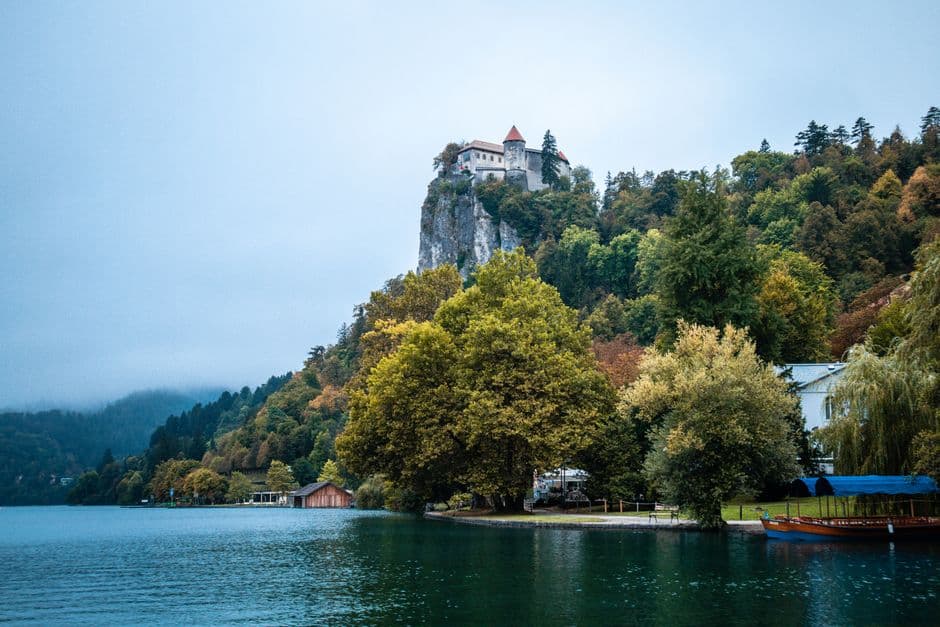
Picture a medieval builder standing at the edge of a cliff. He looks down at the drop and says: "We build here". It sounds reckless, but this is how some of Europe's most striking fortresses came to exist.
The goal was not just to impress people. The goal was survival. A castle on a cliff gave the best defense medieval rulers could get. Enemies could not attack from behind. They could not roll siege engines up a sheer rock face. Sometimes they could not even tell where the cliff ended, and the wall began.
Why build a castle in such a hard place?
Moving stone up a cliff was a logistical nightmare. There were no cranes. There were no trucks, and often no roads worth the name. Builders did this again and again, in different corners of the continent, with no contact between them. There had to be a real reason.
The first reason was defense. A cliff castle stood almost impossible to storm. Attackers could only approach from one side, maybe two. Watchtowers gave a view for miles, so no army could sneak up unseen. Climbing under fire from above was close to suicide.
The second reason was prestige. A castle visible from far away, towering over the countryside, sent one message: someone powerful rules here. A lord who could build a fortress in a spot everyone called impossible earned respect from his own people and from rival lords. The third reason was control. Rulers guarded mountain passes, trade routes, and river mouths from exactly these spots.
Predjama: a castle built into a cave wall
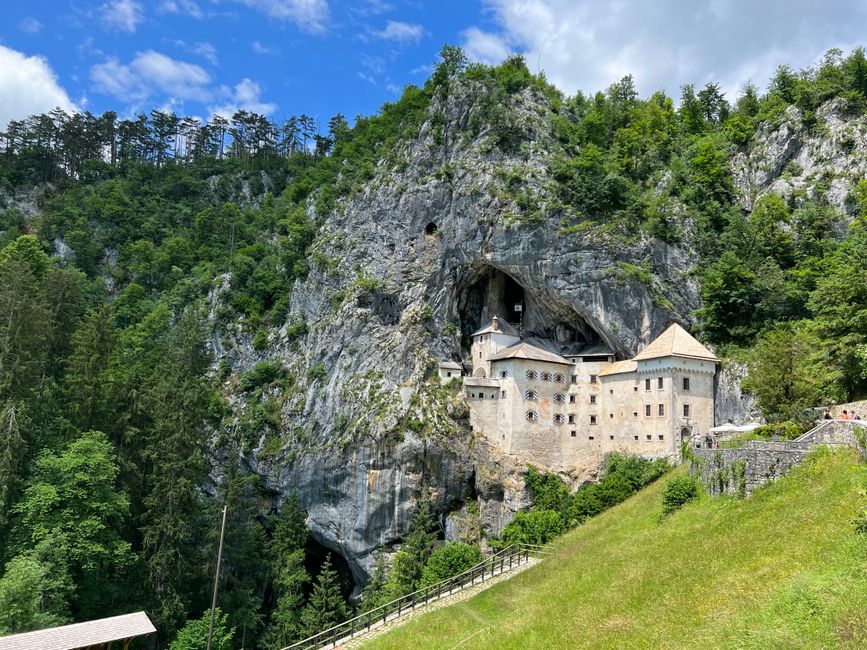
Start with the place most people call impossible at first sight. Predjama Castle sits near Postojna, Slovenia, and it does not just stand on a rock. It is built directly into the mouth of a cave, more than 120 meters above the ground. The front wall blends into the natural cliff face so well that it is hard to tell where nature stops and construction starts.
The castle's most famous resident was Erasmus of Predjama, a 15th-century robber knight. He held off a months-long siege here, using secret cave passages that led outside the walls. Legend says he sent his attackers fresh fruit and meat during the siege, just to prove hunger could not touch him. Today Predjama draws crowds who walk its underground corridors and knight's chambers, and see for themselves how hard this fortress must have been to take.
Dunnottar: a Scottish stronghold surrounded by the sea
Stay with rugged, dramatic terrain and move to the east coast of Scotland, near Stonehaven. Dunnottar Castle sits on a flat-topped rock of conglomerate stone, almost 50 meters above the North Sea. A narrow, winding strip of land connects it to the mainland. Everywhere else, sheer cliffs drop straight into churning water.
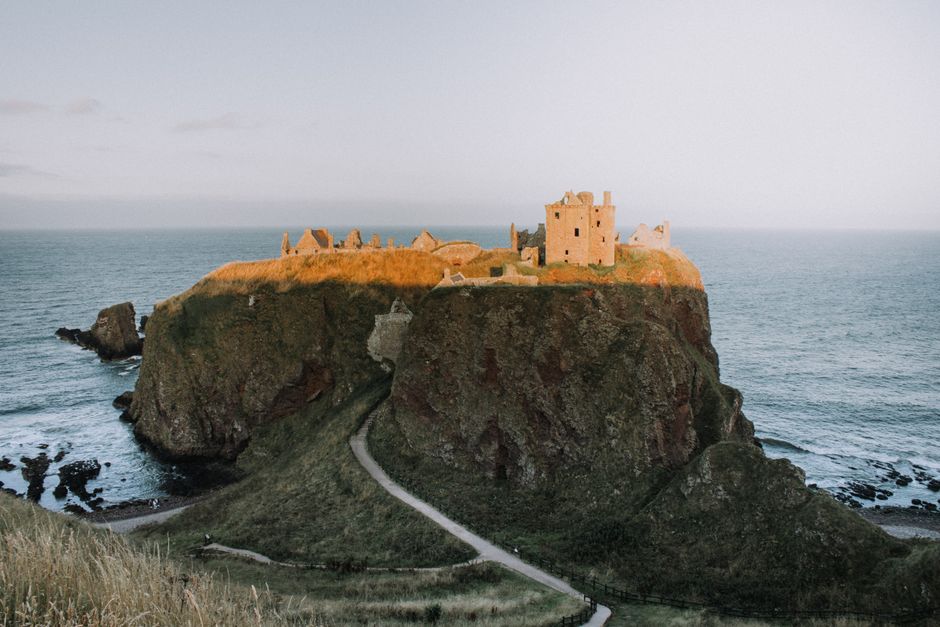
Locals call this rock "pudding stone," because it looks like a pudding full of raisins, big pebbles bound into a hard mass. That geology gave Dunnottar a defensive edge for most of its history. In the 1650s, defenders hid the Scottish Crown Jewels here from Oliver Cromwell's army. The mission worked, but the castle itself fell after a long siege.
For more than 160 years, Dunnottar served as a prison too. One cellar, now called the Whigs' Vault, once held over 160 Scottish Covenanters who refused to accept a state religion forced on them. Many died there from overcrowding and disease.
Walking the ruins today, with waves crashing on the rocks far below, mixes awe at the scenery with the weight of a genuinely dark history. Few Scottish castles carry both in equal measure.
Bled: a romantic fortress above a turquoise lake
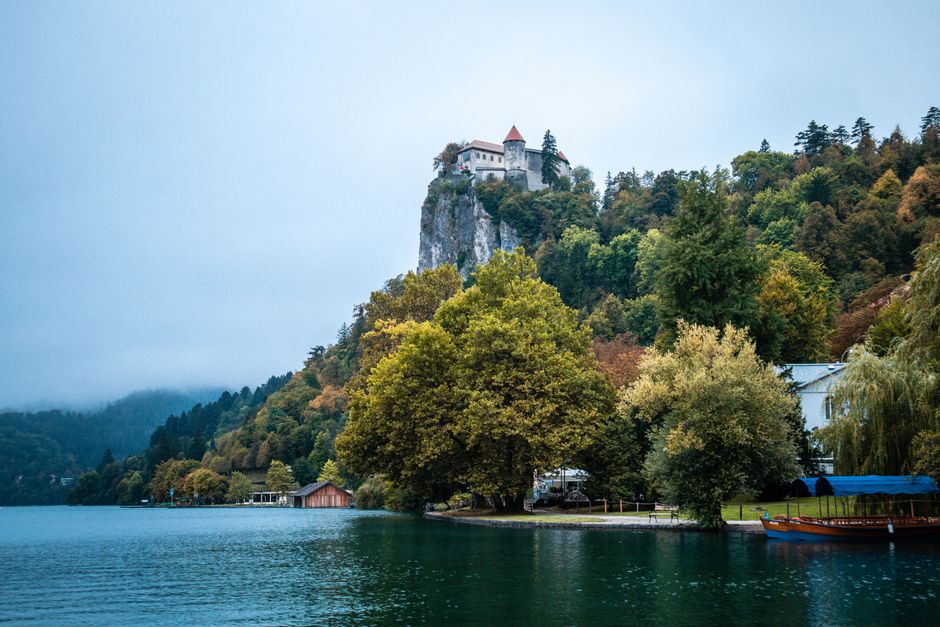
If Predjama stands for Slovenian nerve, Bled Castle stands for its romantic side. It sits on a cliff 100 meters above Lake Bled, where turquoise water and a tiny island church create one of Central Europe's most photographed views. It is the oldest castle in Slovenia. Records mention it as far back as the 11th century.
The building grew in layers over time. The upper section, Romanesque in style, sits next to a lower Renaissance wing. The café terrace at the top is one of those spots where time slows down. You sit with a coffee, look at the lake below, and wonder how people managed the steep climb every single day.
The view here moved the 19th-century poet France Prešeren, who wrote Slovenia's national anthem. He described it in his poem The Baptism at the Savica as something close to paradise.
"The view from the castle rock above Bled is a vision of paradise on earth."
- France Prešeren, The Baptism at the Savica (paraphrased from the poem's imagery)
No army ever took Bled Castle by force. Its position on the edge of the cliff turned every attempt into a failure before it began. The building now houses a history museum, and visitors can press their own coin in the castle forge.
Castello di Duino: where poetry meets the cliff edge
Now to Italy, near Trieste, on the shore of the Adriatic. Castello di Duino sits on a limestone cliff that rises straight out of the sea. The view is dramatic enough that it once inspired one of the 20th century's most important poets. Rainer Maria Rilke wrote part of his famous Duino Elegies here. Legend says he heard a voice in the wind among the rocks that became the poem's first line.
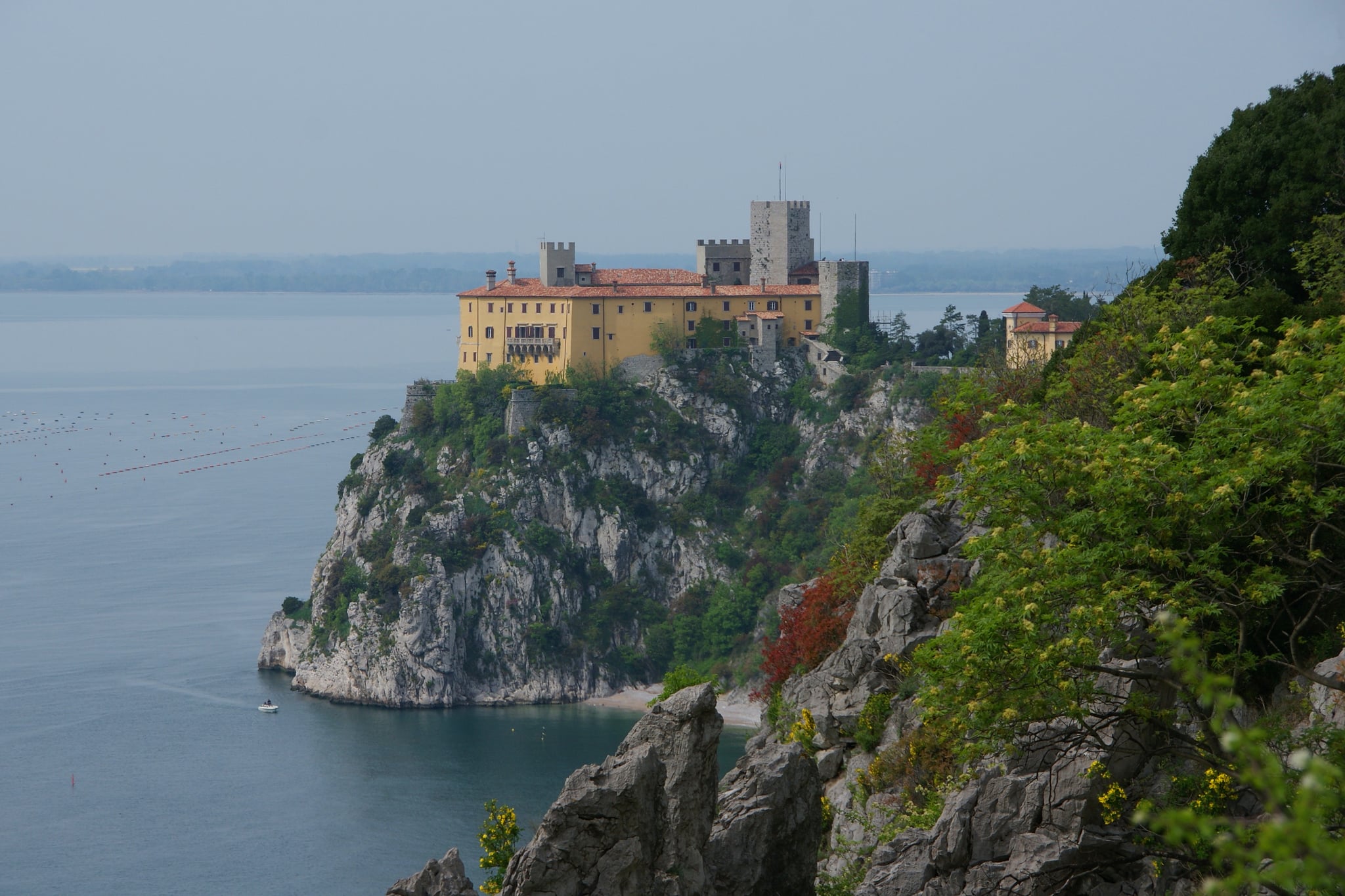
The castle dates to the 14th century and stands on the ruins of an older Roman fort, proof that this spot has drawn people looking for natural protection for thousands of years. A cliffside walking path called the Rilke Trail is now one of the region's best scenic routes. It winds through olive groves and pine trees, with the blue Adriatic on one side and the castle walls on the other.
"Who, if I cried out, would hear me among the angels' hierarchies?"
- Rainer Maria Rilke, Duino Elegies (opening line, inspired by the view from the Duino cliffs)
This mix of beauty and unease still pulls in historians, artists, and travelers looking for a quiet moment at the edge of the world.
Bonifacio: a French citadel hanging over the sea
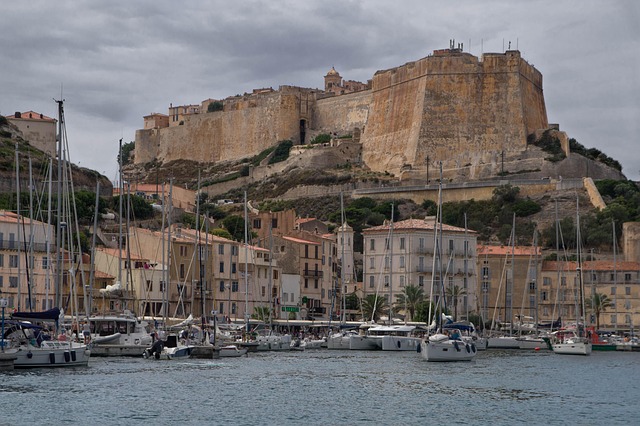
At the southern tip of Corsica, where limestone cliffs drop straight into the Mediterranean, sits the Citadel of Bonifacio. This is not a single castle. It is an entire fortified old town, with houses and walls standing right on the cliff edge, sometimes just a few meters from open air. The view from above stuns even people who normally have no fear of heights.
Erosion has eaten away at the rock under some of these buildings for centuries. Today it looks almost surreal. Some houses appear to float over empty space. The Genoese, who fortified the town in the 12th century, knew exactly what they were doing. This position made an attack from the sea nearly impossible, and the only land entrance sat behind gates and a moat carved straight into solid rock.
Walking Bonifacio's narrow streets feels different from touring a normal castle. Here, an entire community lived, and still lives, on the cliff edge, not just a handful of knights in a tower. Walk down to the harbor and look up. Only from there do you get a real sense of the scale of what people built here.
Dunluce: an Irish ruin that partly fell into the sea
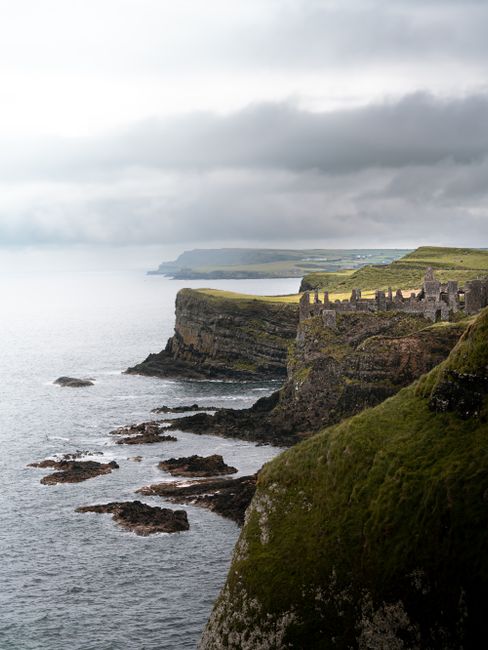
Head next to Northern Ireland's Causeway Coastal Route, in County Antrim. Dunluce Castle sits on a basalt cliff, surrounded by the Atlantic on nearly every side. A narrow stone bridge crosses a deep gap and connects it to the mainland.
The fortress dates to the 13th century, but it reached its peak under the McQuillan clan, and later the MacDonnells, who fought bitterly over it for decades. Local legend tells of Maeve Roe, daughter of a McQuillan lord. She is said to have drowned in a nearby cave, fleeing a marriage forced on her. People claim her cries still carry on stormy nights.
The castle's most dramatic moment actually happened. In the 17th century, part of the kitchen, along with some of the kitchen staff, collapsed straight into the sea during a storm. The cliff under the foundations simply gave way under the waves.
That collapse is a hard reminder. Even a well-chosen defensive position has a cost. Erosion negotiates with no one, no matter how thick the walls are.
Chepstow: the oldest stone castle in Britain
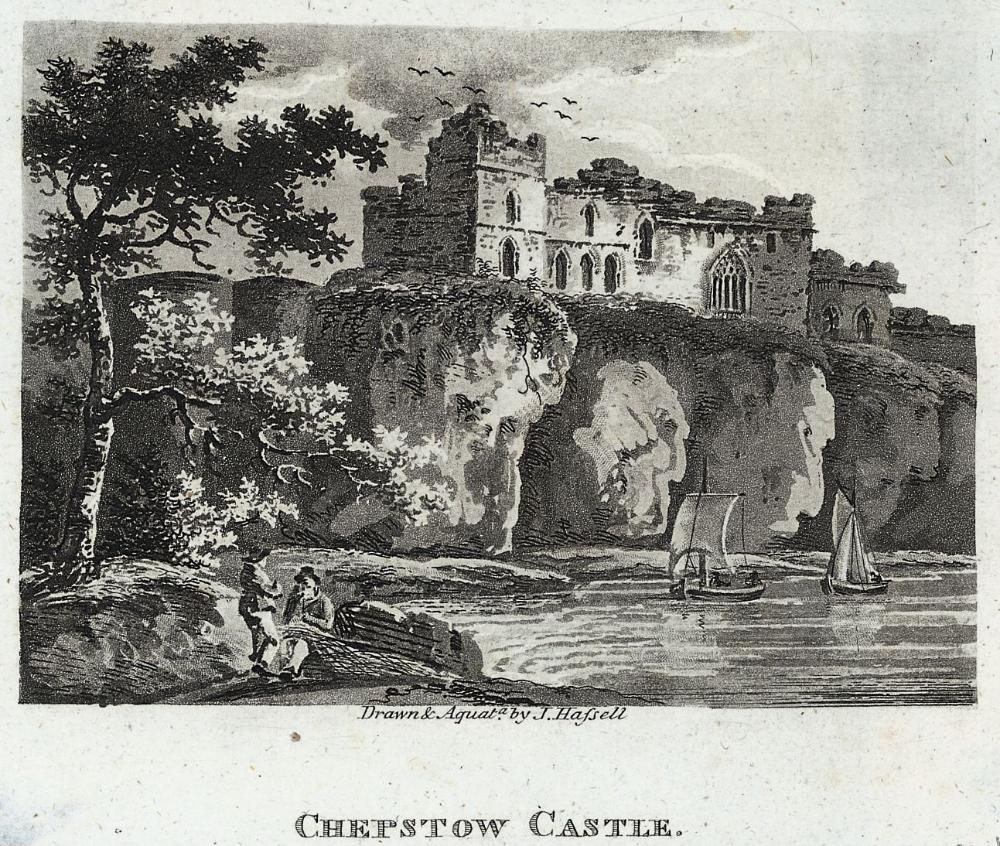
Move to Wales, to the banks of the River Wye, where Chepstow Castle stands. This is the oldest surviving stone castle in Britain. Construction started in 1067. It sits on a limestone cliff, directly above the river.
The Normans, who built it right after conquering England, understood exactly what this spot offered. The Wye formed a natural moat on one side, and the steep cliff protected the castle from every other direction. For centuries, Chepstow served as a key checkpoint on the English-Welsh border, watching both river and land traffic. Much of the stone came from local quarries, which made construction easier than at most other castles on this list, where hauling material felt close to a miracle.
Château de Beynac: France's guardian of the Dordogne Valley
Back to France, to the Périgord Noir region. Château de Beynac stands on a 150-meter limestone cliff above the Dordogne River. It is one of the best-preserved medieval castles in the area, and its stark, plain shape makes an impression from far away.
Builders raised Beynac in the 12th century with one job: seal off the valley and control river traffic. During the Hundred Years' War, it became a key French stronghold, staring directly across the valley at the English-held Château de Castelnaud. That rivalry between two fortresses, within sight of each other, must have made a strong impression on everyone who lived nearby at the time.
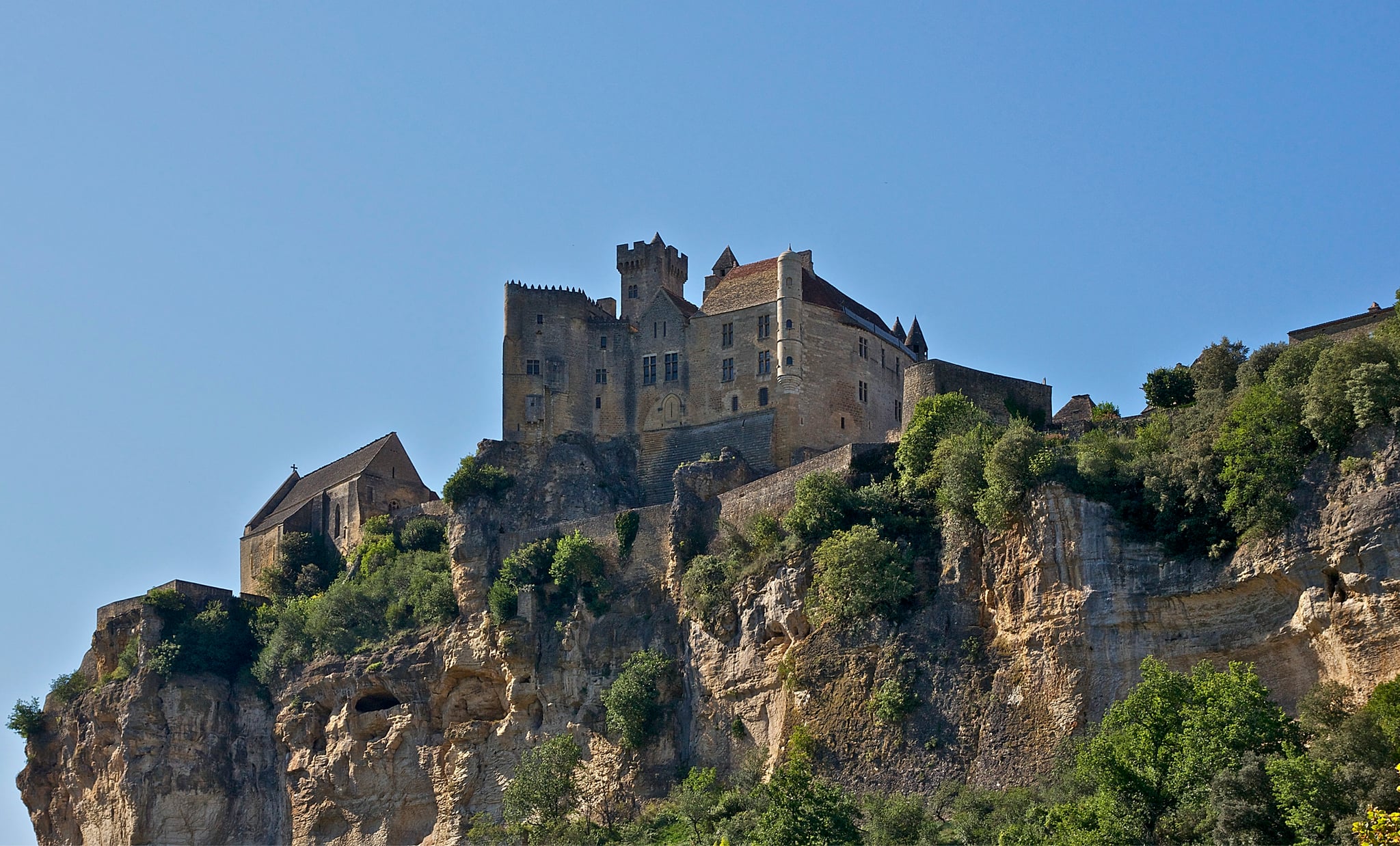
Beynac's reputation says it never fell, but it actually changed hands more than once, always through trickery rather than a direct assault. That was usually the only method that worked against a cliff fortress like this one. The Grosso family has owned Beynac since the 1960s and has run a careful restoration since then. Film crews use it often too, including Ridley Scott's production team.
Neuschwanstein: a fairy-tale castle on a rocky ridge
The most recognizable name on this list is Neuschwanstein in Bavaria. King Ludwig II built it on a rocky ridge above the Pöllat Gorge. This castle became the visual model for Sleeping Beauty's castle at Disneyland, and its silhouette is familiar even to people who have never set foot in Germany.
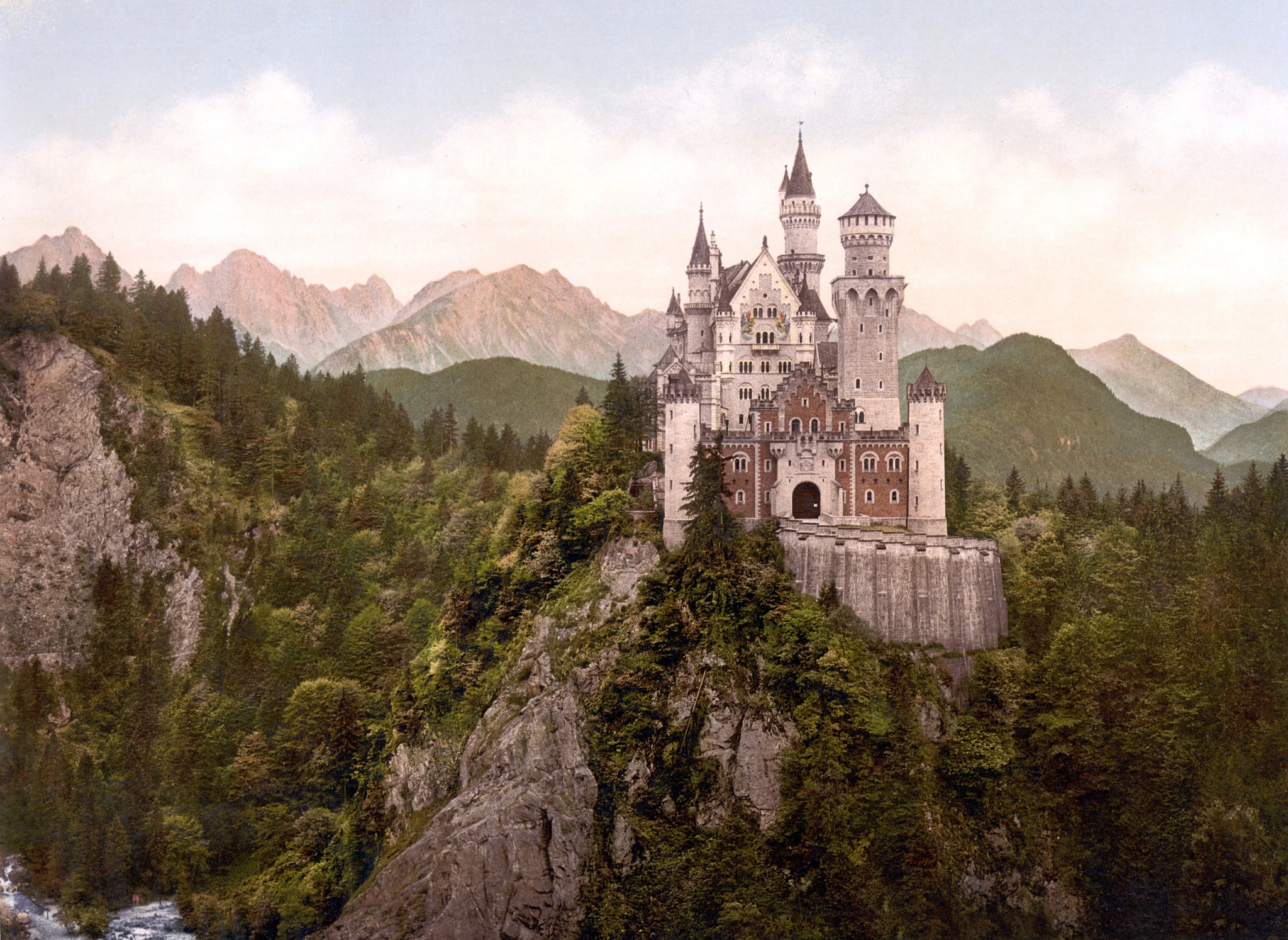
Unlike every other castle here, Neuschwanstein had no defensive purpose. Construction started in 1869, long after cliff fortresses had lost their military value. Ludwig wanted a romantic tribute to medieval architecture and to Richard Wagner's music, and he picked the ridge purely for dramatic effect. The building was never finished. Ludwig died under mysterious circumstances just weeks after officials declared him unfit to rule, and Neuschwanstein now draws over a million visitors a year, an odd outcome for a structure meant as one eccentric king's private fantasy.
The Alcázar of Segovia: a ship's prow among Castilian hills
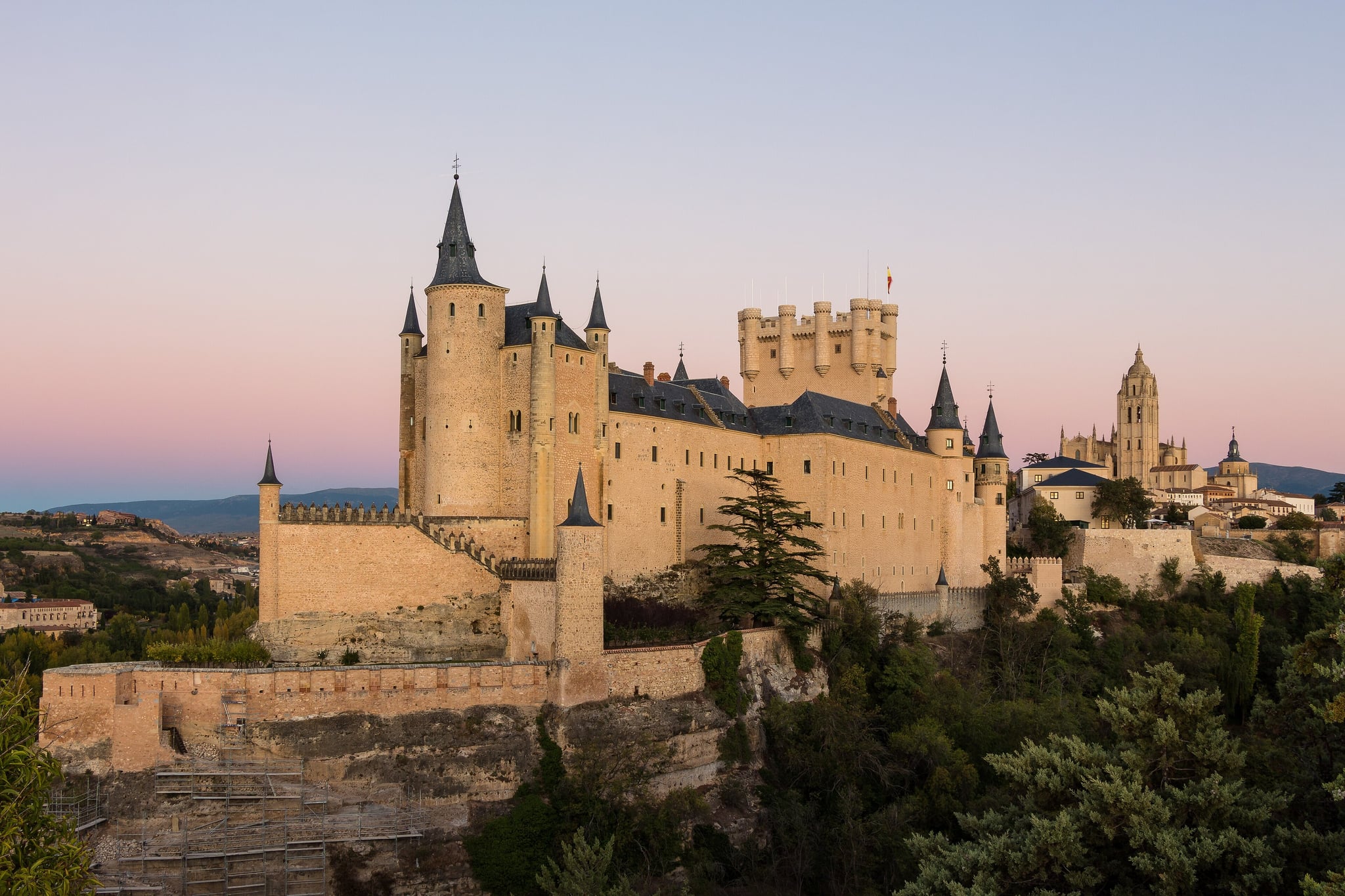
Head to Spain, to the city of Segovia. The Alcázar rises from a rocky spur where two rivers meet, and its shape resembles the prow of a massive ship sailing through a sea of hills. Sharp turrets and slate roofs make this castle stand out for its architecture as much as its location.
People have lived on this site since Roman times. It reached its height under Castilian monarchs, who used the rock's natural defenses to full advantage. In 1474, Isabella I was proclaimed Queen of Castile right here, an event that reshaped the history of Spain and Europe.
A quick list of what sets this place apart:
- a striking shape that mimics a ship's bow, rare among European castles,
- a coronation of European historical weight: Isabella of Castile,
- a possible influence on Disney's own castle design,
- a natural moat formed by two rivers meeting at the base of the cliff.
Culzean: an elegant manor on the Ayrshire coast
Back to Scotland, but this time we leave medieval roughness behind for 18th century elegance. Culzean Castle sits on the edge of the Ayrshire cliffs, with views over the Firth of Clyde toward the Isle of Arran. This is not a classic defensive stronghold. It is the work of architect Robert Adam, who designed the building to make the most of its cliffside drama, not its military strength.
The Kennedy family held a smaller fortified tower here as early as the 16th century. Only when they hired Adam for a redesign in the late 18th century did Culzean gain its current, theatrical shape. The round Drum Tower sits right on the cliff edge on purpose. Inside, the circular saloon gives a panoramic sea view on three sides at once.
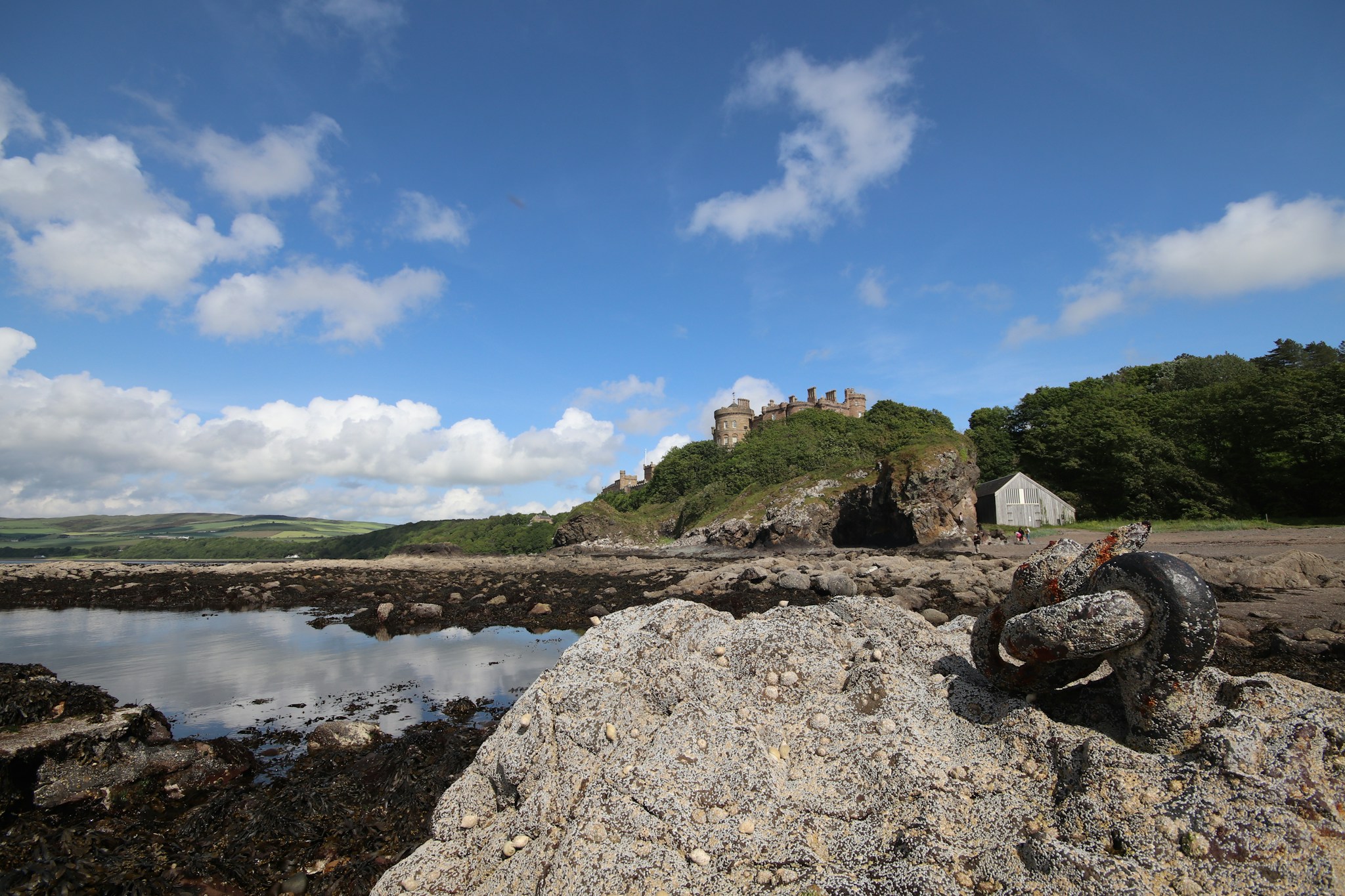
Caves run beneath the castle, and smugglers used them for centuries to move goods from the Isle of Man. Excavations turned up whisky, silk, and even broken brandy bottles from these old runs. In the 20th century, Culzean earned the nickname "Scotland's White House."
President Dwight Eisenhower stayed here four times, using an apartment granted to him for life in thanks for his role in liberating Europe. Few places prove better that a cliff can hold up elegance just as well as it holds up a medieval fortress.
Château Gaillard: Richard the Lionheart's "saucy castle"
Finish in Normandy, near the town of Les Andelys. The ruins of Château Gaillard stand on a chalk cliff 100 meters above a bend in the Seine. This castle is a showcase of medieval military engineering. Richard the Lionheart, King of England and Duke of Normandy, built it in a record two years, between 1196 and 1198.
Richard named his creation "Gaillard," which translates roughly to "bold" or "saucy." He built it to block the French king's path to Rouen along the Seine. The design used new defensive tricks for its time, including concentric walls and early machicolations, features that set the standard for European military architecture for decades. Richard reportedly bragged he could defend the castle even if its walls were made of butter.

Richard never got the chance to defend Gaillard himself. He died a year after it was finished. The castle held out only a few years before falling to a long siege by the French king Philip Augustus, between 1203 and 1204. Standing at the edge of the chalk cliff today, looking at the ruined round tower, it is easy to see why this place still fascinates military historians.
What connects these places
Look at these twelve castles together, and a pattern appears fast. Medieval and Renaissance builders treated nature as a partner, not an obstacle. Rock and cliff became part of the defense system, often stronger than the thickest wall or the deepest hand-dug moat. Geography shaped the outcome of battles, sieges, and sometimes entire kingdoms, as seen at Predjama, Dunnottar, and Château Gaillard.
There is something deeper here than military math. These buildings speak to stubbornness, imagination, and a will to take real risks. Erasmus of Predjama taunted the army trying to starve him out. Ludwig II built a fairy-tale castle purely out of love for art. Every builder on this list shared one belief: an impossible location was not a problem, it was a challenge.
If you ever plan a trip through Europe, step off the usual route. See at least one of these places with your own eyes. Photos, even the best ones, never quite capture the feeling of standing at the edge of a cliff, looking down, and knowing that people built something permanent here, against every rule of logic and gravity.