Dunluce Castle
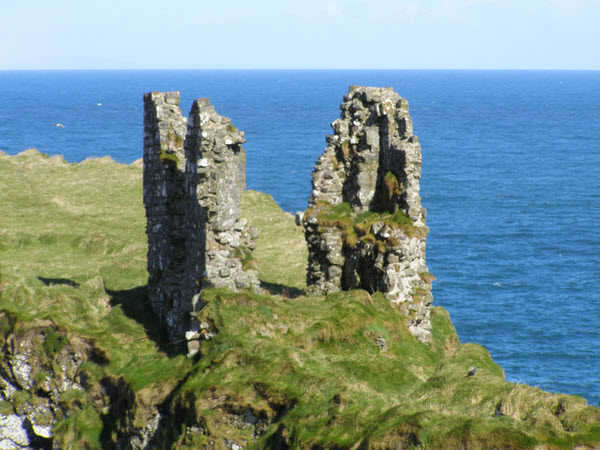
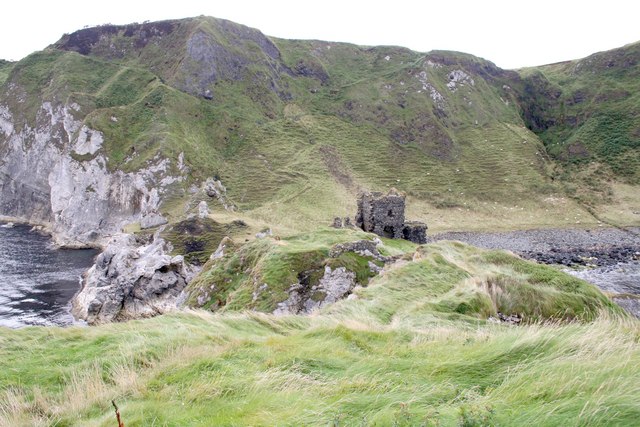
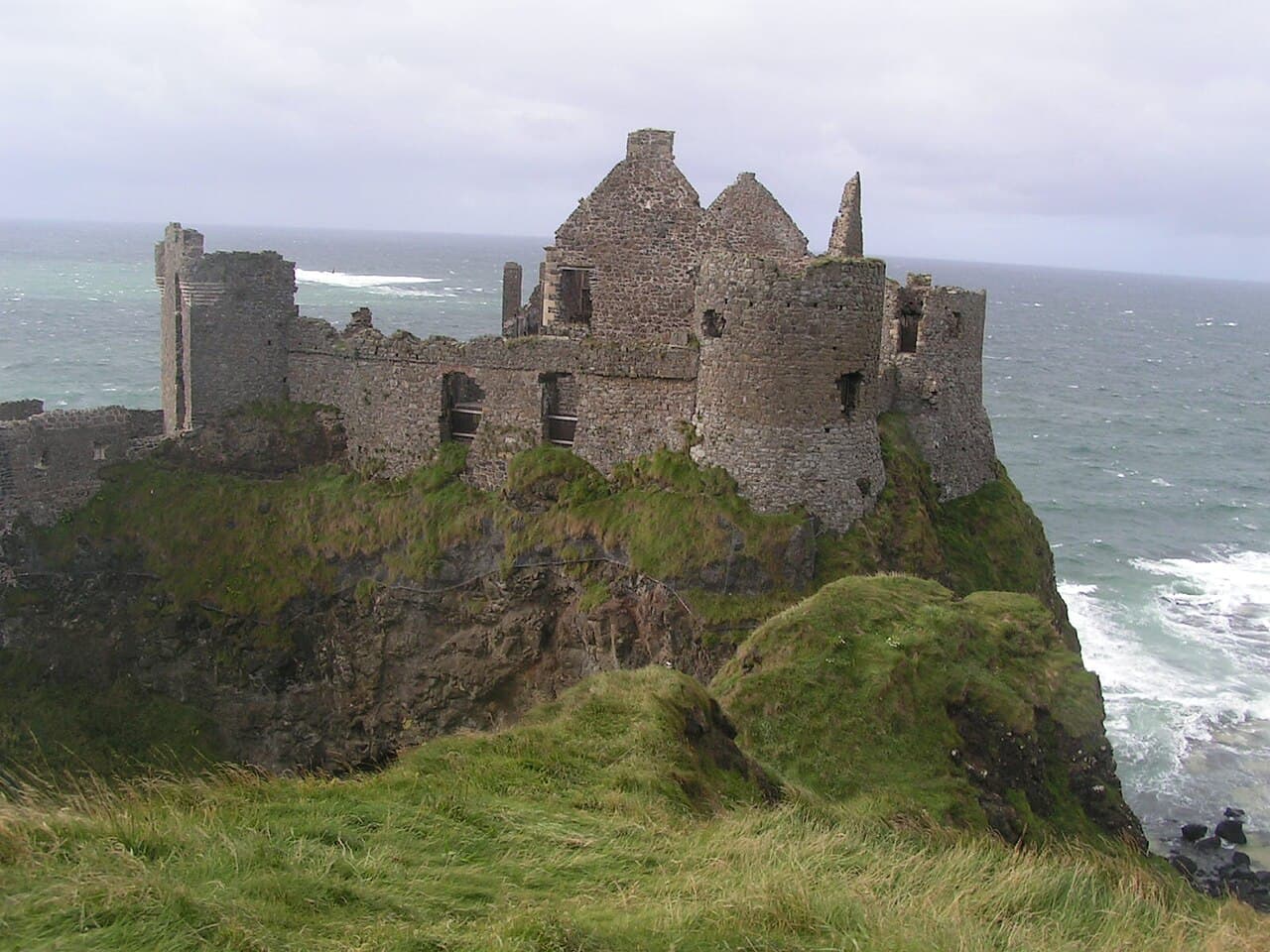
Dunluce Castle is a remarkable medieval fortress perched dramatically on a basalt promontory along the north coast of County Antrim, Northern Ireland. Its strategic location on steep cliffs overlooking the sea has made it a formidable defensive site since early medieval times, captivating visitors with its striking silhouette and turbulent history. The castle is connected to the mainland by a narrow stone bridge, emphasizing its near-island position and natural defenses.
The site where Dunluce Castle stands has been a stronghold since early Christian and Viking periods, taking advantage of the natural basalt outcrop. The first stone fortifications here were established by Richard Óg de Burgh, 2nd Earl of Ulster, around the 13th century. This initial castle formed the foundation for later expansions and modifications by successive owners.
Medieval origins and early fortifications
The earliest parts of Dunluce Castle visible today include two massive drum towers on the eastern side, each approximately nine meters in diameter. These towers were constructed by the McQuillan clan, who controlled the castle from the late 13th century until the mid-16th century. The McQuillans reinforced the fortress to defend against rival clans and external threats, marking the castle as a stronghold of the Lords of the Route.
Historical records first mention the castle in 1513, during the McQuillans' tenure. Their rule ended after a series of battles with the MacDonnell clan, who seized the castle in the mid-1500s, marking a significant shift in power in the region.
The macdonnell era and renaissance transformations
Sorley Boy MacDonnell, a prominent Scottish chieftain, inherited Dunluce Castle in 1556. Under his leadership, the castle underwent substantial fortification and expansion, incorporating Scottish military architectural techniques that reflected Renaissance influences. Sorley Boy's tenure was marked by political intrigue and conflict, including a brief seizure of the castle by Lord Deputy Sir John Perrot in 1584, which was reversed by Queen Elizabeth I two years later.
The year 1588 is notable for the nearby wreck of the Girona, a galleass of the Spanish Armada. The MacDonnells salvaged cannons from the shipwreck and installed them in the castle's gatehouses, enhancing its defenses. Proceeds from selling the recovered cargo funded further restoration and embellishment of the castle, reflecting its status as a powerful noble residence.
Architectural features and layout
Dunluce Castle's layout combines medieval defensive structures with Renaissance residential elements. The surviving ruins include thick curtain walls, round towers, gatehouses fortified with salvaged artillery, and remnants of a grand manor house built in the late 16th century. The castle's defensive position on a basalt cliff with steep drops on either side provided natural protection, complemented by man-made fortifications.
17th-century decline and abandonment
In the early 17th century, the castle was the seat of Randal MacDonnell, 1st Earl of Antrim, Sorley Boy's son. The castle's fortunes waned after a significant structural failure in the 1630s when the kitchen wing collapsed into the sea during a storm. This event reportedly led to Lady Catherine Manners, Randal's English wife, refusing to reside there any longer.
The castle and its adjoining town suffered during the 1641 Irish Rebellion, when an Irish army besieged the fortress, and the nearby town was burned. The castle was captured in 1642 by General Robert Monro. After the mid-17th century, Dunluce Castle fell into disrepair and was eventually abandoned. Its stones were quarried for local buildings, accelerating its ruinous state.
The lost town of dunluce
Archaeological excavations near the castle revealed the remains of a small town founded around 1608 by Randal MacDonnell. This settlement featured a well-planned street grid, stone merchant houses, and advanced amenities such as indoor toilets and a water and sewage system. The discovery highlights the castle's role as not only a military fortress but also a center of early modern urban development.
Legends and cultural significance
Dunluce Castle is steeped in local legend and folklore. One famous tale recounts how the castle's kitchen fell into the sea during a stormy night, a story that has inspired artists and writers alike. While archaeological evidence shows the kitchen remains intact, the legend contributes to the castle's romantic and mysterious aura.
The castle's dramatic ruins have influenced cultural figures such as C.S. Lewis and the band Led Zeppelin, who found inspiration in its haunting silhouette and storied past.
Visiting dunluce castle today
Today, Dunluce Castle is a popular tourist destination managed by the Northern Ireland Environment Agency. Visitors can explore the extensive ruins, including the imposing drum towers, gatehouses, and remnants of the manor house. The site offers spectacular views of the rugged Antrim coastline and the North Atlantic Ocean.
Access to the castle is via a narrow stone bridge connecting the promontory to the mainland. The castle is open to the public for a modest entrance fee, with visiting hours typically during daylight. Archaeological displays and information panels provide insights into the castle's rich history and the adjacent lost town.
Dunluce Castle remains one of Northern Ireland's most iconic medieval ruins, embodying centuries of history, conflict, and architectural evolution. Its dramatic setting and evocative legends continue to draw visitors from around the world.
Frequently asked questions (FAQ)
- How do I get to Dunluce Castle?
- Dunluce Castle is located on the north coast of County Antrim, Northern Ireland, accessible via the A2 coastal road. A narrow stone bridge connects the castle to the mainland, and there is parking nearby for visitors.
- What is the history of Dunluce Castle?
- Dunluce Castle was first built in the 13th century by Richard Óg de Burgh and later controlled by the McQuillan and MacDonnell clans. It played a significant role in regional conflicts and was expanded in the Renaissance period before falling into ruin in the 17th century.
- Can I explore the interior of Dunluce Castle?
- Visitors can explore the extensive ruins of Dunluce Castle, including its drum towers, gatehouses, and manor house remains. However, as it is a ruin, some areas may be restricted for safety reasons.
- When is the best time to visit Dunluce Castle?
- The best time to visit Dunluce Castle is during the spring and summer months when the weather is milder and the site is fully accessible. Early mornings or late afternoons offer dramatic lighting for photography.
- Is Dunluce Castle accessible for people with mobility issues?
- Due to its cliff-top location and uneven terrain, access to Dunluce Castle can be challenging for visitors with mobility issues. The narrow bridge and rugged paths require careful navigation.
- Are there any nearby attractions to visit along with Dunluce Castle?
- Nearby attractions include the Giant's Causeway, the Old Bushmills Distillery, and the scenic Causeway Coastal Route. These sites complement a visit to Dunluce Castle with natural beauty and cultural heritage.
Photo gallery

Public domain
Information
Current owner
Northern Ireland Environment Agency
Website
Visit websiteAddress
87 Dunluce Road, United Kingdom of Great Britain and Northern Ireland
Featured in
Articles on the Castlopedia blog that feature Dunluce Castle.
Sources & official resources
Verify the information above using these authoritative references.
Loading map...
Visitor reviews
No reviews yet. Been here? Write the first review and help other travelers!
Write the first reviewVisited this castle? Share your experience
Your review helps other travelers and adds first-hand knowledge to our encyclopedia.