Chepstow Castle
Chepstow Castle stands as the oldest surviving post-Roman stone fortification in Britain, commanding a dramatic position atop a limestone ridge overlooking the River Wye in Monmouthshire, Wales. Construction began in 1067 under the direction of William fitzOsbern, a close confidant of William the Conqueror, marking it as one of the earliest Norman strongholds established in the Welsh Marches. Originally named Striguil, the castle was strategically positioned to control the vital river crossing and to assert Norman dominance over the borderlands between England and Wales.
The castle's architectural evolution over centuries reflects the changing demands of medieval warfare and noble residence. Unlike many contemporaneous fortifications, Chepstow Castle lacks a central keep and concentric defenses but instead features a unique layout of four successive baileys arranged along the ridge, each representing distinct phases of construction and adaptation. The earliest and most prominent structure, the Great Tower, was likely completed by around 1090 and built entirely of stone from the outset, an exceptional practice at the time that underscored the castle's importance as a border fortress.
The Norman foundation and early military role
The castle's foundation by William fitzOsbern shortly after the Norman Conquest was part of a broader strategy to secure the volatile Welsh Marches. Its initial role was to serve as a military stronghold and administrative center overseeing the newly conquered territory. The adjacent establishment of a priory and the development of the market town and port of Chepstow underpinned the castle's significance as a hub of Norman power and commerce.
Expansion under William Marshal and subsequent lords
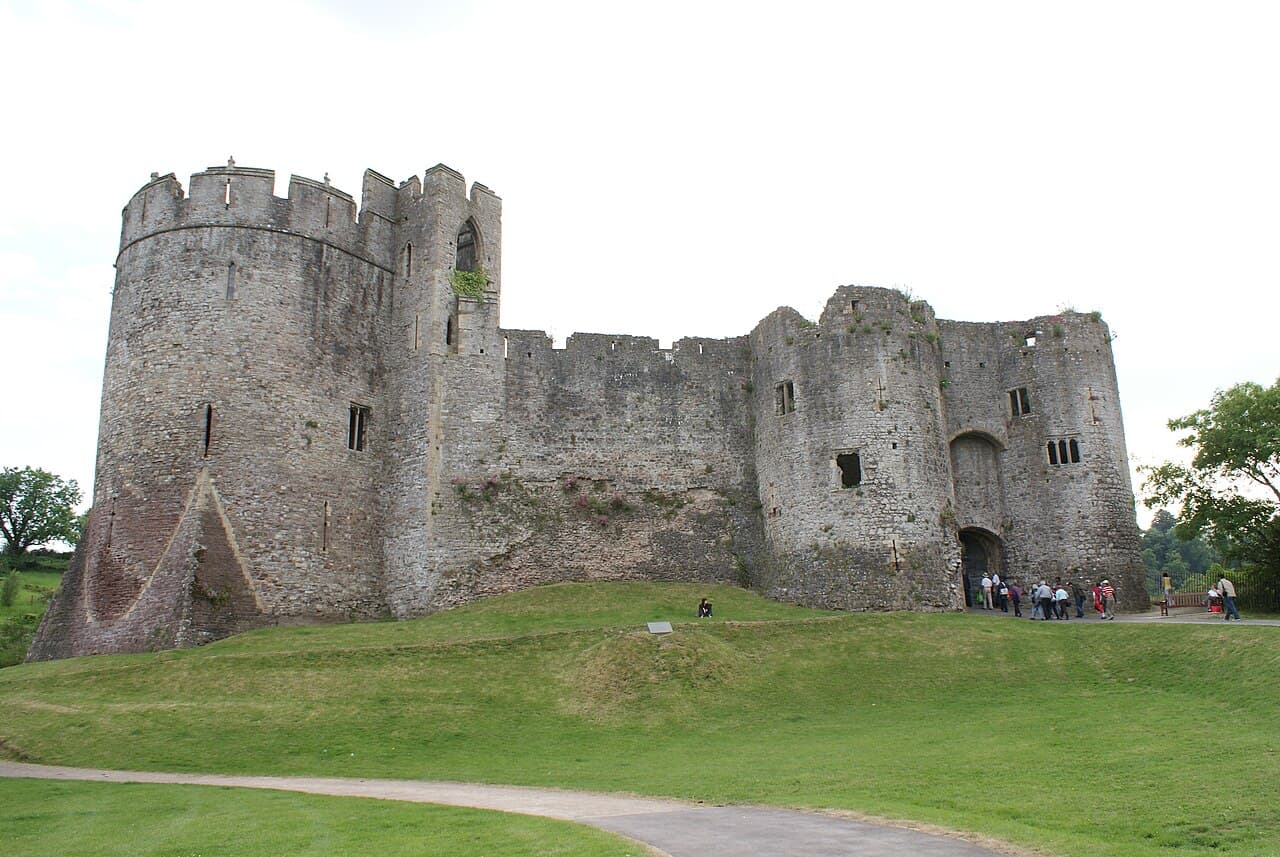
During the late 12th and early 13th centuries, William Marshal, Earl of Pembroke, one of medieval England's most influential magnates, undertook extensive enhancements to the castle. Drawing on his experience from the Crusades and continental warfare, Marshal modernized the defenses, including the construction of the main gatehouse—notable for its timber doors dated by dendrochronology to between 1159 and 1189—and the reinforcement of the Middle Bailey with imposing round towers. Marshal's sons continued to enlarge the Great Tower until approximately 1245, further solidifying the castle's military and residential stature.
Later, in the late 13th century, Roger Bigod, 5th Earl of Norfolk, contributed significantly by adding a new residential range in the Lower Bailey and erecting Marten's Tower, which commands the main landward approach. Bigod also constructed the town's defensive Port Wall between 1274 and 1278 and remodeled the Great Tower, reflecting the castle's dual role as a fortress and noble residence.
Decline of military importance and transition to residence
From the 14th century onward, especially following the conclusion of the Anglo-Welsh wars in the early 15th century, Chepstow Castle's strategic military value waned. Although it was garrisoned during Owain Glyndŵr's rebellion in 1403, the castle's size, limited strategic importance, and garrison strength likely deterred direct assault. Ownership passed through prominent noble families, including Thomas de Brotherton and William Herbert, reflecting the castle's continued status as a prestigious estate rather than a frontline fortress.
By the 16th century, under Sir Charles Somerset, Earl of Worcester, the castle underwent extensive remodeling to serve as a comfortable private residence. This transformation coincided with the Laws in Wales Acts (1535 and 1542), which abolished the autonomous powers of Marcher lords and integrated the region into the English legal framework, further reducing the castle's military role.
Chepstow Castle during the English Civil War
The castle regained military significance during the English Civil War, when it was held by Royalist forces and besieged twice, in 1645 and again in 1648. The siege ended with the castle's surrender to Parliamentarian troops on 25 May 1648. A memorial inside the keep honors Sir Nicholas Kemeys, who led the Royalist defense and was killed in combat after refusing to surrender. Following the war, Chepstow Castle served as an artillery fort, barracks, and political prison, holding notable prisoners such as Bishop Jeremy Taylor and Henry Marten.
Post-war decline and modern conservation
After the Civil War, the castle's military function diminished, and by the late 17th century, it fell into decay. The garrison was disbanded in 1685, and parts of the castle were dismantled or repurposed for agricultural and industrial uses, including glassmaking. Despite this decline, Chepstow Castle became a site of growing historical interest by the late 18th and 19th centuries, attracting tourists arriving by steamship from Bristol.
Early 20th-century excavations in 1910–11 and the purchase of the site by William Royse Lysaght in 1914 initiated preservation efforts. Since 1984, the castle has been managed by Cadw, the Welsh government's historic environment service, which has stabilized the ruins and promoted the castle as a heritage attraction. Visitors today can explore the extensive ruins, including the Great Tower, gatehouse, Marten's Tower, and walk along the battlements, gaining insight into the castle's layered history.
Architectural features and layout
Chepstow Castle's distinctive layout stretches along a narrow ridge between the limestone cliffs overlooking the River Wye and the valley known as the Dell. The castle comprises four baileys, which were added sequentially across four major building phases, illustrating its architectural evolution. The absence of a central keep is unusual for Norman castles, with the Great Tower serving as the primary stronghold.
The castle's stonework incorporates locally quarried limestone and reused Roman masonry from nearby Caerwent, highlighting resourcefulness and continuity of occupation in the region. The impressive gatehouse and round towers demonstrate adaptations to evolving military technology, while residential ranges reflect the castle's role as a noble home.
The great tower
The Great Tower is a dominant feature, built entirely of stone by the late 11th century. It functioned as both a defensive stronghold and a symbol of lordly power. Its robust construction and commanding position made it a formidable obstacle to attackers and a secure residence for its occupants.
Marten's tower and gatehouse
Marten's Tower, constructed in the late 13th century by Roger Bigod, controls the landward approach and remains accessible to visitors today. The main gatehouse, dating from William Marshal's enhancements, features remarkable timber doors and defensive elements such as arrow slits and battlements.
Visiting Chepstow Castle today
Chepstow Castle is open to the public and offers a rich experience of medieval architecture and history. Visitors can explore the extensive ruins, walk the battlements, and learn about the castle's role in the Norman conquest, medieval warfare, and civil conflict. The site hosts regular events and educational programs that bring its history to life.
Managed by Cadw, the castle is well-preserved considering its age and historical vicissitudes. Its location provides stunning views over the River Wye and surrounding countryside, enhancing its appeal as a cultural and heritage destination in Wales.
Frequently asked questions (FAQ)
- What is the historical significance of Chepstow Castle?
- Chepstow Castle is one of the oldest stone castles in Britain, established by the Normans in the late 11th century. It played a crucial role in the defense of the Welsh borders and has witnessed many significant historical events, including the conflicts during the Welsh Wars and the English Civil War.
- When was Chepstow Castle built?
- Construction of Chepstow Castle began in 1067 under the orders of William the Conqueror's knight, William FitzOsbern. The castle has been expanded and modified over the centuries, with significant developments occurring in the 12th and 13th centuries, making it a prime example of medieval military architecture.
- What are the opening hours for Chepstow Castle?
- Chepstow Castle is typically open to visitors from 10:00 AM to 5:00 PM, although hours may vary seasonally. It's advisable to check the official website before your visit to confirm current opening times and any special events that may affect accessibility.
- Can I purchase tickets online for Chepstow Castle?
- Yes, visitors can purchase tickets online through the official Chepstow Castle website. This allows for a smoother entry experience, especially during peak tourist seasons when queues can be longer.
- Is Chepstow Castle accessible for visitors with disabilities?
- Chepstow Castle strives to be accessible to all visitors, with facilities in place for those with mobility challenges. However, due to the castle's historic nature, some areas may have uneven surfaces and steps, so it's recommended to contact the castle staff in advance for specific assistance.
- What is the best time to visit Chepstow Castle?
- The best time to visit Chepstow Castle is during the spring and early autumn months when the weather is generally mild and pleasant. Additionally, visiting during weekdays can help avoid larger crowds that are common on weekends and during school holidays.
- Are there any nearby attractions to Chepstow Castle?
- Yes, Chepstow Castle is located near several attractions, including the beautiful Wye Valley and Tintern Abbey, which are perfect for a day of exploring. The town of Chepstow itself offers charming shops and restaurants, making it a great base for your visit.
- What are the ticket prices for Chepstow Castle?
- Ticket prices for Chepstow Castle are typically around £7 for adults, with discounts available for children, seniors, and families. It's advisable to check the official website for the most current pricing and any promotional offers that may be available.
Photo gallery

Information
Website
Visit websiteFeatured in
Articles on the Castlopedia blog that feature Chepstow Castle.
Sources & official resources
Verify the information above using these authoritative references.
Loading map...
Visitor reviews
No reviews yet. Been here? Write the first review and help other travelers!
Write the first reviewVisited this castle? Share your experience
Your review helps other travelers and adds first-hand knowledge to our encyclopedia.