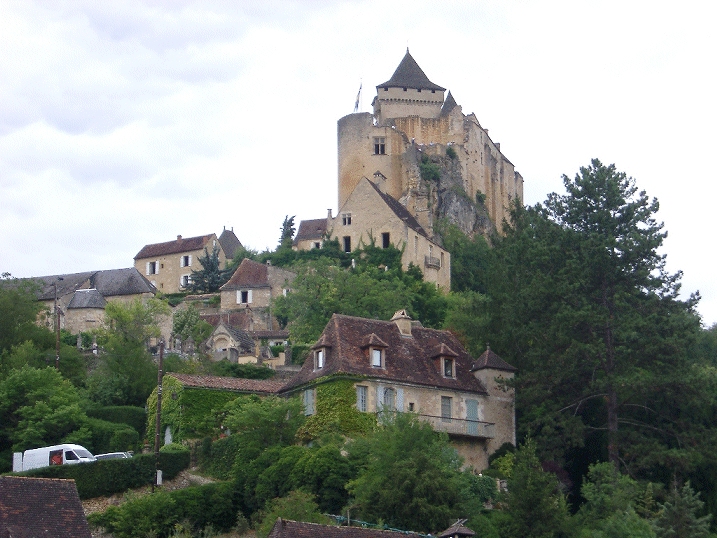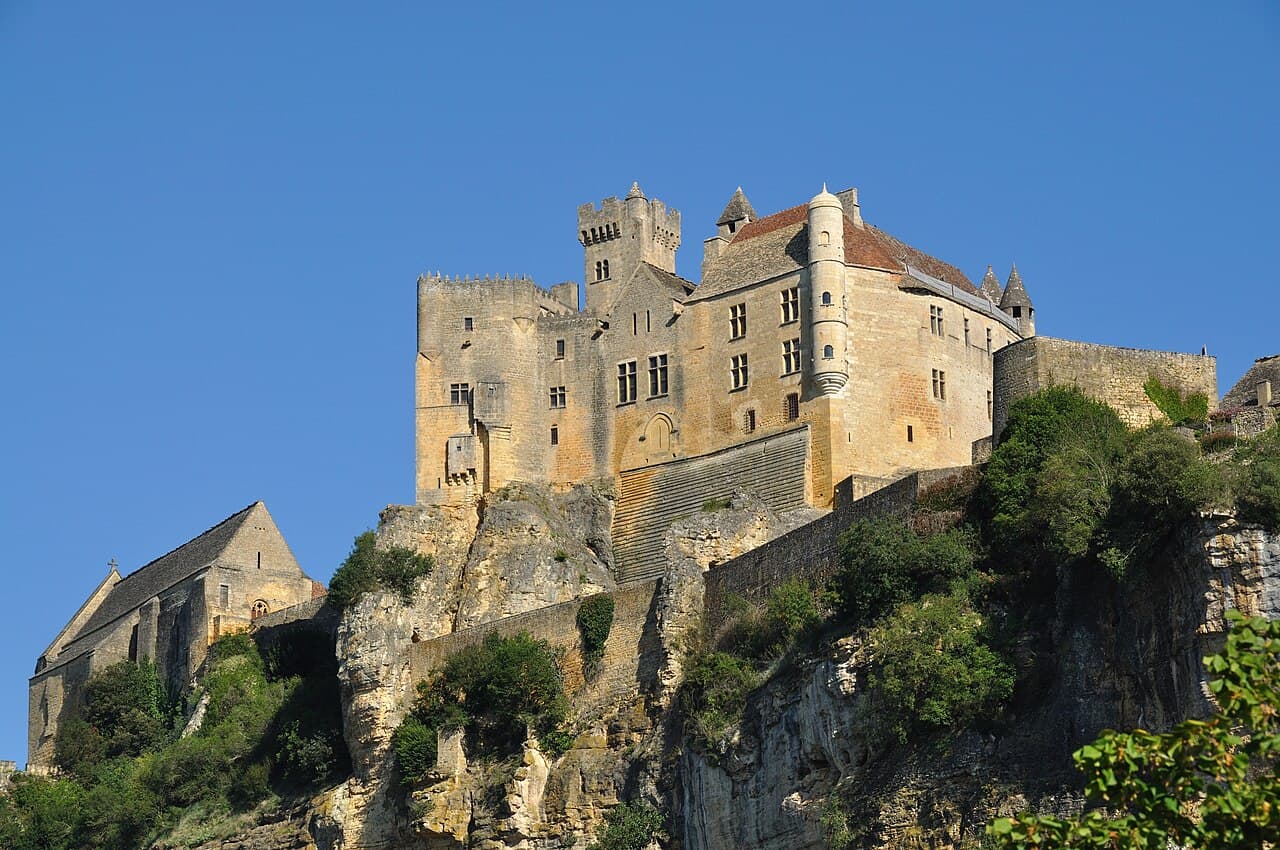
Beynac Castle — France castle

Beynac Castle

Beynac Castle: a majestic high medieval hilltop fortress in France
Beynac-et-Cazenac, Nouvelle-Aquitaine, France
High Medieval (11th–13th c.)
Restored

Beynac Castle stands as a striking example of a high medieval hill castle in the heart of the Dordogne region, specifically in Beynac-et-Cazenac, Nouvelle-Aquitaine, France. Perched dramatically on a limestone cliff overlooking the Dordogne River, this fortress has dominated the landscape since the 12th century, serving both as a military stronghold and a symbol of feudal power.

Historical significance and origins

The construction of Beynac Castle began in the 12th century, during the height of the high medieval period, a time marked by frequent conflicts and territorial disputes in southwestern France. The castle was originally built by the Beynac family, a noble lineage that played a prominent role in the region's history. Its strategic location allowed it to control the river traffic and the surrounding valley, making it a vital military and economic asset.

Throughout the Hundred Years' War (1337–1453), Beynac Castle was a key defensive site contested between the English and French crowns. The castle's fortifications were tested during several sieges, and it remained in French hands, symbolizing the resilience of local nobility. Its ownership passed through various noble families over the centuries, each contributing to its maintenance and modifications.

Architectural features and layout

Defensive structures

Beynac Castle exemplifies the typical hill castle design, utilizing the natural topography for defense. The castle is built on a steep cliff, with sheer drops on several sides, reducing the need for extensive outer walls. The main defensive elements include massive curtain walls, round towers, and a keep (or donjon) that served as the last refuge during attacks.

The gatehouse is fortified with a portcullis and murder holes, designed to repel invaders. The castle's battlements and walkways provided defenders with excellent vantage points to monitor and defend the valley below. A deep moat or ditch further enhanced the defenses on the more accessible sides.

Residential and functional spaces

Inside the castle walls, the layout includes a great hall used for gatherings and administrative functions, chapel for religious observances, and various living quarters for the lord and his retinue. The castle also contained storerooms, kitchens, and stables, supporting a self-sufficient community during sieges.

The architecture reflects practical medieval design, with thick stone walls for insulation and defense, narrow windows for archery, and vaulted ceilings in important chambers to enhance structural strength.

Restoration and current status

After centuries of use and periods of decline, Beynac Castle underwent significant restoration in the 20th century, which has preserved its imposing silhouette and many original features. Today, it is classified as restored and is one of the best-preserved castles in the Dordogne region.

The castle is open to the public, offering visitors a chance to explore its medieval architecture, climb its towers, and enjoy panoramic views of the Dordogne valley. It also hosts cultural events and medieval reenactments, enriching the visitor experience.

Architectural style and cultural importance

Beynac Castle is a quintessential example of high medieval military architecture, characterized by its robust stone construction, strategic hilltop placement, and functional design tailored to defense and feudal governance. Its preservation allows insight into the feudal society of medieval France and the architectural innovations of the period.

The castle is a protected historic monument and a major tourist attraction, contributing to the cultural heritage and economy of the Nouvelle-Aquitaine region.

Visiting Beynac Castle

Visitors to Beynac Castle can explore its extensive fortifications, including the keep, towers, and curtain walls, and learn about its history through guided tours and exhibits. The site offers spectacular views over the Dordogne River and the surrounding medieval villages, making it a must-see destination for history enthusiasts and travelers.

The castle is accessible year-round, with varying opening hours depending on the season. Tickets are reasonably priced, with discounts for children and groups.

Frequently asked questions

  • When was Beynac Castle built? Beynac Castle was constructed in the 12th century during the high medieval period.
  • What type of castle is Beynac? It is a hill castle, strategically located on a limestone cliff overlooking the Dordogne River.
  • Is Beynac Castle open to visitors? Yes, the castle is open to the public with guided tours available and offers panoramic views of the region.
  • What architectural style is Beynac Castle? It exemplifies high medieval military architecture with robust stone walls and defensive towers.
  • What is the condition of Beynac Castle? The castle is restored and well-preserved, maintaining much of its original medieval character.

Frequently asked questions (FAQ)

How do I get to Beynac Castle?
Beynac Castle is located in the charming village of Beynac-et-Cazenac, easily accessible by car or public transport from nearby towns like Sarlat-la-Canéda. There is limited parking near the castle, so consider arriving early to secure a spot. The castle is also within walking distance from the village center, making it convenient for visitors.
What is the historical significance of Beynac Castle?
Beynac Castle dates back to the 12th century and played a crucial role in the Hundred Years' War, serving as a stronghold for the English and French armies. Its strategic position overlooking the Dordogne River made it an important military site. Today, it stands as a testament to the region's medieval history and architectural prowess.
When was Beynac Castle built?
Construction of Beynac Castle began in the early 12th century and was completed over several generations. The castle has undergone various renovations and restorations, preserving its historical elements while enhancing its structural integrity. Visitors can explore its rich history through the preserved architecture and informative displays.
Can I visit Beynac Castle year-round?
Yes, Beynac Castle is open to visitors throughout the year, although opening hours may vary by season. It is advisable to check the official website for the most current visiting hours, especially during holidays or special events. The castle offers a unique experience in every season, showcasing the stunning landscape of the Dordogne valley.
Why is Beynac Castle a popular tourist attraction?
Beynac Castle is renowned for its breathtaking views of the Dordogne River and the surrounding countryside, as well as its well-preserved medieval architecture. The castle's rich history and dramatic setting make it a favorite among history buffs, photographers, and nature lovers alike. Additionally, its proximity to other attractions in the region enhances its appeal.
Is it possible to access Beynac Castle with limited mobility?
While Beynac Castle is a historical site with some steep paths and staircases, there are efforts to improve accessibility for visitors with limited mobility. However, it is recommended to check in advance for specific accessibility options available on-site. Staff can provide assistance to ensure a more enjoyable visit.
What are the ticket prices for Beynac Castle?
Ticket prices for Beynac Castle are generally affordable, with discounts available for students, seniors, and children. Family tickets may also be offered, making it a budget-friendly option for visitors. It is best to purchase tickets on-site or check the official website for any special promotions or group rates.
What is the best time to visit Beynac Castle?
The best time to visit Beynac Castle is during the spring and fall when the weather is mild, and the tourist crowds are smaller. Summer can be quite busy, though the vibrant surroundings and events make it lively. Early mornings or late afternoons are ideal for a quieter experience and stunning views of the sunset.
Are there any nearby attractions to Beynac Castle?
Yes, Beynac Castle is located near several other attractions, including the picturesque village of La Roque-Gageac and the stunning gardens of Marqueyssac. The Dordogne region is rich in history and natural beauty, offering opportunities for hiking, canoeing, and exploring other medieval sites. These nearby attractions make it easy to plan a full day of exploration.

Photo gallery

Beynac Castle
Click to view

Photo by Gentil Hibou•CC BY-SA 3.0

1 photo • Click any image to view in full screen

Information

Hill Castle

Articles on the Castlopedia blog that feature Beynac Castle.
Sources & official resources

Verify the information above using these authoritative references.

Loading map...

Visitor reviews

No reviews yet. Been here? Write the first review and help other travelers!

Write the first review

Visited this castle? Share your experience

Your review helps other travelers and adds first-hand knowledge to our encyclopedia.

Write a review

(5/5)

0/2000 characters

Your review will be visible after admin approval

Nearby castles

1.1 km

Château de Fayrac

, France

The Château de Fayrac stands as a remarkable example of a hill castle in the region of Hauts-de-France, France. Its origins trace back to at least the 13th century, when it was first documented as a modest fortified house known as Afayrac or Affeyrac. Over the centuries, the château evolved through successive architectural phases, reflecting the shifting needs and tastes of its noble owners, from medieval military defense to Renaissance refinement and 19th-century cultural revival. Medieval origins and military significance The earliest surviving elements of the château, including vaulted cellars and a round tower, date to the 13th century. Initially, the castle functioned as a fortified residence for local lords, documented in ecclesiastical records. During the Middle Ages, the château was closely linked to the powerful Caumont family, lords of the nearby Castelnaud estate. By the 14th century, the site was known as the “tours de Fayrac” and served as a strategic defensive lookout supporting the English stronghold at Castelnaud during the Hundred Years’ War. Its position overlooking the Dordogne River enabled surveillance and control of surrounding territories. In 1342, the castle was transferred as part of a dowry from Raoul de Caumont to his daughter, illustrating its role in noble alliances. The 15th century saw the addition of a gatehouse with a drawbridge, enhancing the château’s defensive capabilities. This gatehouse remains a prominent architectural feature, marking the fortified entrance to the inner courtyard. Renaissance transformations and architectural evolution By the early 16th century, under the ownership of Raymond de Prouhet, the château underwent significant modifications incorporating Renaissance architectural elements. These changes included the introduction of larger windows and smaller crenellated turrets on the residential wings, reflecting contemporary stylistic trends influenced by prominent figures such as Bishop Nicolas Gaddi of Sarlat. The château’s layout, with three wings enclosing an elevated courtyard open on one side but protected by a wall, demonstrates a blend of defensive purpose and residential comfort. Religious conflicts and noble alliances During the French Wars of Religion in the late 16th century, the château was a Protestant stronghold. Owned by the Blancher family through marriage, it aligned with regional Protestant forces. Jean de Blancher, a Protestant lord of Fayrac, actively defended the château and surrounding fortresses. His marriage to Simone de Vivans connected him to the French Resistance within Domme, where he commanded after its capture. The violent religious conflicts of the period are underscored by the death of his Catholic brother Pierre at the hands of Protestants. 18th and 19th-century restoration and cultural significance By the 18th century, the château remained in the hands of the Blancher family. However, during the French Revolution in 1789, the family fled, and the property was confiscated and sold to a lawyer named Gayraud from nearby Sarlat. Gayraud initiated restoration efforts to preserve the château’s structure. The 19th century brought extensive refurbishment under Fernand Fouant de La Tombelle, a noted composer. His ownership infused the château with cultural importance, including the establishment of a large music collection and the installation of an Érard grand piano. Restoration work also included reconstructing a medieval donjon as a replica of the original keep, reflecting the Romantic era’s fascination with medieval architecture. 20th-century history and current status During World War II in 1944, the château briefly hosted André Malraux, who was involved with the French Resistance. Since 1928, the château has been officially recognized and protected as a historic monument. It remains a private residence, well maintained and preserving its layered history from medieval fortifications through Renaissance enhancements to 19th-century cultural additions. Architectural features and layout The château is situated on a small hill overlooking the Dordogne River, with a layout comprising three wings forming an elevated inner courtyard that is open on one side but secured by a protective wall. Two massive towers face the river, lending a fortress-like appearance and recalling the château’s military origins. The other wings feature large windows and smaller crenellated turrets, illustrating the Renaissance influence. The 15th-century gatehouse with its drawbridge remains a defining feature, marking the fortified entrance and linking the defensive and residential functions of the château. The presence of a reconstructed medieval donjon adds to the château’s historical ambiance, representing the 19th-century restoration efforts inspired by Romanticism. Inside one of the towers is a notable music library and the Érard grand piano, relics of the château’s 19th-century cultural chapter. These elements highlight the château’s unique combination of military, residential, and artistic heritage. Preservation and accessibility Today, the Château de Fayrac is well preserved and protected as a listed historic monument. Despite its private ownership and inaccessibility to the public, the château retains clear architectural layers that document its evolution over seven centuries. Its combination of medieval defensive structures, Renaissance renovations, and 19th-century restorations makes it a significant example of French castle architecture.

High Medieval (11th–13th c.)
Details
2.1 km

Castle of Beynac

Beynac-et-Cazenac, France

The Castle of Beynac is one of the most spectacular and well-preserved medieval castles in the Dordogne region of southwestern France. Perched atop a towering limestone cliff about 150 meters above the Dordogne River, the castle dominates the valley with commanding views of the surrounding countryside. Its strategic location made it a key stronghold controlling the vital river valley route during the High Medieval period. Constructed in the 12th century by the noble Barons of Beynac, the castle was designed primarily for defense. The natural cliff face provided formidable protection on one side, while the other sides were fortified with double crenelated walls, double moats—including a deep natural ravine—and a double barbican system, all intended to render the castle nearly impregnable. This combination of natural and man-made defenses exemplifies the strategic military architecture of the High Medieval era. Historical context and significance Early history and construction The earliest records of the Castle of Beynac date back to 1115, linked to Mainard de Beynac and his family, who held extensive lands in the region. The castle was built to assert control over the Dordogne valley, a crucial frontier between the territories of the French crown and the English during the medieval period. The Barons of Beynac were influential supporters of the nearby abbey of Cadouin, indicating their prominence in both secular and ecclesiastical affairs. The castle’s initial construction included a large square Romanesque donjon (keep) featuring defensive elements such as machicolations and a narrow spiral staircase tower. This donjon remains the oldest surviving structure within the castle complex, highlighting the military architectural style of the 12th century. Conflicts and sieges In 1197, the castle was famously captured by Richard the Lionheart, King of England, who scaled the cliff face to seize the fortress. Despite this daring conquest, Richard’s occupation was brief due to his death shortly afterward during a campaign against the nearby Castle of Chalus. The castle soon returned to the control of the Beynac family. During the Albigensian Crusade in 1214, the castle suffered damage when Simon de Montfort accused the Beynac lords of heresy and destroyed parts of the castle, including the main tower and walls. However, the family regained possession within a year and rebuilt the fortifications, demonstrating resilience amid religious and political turmoil. The Hundred Years’ War (1337–1453) saw Beynac as a steadfast French stronghold, positioned directly opposite the English-held Castle of Castelnaud across the Dordogne River. The two castles were focal points of ongoing skirmishes and military engagements. Despite the turbulent conflict and temporary English control of the surrounding region, Beynac was never permanently captured by English forces. Later history and decline In the 16th century, during the French Wars of Religion, the Beynac family converted to Protestantism and supported the Huguenot cause. In response to the period’s instability, King Henry IV ordered significant remodeling of the castle’s defenses in 1585 to strengthen its military capabilities. The male line of the Beynac family ended in 1753, and the castle passed to the Beaumont-Beynac family through marriage. Over time, the castle was gradually abandoned and fell into disrepair by the late 19th century. The last of the Beynacs, Marie-Claude de Beynac, died in 1811 without heirs, marking the end of the family’s direct association with the castle. In 1944, the castle was officially classified as a historic monument, recognizing its cultural and architectural significance. In 1962, Lucien Grosso purchased the property and undertook extensive restoration efforts to revive its medieval appearance and structural integrity. Architectural features and layout Defensive structures The castle’s position atop a steep cliff provides natural defense on the riverside. The plateau side, more vulnerable to attack, is heavily fortified with a double crenelated enceinte (curtain wall), double moats including a deep natural ravine, and two barbicans serving as outer defensive gateways. This layered defense system exemplifies medieval military engineering aimed at resisting sieges and assaults. The donjon and residential wings The Romanesque donjon is a prominent feature, characterized by thick walls, limited openings, and defensive elements such as machicolations and an échauguette (small watch turret). Its crenellated terrace offers panoramic views of the Dordogne valley and surrounding castles. Adjacent to the donjon is a residential wing dating from the 12th century, expanded and modified through the 16th and 17th centuries. Opposite this lies another residential wing with parts from the 14th century, including a courtyard and a square staircase leading to 17th-century apartments. These living quarters reflect the castle’s evolution from a purely military fortress to a noble residence. Interior decoration and art The interior of the castle retains significant historical elements such as 17th-century wood paneling and painted ceilings. The main hall, once the meeting place of the Périgord Estates, contains a Renaissance-style sculpted fireplace adorned with bucrania (carved ox skulls symbolizing strength). A small oratory within the castle is decorated with 15th-century frescoes depicting religious scenes including the Pietà, Saint Christopher, and the Last Supper featuring Saint Martial as the host. The castle also houses a rich collection of tapestries illustrating hunting scenes and noble life, highlighting its cultural importance beyond military functions. Cultural legacy and modern restoration Restoration and preservation Following decades of neglect, the castle’s restoration began in earnest after its acquisition by Lucien Grosso in 1962. His efforts focused on preserving the castle’s medieval character, repairing structural damage, and maintaining original architectural features. Today, the Castle of Beynac stands as one of the best-preserved medieval fortresses in the region, attracting visitors interested in history, architecture, and scenic views. Filming and tourism The castle’s authentic medieval appearance and dramatic location have made it a popular filming location for historical and fantasy movies, including "Joan of Arc" (1999) and "The Visitors" (1993). As a tourist attraction, it offers guided tours showcasing its rich history, architectural features, and art collections. Visitors can explore the castle’s defensive walls, towers, and interior rooms, enjoying breathtaking views over the Dordogne valley and neighboring castles such as Castelnaud. The site provides a unique opportunity to experience the military and residential aspects of a medieval fortress in a remarkably preserved setting.

High Medieval (11th–13th c.)
Details
2.8 km
Castle of Milandes — France castle

Castle of Milandes

Castelnaud-la-Chapelle, France

The Castle of Milandes, located in Castelnaud-la-Chapelle in the Dordogne region of southwestern France, stands as a magnificent example of late medieval architecture with strong Renaissance influences. Built in the late 15th century by the noble Caumont family, it served as their principal residence until the upheavals of the French Revolution. The castle is renowned not only for its architectural beauty but also for its rich history and its connection to the iconic Josephine Baker, who owned and restored the castle in the 20th century. Architectural features and design The Castle of Milandes is a hill castle strategically perched about 50 meters above the left bank of the Dordogne River, overlooking the picturesque valley below. Its design reflects a blend of medieval defensive elements softened by Renaissance aesthetics, making it both a fortress and a comfortable noble residence. The main building features a square keep on the south side and two round towers with turreted spiral staircases, characteristic of the period's military architecture. The northern facade retains much of its original late 15th-century appearance, including stone mullioned windows with stained glass that were added at the behest of Claude de Cardaillac, wife of François de Caumont. These windows brighten the interior and add an elegant touch to the otherwise robust stonework. The castle is also adorned with turrets, gargoyles, and battlements that enhance its romantic and defensive character. The southern facade was extensively remodeled in the early 20th century during restoration efforts by industrialist Charles-Auguste Delbret-Claverie, who introduced neo-Gothic and neo-Renaissance elements. These additions include new towers, lodgings, balconies, and balustrades decorated with allegorical sculptures, blending historical styles with early modern tastes. The castle chapel, built in 1503, is a notable feature within the estate. It contains a crypt and 16th-century frescoes, including a large depiction of Saint Christopher. Originally excluded from the estate due to a cadastral error, the chapel was reintegrated in the 21st century. Following the Caumont family's conversion to Protestantism, the chapel was adapted for Protestant worship, reflecting the religious shifts of the era. Historical context and ownership The Castle of Milandes was commissioned by François de Caumont, Count of Castelnaud, around 1489 as a more comfortable and romantic residence compared to the older, more austere Castle of Castelnaud. François built Milandes primarily for his wife, Claude de Cardaillac, incorporating features that emphasized comfort and aesthetic appeal, such as large windows overlooking the valley and elegant interior spaces. During the turbulent French Wars of Religion in the 16th century, the Caumont family, who had converted to Protestantism, maintained control of the castle despite the widespread conflict. Their religious affiliation influenced modifications to the castle, including the chapel's conversion to a Protestant temple. In the 17th and 18th centuries, the castle remained in the Caumont family until the French Revolution forced its abandonment. The castle was sold in the 19th century but fell into neglect and suffered a damaging fire around 1900. The early 20th century saw a revival under the ownership of Charles-Auguste Delbret-Claverie, a French industrialist who undertook extensive restoration work. Architect Henri Lafillée led these efforts, introducing neo-Gothic and neo-Renaissance styles, adding new structural elements and restoring the castle's grandeur. A formal French garden was designed by Jules Vacherot in 1908, complementing the castle's architecture and enhancing its setting. Josephine baker's era and legacy From 1937, the castle gained international fame when it was rented and later purchased in 1947 by Joséphine Baker, the celebrated American-born French singer, dancer, and civil rights activist. Baker and her husband Jo Bouillon modernized the castle by installing running water, electricity, and central heating, making it a comfortable home for their family. Baker created an avant-garde tourist complex on the estate known as the Village du Monde, which included a hotel, bar-restaurant, performance hall, wax museum, bowling alley, mini-golf, tennis courts, and a swimming pool. This ambitious project reflected her vision of cultural exchange and celebration of diversity. She adopted twelve children of various nationalities, whom she called her "rainbow tribe," living at Milandes with them and fostering a unique family environment. The castle's interiors from this period feature art deco elements, especially in the bedrooms and bathrooms, reflecting the style of the 1930s and 1950s. Financial difficulties eventually forced Baker to sell the castle in the 1960s, and she was controversially evicted in 1969. Despite this, her legacy remains a significant part of the castle's history, and an exhibition dedicated to her life and work is now part of the visitor experience. Restoration and present-day status Since the 1960s, the Castle of Milandes has changed ownership several times. It was listed as a historic monument in stages, with terraces, facades, and roofs protected since 1986, and the entire estate including the winery, gardens, and stables added in 2009. The current owners, Henry and Claude de Labarre, have overseen ongoing restoration efforts, managed by their daughter Angélique de Saint-Exupéry. The castle today is a popular tourist destination, admired for its harmonious combination of medieval and Renaissance architecture, neo-Gothic restoration elements, and its cultural significance linked to Joséphine Baker. The extensive gardens, terraces, and the winery add to the estate's charm. From April to October, visitors can enjoy a renowned falconry and birds of prey show held on the castle grounds, which draws many enthusiasts of medieval traditions and wildlife. Inside, the castle houses a collection of Joséphine Baker memorabilia, including furniture, stage costumes, and honors, providing a unique glimpse into the life of this extraordinary woman. The castle in its regional context The Castle of Milandes is situated near the famous Castle of Castelnaud-la-Chapelle, a medieval fortress built in the late 12th century and renowned for its military architecture and museum of medieval warfare. Together, these castles represent the rich feudal and cultural history of the Dordogne valley, a region known for its concentration of historic castles and picturesque landscapes. While Castelnaud was primarily a defensive stronghold, Milandes was designed as a more comfortable noble residence, reflecting the evolution of castle architecture from purely military to residential and aesthetic purposes during the Renaissance. Visitor experience and attractions Visitors to the Castle of Milandes can explore the beautifully restored interiors, including the turrets, gargoyles, and stained glass windows. The formal gardens and terraces offer stunning views of the Dordogne valley. The falconry shows provide engaging entertainment that connects visitors to medieval traditions. The exhibition dedicated to Joséphine Baker offers insight into her life, her artistic career, and her humanitarian efforts, making the castle a cultural as well as historical destination. Architectural significance The Castle of Milandes exemplifies the transition from fortified medieval castles to Renaissance chateaux that emphasize comfort, light, and beauty. Its combination of defensive features such as towers and battlements with elegant stained glass windows and decorative elements illustrates the changing tastes and social functions of castles in late 15th and early 16th-century France. The early 20th-century restorations introduced neo-Gothic and neo-Renaissance styles, which are significant for understanding the historic preservation movement in France and the romantic revival of medieval architecture during that period.

Late Medieval (14th–15th c.)
Details