Dunnottar Castle
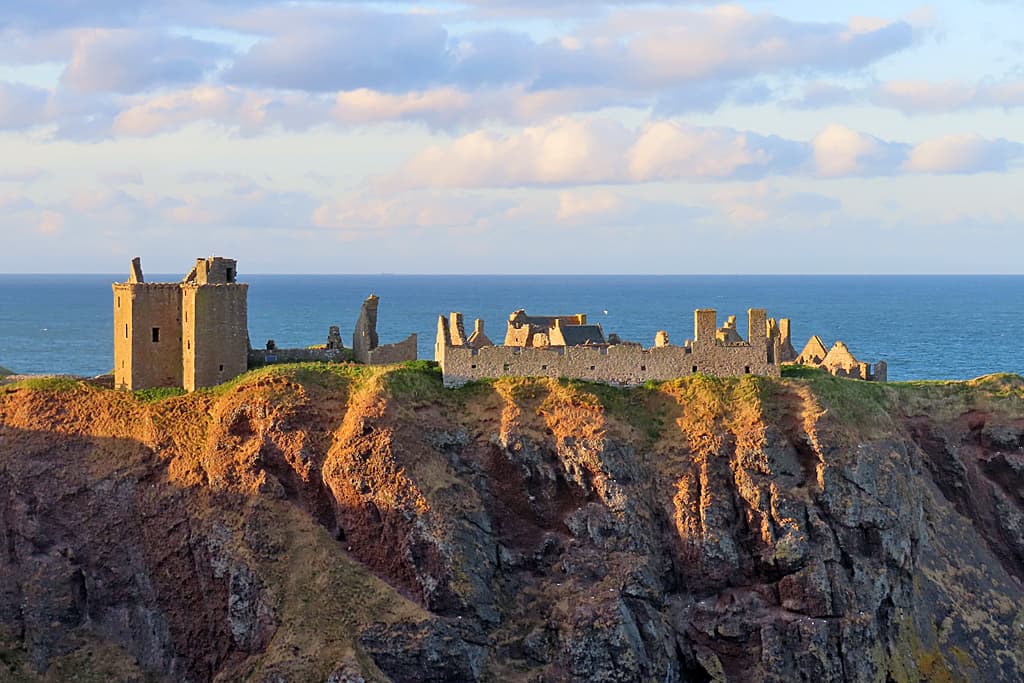
Dunnottar Castle is a striking ruined medieval fortress perched on a rocky headland overlooking the North Sea on Scotland's northeast coast, near the town of Stonehaven in Aberdeenshire. The castle's dramatic location atop cliffs rising approximately 50 meters above the sea adds to its imposing presence and strategic defensive advantages. Its surviving structures date predominantly from the 15th and 16th centuries, although the site has been fortified since the Early Middle Ages, reflecting its long-standing military and political significance in Scottish history.
The castle occupies about 1.4 hectares on a headland connected to the mainland by a narrow isthmus, accessible only by a steep path leading to the heavily fortified gatehouse. The natural defenses of steep cliffs on three sides made Dunnottar an almost impregnable stronghold, which played a pivotal role in Scotland's turbulent history, including the Wars of Scottish Independence, the 17th-century civil wars, and the Jacobite risings.
The early history and strategic importance
The origins of Dunnottar Castle trace back to the Early Middle Ages, with archaeological and historical records indicating fortifications on the site as early as the 7th century. The area was originally under the control of the Picts, an ancient people of Scotland, and two sieges recorded in the Annals of Ulster in 681 and 694 are linked to King Brude's expansion efforts. In 900 AD, King Donald II of Scotland famously died defending the fortress against Viking invaders, underscoring the site's early military significance.
By the 10th century, Dunnottar was a key defensive position against Norse incursions, and in 934, the English King Æthelstan raided the region, highlighting the castle's strategic importance on Scotland's eastern coast. By the late 12th and early 13th centuries, Dunnottar had become a local administrative center under King William the Lion. It also appears in medieval literature such as the early 13th-century Arthurian romance Roman de Fergus, indicating its cultural as well as military prominence.
The medieval castle and the Wars of Scottish Independence
During the Wars of Scottish Independence in the late 13th and early 14th centuries, Dunnottar Castle was a significant military site. In 1297, the Scottish patriot William Wallace reportedly captured the castle from English occupiers. A grim episode in the castle's history involves Wallace allegedly burning alive approximately 4,000 English prisoners in the castle's church, a testament to the brutal nature of the conflict.
In 1336, English King Edward III ordered the partial reconstruction and fortification of Dunnottar to strengthen English control in Scotland. However, Scottish forces under Andrew Murray recaptured and destroyed the castle that same year. The castle was subsequently acquired by the powerful Keith family in the 14th century, who became the Earls Marischal and held the site for several centuries.
Architectural development and noble residence
The 14th-century tower house was completed by William Keith, although he was initially excommunicated for building on consecrated ground; this was later reversed by Pope Benedict XIII in 1395. The Keith family transformed Dunnottar from a purely military fortress into a noble residence over the following centuries.
In the 16th century, George Keith, 5th Earl Marischal, undertook major rebuilding and expansion projects, adding a palace and restoring the chapel. The castle's architecture reflects a blend of defensive features and residential comfort, including curtain walls, a heavily fortified gatehouse with a portcullis, and multiple gun ports designed for artillery defense.
The palace comprises three wings arranged around a quadrangle, featuring seven identical lodgings with fireplaces and windows, a long gallery with an ornate oak ceiling, and various service rooms such as kitchens, brewhouse, bakery, and storerooms. The presence of a Water Gate and postern gate provided discreet access from the sea, enhancing the castle's defensibility and supplying routes.
Notable buildings within the castle
- Benholm's Lodging: A five-storey 16th-century stone building built into the rock, containing a prison below and apartments above, equipped with multiple tiers of gun ports.
- Waterton's Lodging (Priest's House): Dating from around 1574, this building includes a hall, kitchen, private chambers, and a spiral staircase.
- 14th-century tower house: Approximately 12 by 11 meters, originally four stories plus a garret, containing a great hall, private chambers, a forge, and a stable block.
- 13th-century chapel: Consecrated in 1276 and largely rebuilt in the 16th century, retaining medieval walls and original windows, with an adjacent graveyard.
The 17th century and protection of the Honours of Scotland
Dunnottar Castle is famously associated with the Honours of Scotland, the Scottish crown jewels. During the 17th-century civil wars, the castle was a Covenanter stronghold opposing royal interference in the church. In 1651, as Oliver Cromwell's forces besieged Dunnottar, the Honours were smuggled out by Christian Fletcher and others and hidden at Kinneff Church, remaining concealed until the monarchy was restored in 1660.
The castle also served as a prison for Covenanters who refused allegiance to King James VII in 1685; many prisoners died or were transported overseas. The castle's role in these religious and political conflicts highlights its continued strategic and symbolic importance.
The Jacobite risings and decline
In the late 17th and early 18th centuries, Dunnottar was involved in the Jacobite risings. The 10th Earl Marischal supported the 1715 Jacobite Rising, leading to the forfeiture of his titles and estates. Following this, the castle was sold to the York Buildings Company in 1720, which dismantled much of the structure for building materials.
Ownership changed hands several times, and the castle fell into ruin until the 20th century when the Pearson family purchased and undertook restoration efforts. Today, Dunnottar Castle is a scheduled monument and a popular historic site open to the public, attracting visitors with its dramatic setting and rich history.
Architectural remains and visitor experience
The castle's remains are spread across the headland, with defensive curtain walls blocking a cliff cleft and a gatehouse featuring a portcullis and blocked gates. The layout includes multiple buildings connected by underground passages and tunnels, enhancing its defensibility.
Notable features include the circular cistern or fish pond in the quadrangle's center, a bowling green, and the partially roofed dining room and Silver House restored in the 1920s. The castle's rugged landscape and sea views create a compelling visitor experience, combining natural beauty with historical intrigue.
Dunnottar Castle remains one of Scotland's most evocative and historically significant ruins, embodying centuries of Scottish history, architecture, and resilience against both natural and human threats.
Frequently asked questions (FAQ)
- How do I get to Dunnottar Castle?
- Dunnottar Castle is located just south of Stonehaven, easily accessible by car or public transport. If you're traveling by train, the nearest station is Stonehaven, from which you can enjoy a scenic walk to the castle.
- What is the historical significance of Dunnottar Castle?
- Dunnottar Castle is steeped in history, having served as a fortress and royal residence for centuries. It played a crucial role during the Wars of Scottish Independence and is famously known for the hiding of the Honours of Scotland (Scottish crown jewels) during the English Civil War.
- When was Dunnottar Castle built?
- The origins of Dunnottar Castle date back to the 14th century, though the site has been occupied since at least the 5th century. Its strategic position on a cliff overlooking the North Sea has made it an important military stronghold throughout its history.
- Can I visit Dunnottar Castle year-round?
- Yes, Dunnottar Castle is open to visitors throughout the year, although opening hours vary by season. It's advisable to check the official website for the most current information on visiting times and any seasonal events.
- Why is Dunnottar Castle known for its architecture?
- Dunnottar Castle is renowned for its dramatic cliffside location and impressive medieval architecture. The ruins include a variety of structures such as the Great Hall and the chapel, showcasing the castle's historical significance and engineering prowess.
- Is it possible to access Dunnottar Castle with mobility issues?
- Dunnottar Castle has some accessibility challenges due to its rugged terrain and steep paths. However, visitors with mobility issues can enjoy the views from the surrounding area, and staff are often available to assist where possible.
- What is the best time to visit Dunnottar Castle?
- The best time to visit Dunnottar Castle is during the spring and summer months when the weather is milder and the gardens are in bloom. Visiting during these seasons also offers the chance to enjoy various events and activities hosted at the castle.
- Are there any nearby attractions to explore?
- Yes, nearby attractions include the picturesque town of Stonehaven, the beautiful Dunnottar Woods, and the nearby beach. You can also explore local shops and restaurants, making it a great day out.
- What are the ticket prices for Dunnottar Castle?
- Ticket prices for Dunnottar Castle vary depending on age and whether you are a concessionary visitor. It's best to check the official website for the latest pricing information and any available discounts.
- What are the opening hours for Dunnottar Castle?
- Dunnottar Castle's opening hours change seasonally, typically opening from 9:30 AM to 5:30 PM during peak months. Visitors should confirm the current hours on the official website before planning their trip.
Photo gallery

Information
Website
Visit websiteFeatured in
Articles on the Castlopedia blog that feature Dunnottar Castle.
Sources & official resources
Verify the information above using these authoritative references.
Loading map...
Visitor reviews
No reviews yet. Been here? Write the first review and help other travelers!
Write the first reviewVisited this castle? Share your experience
Your review helps other travelers and adds first-hand knowledge to our encyclopedia.