Duino Castle
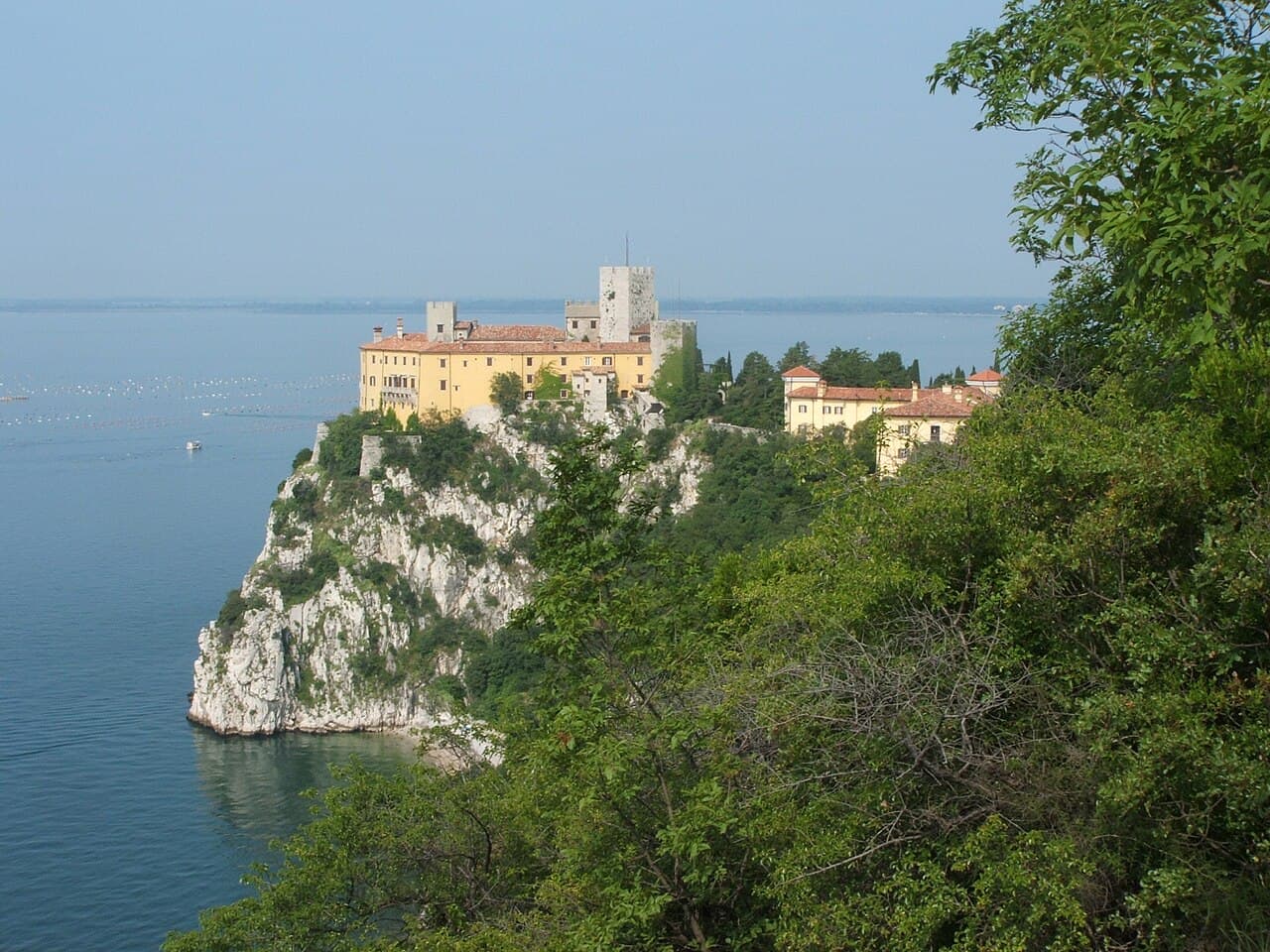
Duino Castle, or Castello di Duino, stands majestically on a rocky promontory overlooking the Gulf of Trieste in the Friuli-Venezia Giulia region of northeastern Italy. This hill castle is renowned for its layered history, spanning from a Roman military outpost to a medieval fortress and a noble residence that has witnessed centuries of European history. Its dramatic location on the cliffs of the Kars mountain range offers panoramic views of the Adriatic Sea and the surrounding landscape, making it a striking symbol of the region's strategic and cultural past.
The site of Duino Castle originally hosted a Roman fortification known as Castellum Pucinum, visited by Emperor Diocletian in the 3rd century. Overlooking the sea from a commanding position, the location was ideal for defense and control of maritime routes. The first medieval castle, often called the "Old Castle," dates back to the 11th century and was under the authority of the Patriarchate of Aquileia. Today, only ruins of this early structure remain, perched on a northern rocky spur and inaccessible to visitors.
Construction and architectural evolution
In 1389, Ugone di Duino, captain of Trieste, initiated the construction of what is known as the "New Castle" on the site of the older fortress. This new structure was built on the remains of the Roman outpost and incorporated medieval defensive features characteristic of the high medieval period. The castle was completed in the early 15th century under Ramberto III of Waldsee, who strengthened its fortifications amid regional conflicts involving the Republic of Venice and the expanding Ottoman threat.
The castle's design is complex and labyrinthine, featuring a square keep built in the 16th century, which remains one of its most prominent architectural elements. The keep and the surrounding buildings are arranged around a courtyard, with narrow, angled passages and terraces that provide changing views of the sea and landscape. The layout reflects both defensive needs and residential comfort, blending military architecture with noble living quarters.
Defensive features
Duino Castle's strategic location on cliffs demanded robust defensive measures. Its walls and towers were constructed to withstand sieges, including the near destruction by the Turks in the 15th century. The castle's battlements, gates, and moats were designed to protect against both land and sea attacks. The 16th-century square keep served as a last refuge and command center during conflicts.
Later modifications and ownership
After the death of Ramberto III in 1483, the castle passed to the House of Austria. It briefly fell into Venetian hands before being reclaimed by Emperor Maximilian I in 1508, who granted it to Giovanni Hofer. The castle later came under the ownership of the princely Von Thurn und Taxis family in the 17th century, who have maintained possession to the present day. This family has played a significant role in the castle's preservation and cultural legacy.
Cultural significance and notable residents
Duino Castle has been a residence and cultural hub for many prominent figures. The Von Thurn und Taxis family hosted illustrious guests such as composers Johann Strauss and Franz Liszt, Empress Elisabeth of Austria (Sissi), Archduke Maximilian and his bride Charlotte of Belgium, the Counts of Chambord, Archduke Franz Ferdinand, writer Mark Twain, and poet Rainer Maria Rilke. Rilke famously began composing his celebrated Duino Elegies during his stay in 1912, dedicating the work to Princess Maria della Torre e Tasso, a member of the castle's owning family.
The castle's cultural importance is further enhanced by its preservation of original furnishings and artifacts, including a piano once owned by Franz Liszt. The castle serves as a museum and a testament to the region's rich artistic and noble heritage.
Military use in the 20th century
During World War II, Duino Castle was repurposed for military defense. The German forces constructed a bunker in 1943 within the rocky cliffs adjacent to the castle to protect the nearby naval base of Sistiana from potential Allied attacks. After the war, the British used this bunker as a fuel storage facility. Today, the bunker is accessible to visitors and includes a small museum detailing its wartime role.
Visitor experience and surrounding landscape
Visitors to Duino Castle can explore parts of the castle, its gardens, and the wartime bunker for a modest admission fee. The castle offers a unique experience with its labyrinthine passages, medieval architecture, and spectacular views of the Gulf of Trieste and the Adriatic coast. The castle grounds include well-maintained gardens that enhance the historic ambiance.
One of the highlights for visitors is the Rilke Path, a scenic two-kilometer walking trail inaugurated in 1987 that runs along the cliffs between Duino and Sistiana Bay. The path offers breathtaking views of the Duino Cliffs Nature Reserve and the sea below, connecting the castle to the natural beauty of the region.
Legend of the white lady
A local legend associated with Duino Castle is that of the "White Lady," a noblewoman said to have been cast into the sea and transformed into a rock formation visible in the bay. This folklore adds a mystical dimension to the castle's history and attracts visitors intrigued by its stories.
Archaeological and historical remains
Besides the castle itself, the site includes archaeological remains from various periods. Below the castle lies a cave dedicated to the ancient Mithraic cult, dating from between the 4th and 2nd centuries BCE. This rare archaeological site provides evidence of religious practices predating the medieval fortress and highlights the long-standing significance of the location.
The ruins of the original 11th-century castle remain visible on a rocky outcrop, offering a glimpse into early medieval fortifications. The castle's layered construction reflects its adaptation through centuries of political and military changes.
Ownership and preservation
Today, Duino Castle remains the private residence of the Thurn und Taxis family, specifically under the stewardship of Prince Carlo Alessandro della Torre e Tasso, Duke of Castel Duino. The family has opened parts of the castle to the public as a museum and park, balancing preservation with accessibility. Their ongoing care ensures that this historic fortress continues to be a significant cultural landmark in the Friuli-Venezia Giulia region.
Frequently asked questions (FAQ)
- How do I get to Duino Castle?
- Duino Castle is easily accessible by car and public transport. If you are traveling by train, the nearest station is in Sistiana, from where you can take a bus or taxi to reach the castle.
- What is the historical significance of Duino Castle?
- Duino Castle has a rich history dating back to the 14th century and has been a prominent noble residence. It is known for its connections to the Thurn und Taxis family and its stunning views over the Gulf of Trieste.
- When was Duino Castle built?
- Construction of Duino Castle began in the early 14th century, with various modifications made over the centuries. Its architecture reflects both medieval and Renaissance styles, showcasing the evolution of building techniques.
- Can I take guided tours at Duino Castle?
- Yes, guided tours are available at Duino Castle, providing visitors with in-depth knowledge about its history and architecture. It is recommended to book in advance, especially during peak tourist seasons.
- Why is Duino Castle considered an architectural gem?
- Duino Castle is renowned for its stunning blend of medieval and Renaissance architecture, with intricate frescoes and beautifully maintained gardens. Its strategic location on a cliff overlooking the sea adds to its breathtaking aesthetic appeal.
- Is it possible to visit Duino Castle year-round?
- Yes, Duino Castle is open to visitors year-round, although opening hours may vary by season. It's advisable to check the official website for the most current visiting hours and any seasonal events.
- What are the ticket prices for Duino Castle?
- Ticket prices for Duino Castle vary depending on the type of tour and age group. Discounts are often available for students and seniors, so be sure to inquire when purchasing your tickets.
- What is the best time to visit Duino Castle?
- The best time to visit Duino Castle is during the spring and early fall when the weather is mild and the gardens are in full bloom. Summer can be crowded, but it also offers vibrant events and activities.
- Are there any nearby attractions to visit along with Duino Castle?
- Yes, nearby attractions include the charming coastal town of Sistiana and the stunning natural reserves of the Trieste coastline. Additionally, the nearby Miramare Castle and its beautiful park are worth a visit.
Photo gallery

Information
Featured in
Articles on the Castlopedia blog that feature Duino Castle.
Sources & official resources
Verify the information above using these authoritative references.
Loading map...
Visitor reviews
No reviews yet. Been here? Write the first review and help other travelers!
Write the first reviewVisited this castle? Share your experience
Your review helps other travelers and adds first-hand knowledge to our encyclopedia.



