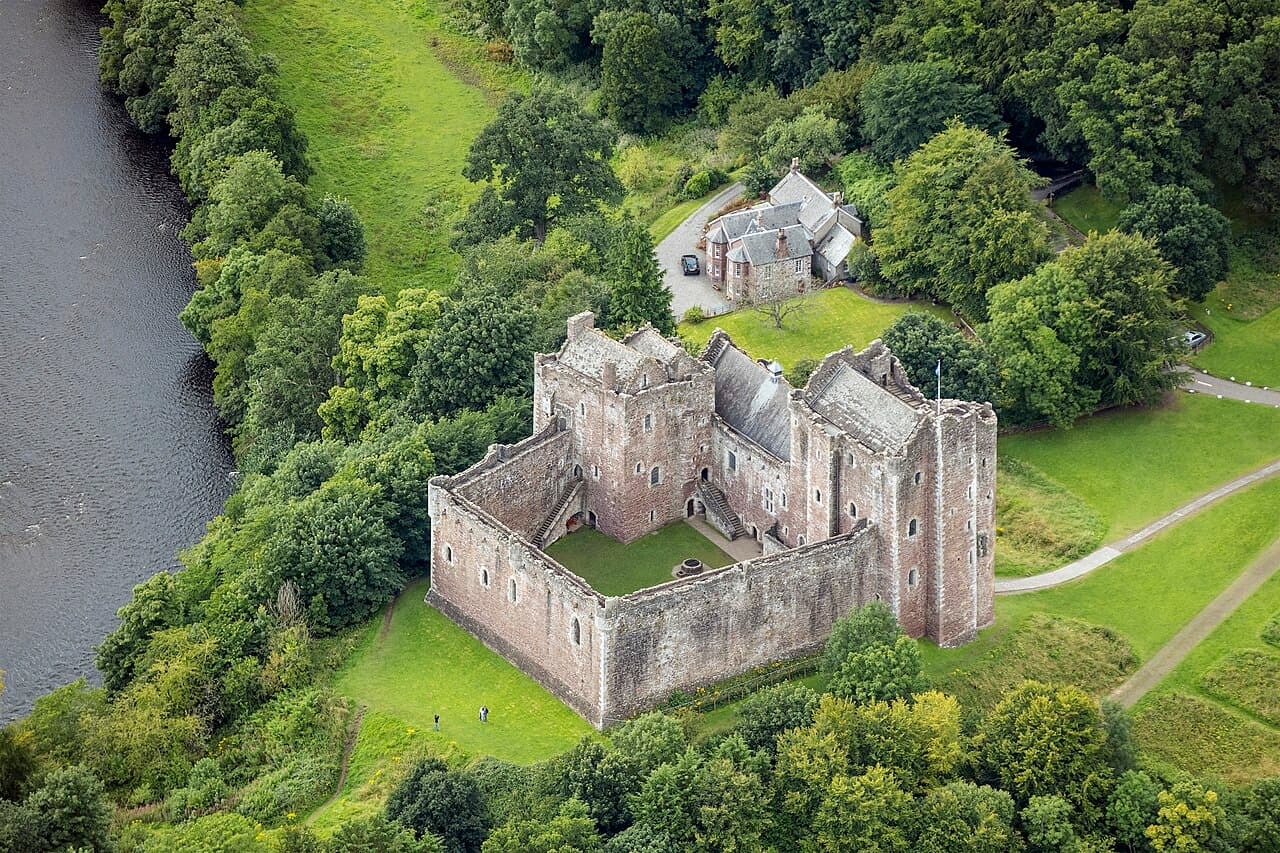
Doune Castle
Doune Castle stands as a remarkable example of a late medieval hill castle in central Scotland, near the village of Doune in the Stirling district. This imposing fortress is strategically positioned on a wooded bend where the Ardoch Burn meets the River Teith, a location that has been of defensive importance since ancient times. The castle’s name derives from the Gaelic word “dün,” meaning "fort," reflecting its long-standing role as a fortified site.
The origins of Doune Castle trace back to the 13th century, when an initial medieval fortress was constructed on this site. However, this early structure likely suffered significant damage during the Scottish Wars of Independence in the late 13th and early 14th centuries. The castle’s present form was established in the late 14th century under the direction of Robert Stewart, Duke of Albany (c. 1340–1420), who was the son of King Robert II of Scotland and served as the Regent of Scotland from 1388 until his death. Duke Albany’s vision transformed Doune into a stronghold that combined residential comfort with formidable military defenses, reflecting the architectural ideals of a royal castle of the period.
Historical significance and royal connections
Following the execution of Albany’s son, Murdoch Stewart, in 1425, Doune Castle reverted to direct crown ownership. It was subsequently used as a royal hunting lodge and a dower house for widowed queens such as Mary of Guelders, Margaret of Denmark, and Margaret Tudor. These queens were consorts to kings James II, James III, and James IV, respectively, linking the castle intimately to the Scottish royal household and its domestic sphere.
In the late 16th century, the castle became the property of the Earls of Moray through marriage alliances, marking a shift from royal to noble ownership. The Moray family maintained the castle for several centuries, during which time Doune witnessed military action in key historical conflicts. It played roles in the Wars of the Three Kingdoms in the mid-17th century and Glencairn’s rising of 1654. Furthermore, the castle was involved in the Jacobite risings of 1689, 1715, and 1745. Notably, during the 1745 uprising, Bonnie Prince Charlie occupied Doune Castle and used it as a prison for captured government soldiers, underscoring its continued strategic importance.
Architectural features and layout
Site and defensive structures
Doune Castle occupies a naturally defensible position on a promontory near the confluence of two watercourses. Its layout forms an irregular pentagon, with buildings arranged primarily along the north and northwest sides, enclosing a central courtyard. The castle’s walls are constructed from coursed sandstone rubble, with lighter Ballengeich stone used for door and window dressings, providing both strength and aesthetic contrast.
The main entrance is located on the north side and accessed through a vaulted, cobbled passage approximately 14 meters long beneath the principal tower, known as the Lord’s tower. This tower measures roughly 18 by 13 meters in footprint and rises to about 29 meters in height, making it a dominant feature of the castle’s silhouette. A round tower projects from the northeast corner near the entrance, enhancing the defensive capabilities of the gatehouse.
Interior spaces and residential quarters
Inside the Lord’s tower, the first floor contains the Lord’s Hall, notable for its vaulted ceilings and two fireplaces, which provided warmth and comfort. The upper chambers include the Duchess’ suite, featuring a small oratory with a piscina (a basin for draining water used in religious ceremonies) and a credence niche for sacred vessels, indicating the importance of private devotional space within the residence.
The entrance passage is heavily fortified, protected by two sets of timber doors and a surviving iron grille called a yett. Guardrooms flank this passage and are equipped with gunloops for defense, illustrating the castle’s military preparedness. Access to the Lord’s Hall is indirect, requiring visitors to use an enclosed stair from the courtyard rather than entering directly from the ground floor passage.
The Great Hall, situated west of the Lord’s tower, measures approximately 20 by 8 meters with a timber roof about 12 meters high, replaced during the 19th-century restoration. This hall lacks a fireplace and was likely heated by a central hearth vented through a louvre in the roof. Large windows provide ample natural light, and stairs connect the hall to three cellars below.
The Great Hall links to the kitchen tower via two large elliptical-arched serving hatches, an unusual architectural feature for the period. The kitchen itself is vaulted, measuring about 17 by 8 meters, and contains a large fireplace 5.5 meters wide alongside an oven. This kitchen is considered one of the best-equipped medieval kitchens in Scotland, reflecting the castle’s status and the importance of hospitality.
A stair turret added in 1581 leads from the kitchen lobby to two floors of guest rooms, including the Royal Apartments. These apartments comprise two bedrooms and an audience chamber designed to accommodate royal visitors, underscoring the castle’s role as a noble residence and royal retreat.
Curtain walls and defensive features
The curtain wall surrounding the castle is approximately 2 meters thick and rises to about 12 meters in height. It features a parapet walkway, open round turrets at the corners, and semicircular projections along the walls, all designed to enhance defense. A machicolated square turret above the postern gate on the west side allowed defenders to drop objects or pour boiling liquids on attackers below, a classic medieval defensive feature.
Architectural evidence such as projecting stones called “tuskings” and four pointed-arch windows in the south curtain wall suggest plans for additional buildings that were never completed. A large window on the east side may have been intended for a chapel dedicated to Saint Fillan, although no foundations for such a chapel survive.
Restoration and modern preservation
By 1800, Doune Castle had fallen into ruin, losing its roof and much of its internal structure. Restoration efforts began in the 1880s under George Stuart, 14th Earl of Moray, who replaced timber roofs, floors, and interior fittings, preserving the castle’s architectural integrity and making it accessible to visitors. The restoration included the installation of 19th-century floor tiles and timber paneling, as well as the addition of a minstrels’ gallery in the Lord’s Hall.
In 1984, Douglas Stuart, the 20th Earl of Moray, donated Doune Castle to Historic Environment Scotland, ensuring its protection as a Scheduled Ancient Monument and a Category A listed building. Today, the castle is well-preserved and open to the public, offering a vivid glimpse into Scotland’s medieval past and its evolution through centuries of political and social change.
The castle grounds include surrounding woodlands and parkland along the rivers. A footbridge constructed in 2022 from local larch timber connects the castle to an old mill site nearby, integrating the historic environment with its natural landscape setting.
Cultural significance and popular media
Doune Castle is renowned not only for its historical and architectural importance but also for its prominent role in film and television. The castle’s striking appearance and well-preserved medieval features have made it a popular filming location. It famously appeared in the 1975 comedy classic Monty Python and the Holy Grail, where it served as several different castles in the film’s narrative.
Earlier, in 1952, Doune Castle featured in the MGM film Ivanhoe, starring Elizabeth Taylor. More recently, it has appeared as the exterior of Winterfell in the first season of the acclaimed TV series Game of Thrones. The castle also played a significant role in the TV adaptation of Outlander, representing Castle Leoch in nearly half of the first season’s episodes.
These appearances have enhanced Doune Castle’s profile as a cultural landmark, attracting visitors worldwide who are drawn by its cinematic legacy as well as its authentic medieval atmosphere.
Visitor experience and access
Visitors to Doune Castle can explore its impressive gatehouse with its original iron gate and drawbar, the great hall with its distinctive central hearth and minstrels’ gallery, and the well-equipped kitchen tower. The castle’s layout allows for a comprehensive understanding of medieval castle life, combining defensive structures with residential and ceremonial spaces.
Managed by Historic Environment Scotland, the castle offers guided tours and informative displays that illuminate its rich history and architectural features. Its location near Stirling makes it accessible for day trips, and the surrounding natural landscape provides scenic walking routes.
Frequently asked questions (FAQ)
- When was Doune Castle originally built and who rebuilt it?
- Doune Castle was originally built in the 13th century and was rebuilt in its present form in the late 14th century by Robert Stewart, Duke of Albany.
- What are the main architectural features of Doune Castle?
- Key features include the 29-meter tall Lord's tower, a vaulted great hall with a central hearth, a well-equipped kitchen tower, and a thick curtain wall with machicolations.
- Can visitors see the castle’s interior and what can they expect?
- Yes, visitors can explore the gatehouse, great hall, kitchen tower, and residential chambers, including the Duchess’ suite and Royal Apartments, with guided tours available.
- What is the significance of Doune Castle in film and television?
- Doune Castle is famous for its appearances in Monty Python and the Holy Grail, Game of Thrones, Outlander, and the 1952 film Ivanhoe, making it a popular cultural landmark.
- How is Doune Castle preserved today and who manages it?
- Doune Castle is well-preserved and managed by Historic Environment Scotland, which maintains it as a Scheduled Ancient Monument and Category A listed building.
- Is Doune Castle accessible for visitors and what facilities are available?
- The castle is open to the public with visitor facilities including guided tours, informative displays, and scenic walking routes in the surrounding parkland.
Photo gallery

Information
Featured in
Articles on the Castlopedia blog that feature Doune Castle.
Sources & official resources
Verify the information above using these authoritative references.
Loading map...
Visitor reviews
No reviews yet. Been here? Write the first review and help other travelers!
Write the first reviewVisited this castle? Share your experience
Your review helps other travelers and adds first-hand knowledge to our encyclopedia.



