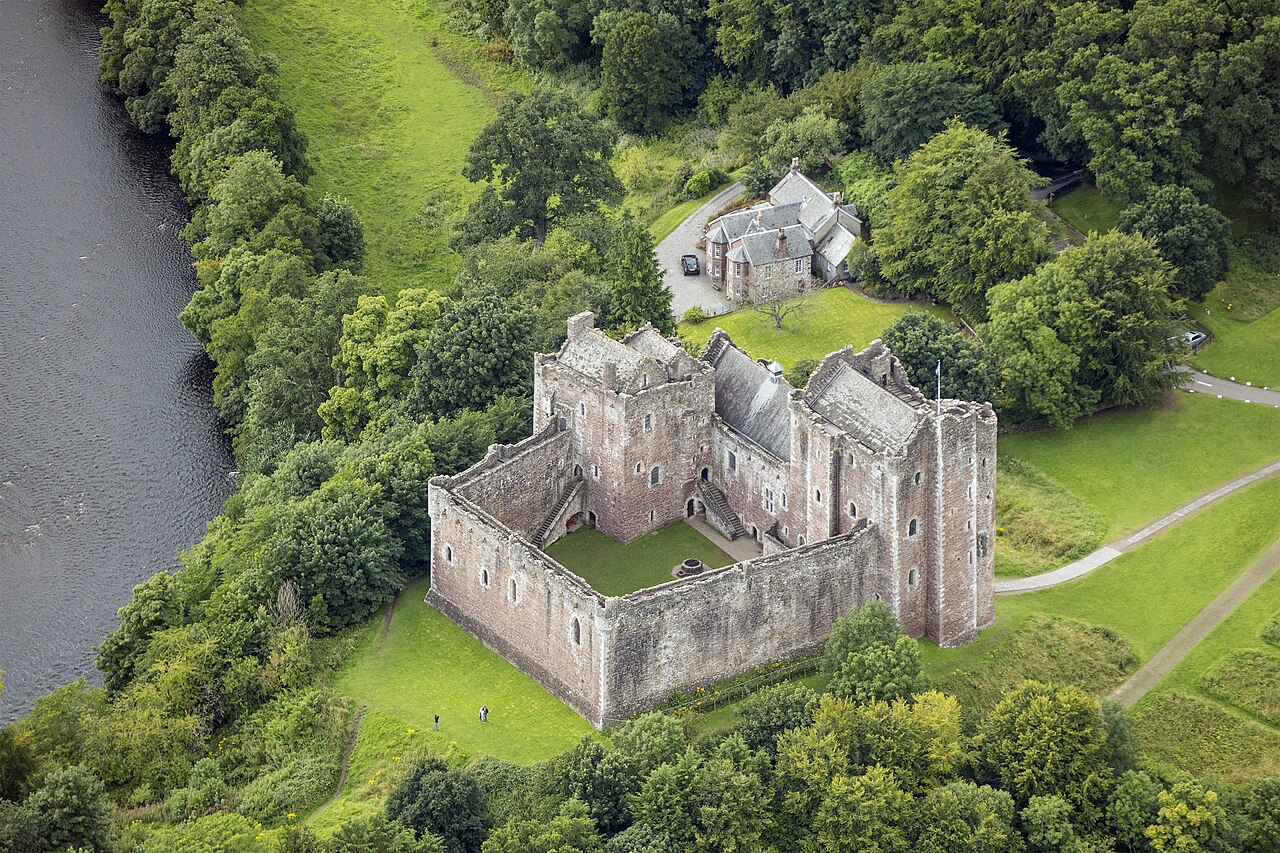
Kilbryde Castle
Kilbryde Castle stands as a notable example of a late medieval Scottish castle with significant architectural evolution reflecting centuries of Scottish history. Originally constructed in 1460 by the Earl of Menteith, this castle is located near the town of Doune in Scotland. Its design and subsequent remodels embody the distinctive Scots baronial style, which blends medieval defensive features with Renaissance and Victorian-era romanticism.
Historical origins and early significance
The castle's foundation in the 15th century places it firmly within the late medieval period, a time when Scotland was marked by clan conflicts and the need for fortified residences. Built by the Earl of Menteith, Kilbryde Castle served both as a stronghold and a noble family seat. The castle's position near Doune, a strategic location in central Scotland, allowed it to play a role in local power dynamics during turbulent times.
Architectural features of the original castle
The initial structure of Kilbryde Castle was typical of late medieval Scottish castles, with defensive elements such as thick stone walls, battlements, and narrow windows designed for protection. The castle was castellated, featuring battlemented parapets that gave it a fortified appearance. Its layout likely included a central keep or tower house, surrounded by ancillary buildings and courtyards, although detailed records of the original plan are limited.
The Scots baronial style influence
While the castle's origins are medieval, its current appearance owes much to the Scots baronial style, a revivalist architectural movement that emerged in the 19th century. This style is characterized by features such as turrets, crow-stepped gables, and decorative stonework, which evoke the romanticized image of Scottish castles. Kilbryde Castle's castellated silhouette and ornamental details reflect this style, blending historical authenticity with Victorian tastes.
19th century remodeling and restoration
In 1877, Kilbryde Castle suffered a significant structural setback when its roof collapsed. This event prompted a major remodeling effort led by the Scottish architect Thomas Heiton. Heiton's work in the late 1870s restored and enhanced the castle, shaping it into the form recognizable today. His approach balanced preservation of the historic fabric with the introduction of modern Victorian elements, reinforcing the castle's status as a stately home rather than a purely defensive fortress.
Architectural modifications by Thomas Heiton
Heiton's remodeling included rebuilding the roof with improved structural techniques and adding features typical of the Scots baronial revival. The incorporation of turrets, decorative stone chimneys, and enlarged windows allowed more light into the interiors, adapting the castle for comfortable living. These changes reflected broader 19th-century trends where castles were transformed into romantic residences celebrating Scotland's medieval heritage.
20th century refurbishments and current status
Further refurbishments took place in the 1950s, focusing on modernization and maintenance to preserve the castle's integrity. These works ensured Kilbryde Castle remained a livable family home while retaining its historic character. The castle continues to be privately owned by Sir James and Lady Carola Campbell, descendants of the family that acquired it in 1659.
Gardens and public access
The castle is surrounded by extensive gardens that reflect traditional Scottish landscaping styles. These gardens are notable for their design and seasonal variety, offering visitors a glimpse into the estate's natural beauty. While the castle itself remains a private residence, the gardens are open to the public on selected days or by appointment, allowing visitors to experience part of the castle's heritage.
Architectural and cultural significance
Kilbryde Castle exemplifies the evolution of Scottish castle architecture from a defensive medieval stronghold to a romantic Victorian residence. Its Scots baronial style features have influenced many other Scottish country houses and castles. The castle's continuous occupation by the Campbell family for over three centuries adds to its cultural importance, linking it to Scotland's noble lineage and regional history.
Today, Kilbryde Castle remains an important heritage site that illustrates the layers of Scottish history through its architecture and landscape. Its preservation and selective public access contribute to the appreciation of Scotland's architectural traditions and aristocratic past.
Frequently asked questions (FAQ)
- What is the best time to visit Kilbryde Castle gardens?
- The best time to visit Kilbryde Castle gardens is during the spring and summer months when the plants and flowers are in full bloom. The gardens are open on selected days or by appointment, so it is advisable to check in advance for visiting opportunities.
- Can I tour the interior of Kilbryde Castle?
- Kilbryde Castle is a private residence and is not generally open to the public for interior tours. However, visitors can enjoy the extensive gardens on designated days or by appointment.
- Who was the architect responsible for the 19th-century remodeling of Kilbryde Castle?
- The 19th-century remodeling of Kilbryde Castle was carried out by the Scottish architect Thomas Heiton in the late 1870s after the roof collapse in 1877.
- What architectural style characterizes Kilbryde Castle?
- Kilbryde Castle is characterized by the Scots baronial style, a romantic revival style featuring turrets, battlements, and decorative stonework that evoke medieval Scottish castles.
- Is Kilbryde Castle accessible for visitors with mobility issues?
- As Kilbryde Castle is a private residence with limited public access primarily to the gardens, accessibility may vary. Visitors with mobility issues should contact the estate in advance to inquire about accommodations.
Information
Current owner
Sir James and Lady Carola Campbell
Loading map...
Visitor reviews
No reviews yet. Been here? Write the first review and help other travelers!
Write the first reviewVisited this castle? Share your experience
Your review helps other travelers and adds first-hand knowledge to our encyclopedia.