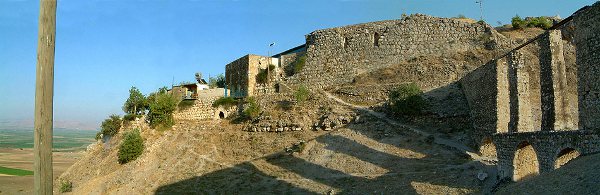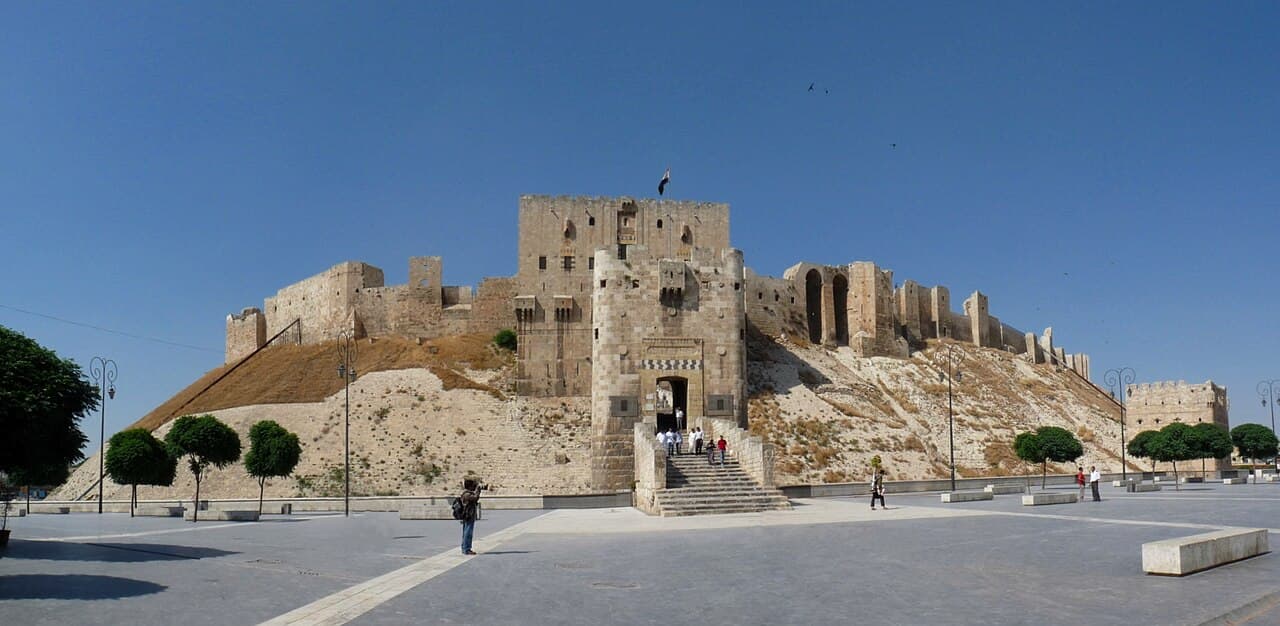
Aleppo Citadel
Aleppo Citadel is one of the oldest and most historically significant fortresses in the world, located on a prominent hilltop in the heart of Aleppo, northern Syria. This hill castle has been continuously occupied and developed for over five millennia, showcasing a remarkable layering of architectural styles and cultural influences from various civilizations. Its strategic position atop an elliptical mound roughly 50 meters above the old city provided a commanding vantage point and formidable defense throughout its long history.
The earliest known use of the site dates back to the mid-3rd millennium BCE, when it served as a sacred precinct featuring a temple dedicated to the ancient storm god Hadad. Archaeological evidence and cuneiform tablets from nearby ancient cities like Ebla and Mari confirm this religious significance. Over time, the site evolved from a religious sanctuary into a fortified acropolis, particularly during the Hellenistic period under the reign of Seleucus I Nicator in the 4th to 3rd centuries BCE. Seleucus established the city as "Beroea" and enhanced its military importance by strengthening fortifications.
Historical evolution and strategic importance
Ancient origins and classical antiquity
The hill initially hosted a temple complex dedicated to Hadad, marking the site's earliest known function. During the Hellenistic era, significant fortifications and urban planning were implemented, including colonnaded streets leading to the citadel entrance. The city's location at a crossroads of trade and military routes made it a coveted stronghold for successive empires.
Roman and Byzantine periods
In 64 BCE, Aleppo was annexed by the Roman Republic under Pompey. The city flourished under Roman and later Byzantine rule. Roman Emperor Julian visited the temple of Zeus within the citadel in 363 CE, highlighting its religious and cultural prominence. Byzantine influence is evident in the conversion of two churches inside the citadel into mosques during Islamic rule, although few Byzantine structures survive today.
Early Islamic and Hamdanid era
Following the Muslim conquest in 636 CE, the citadel was repaired after a major earthquake. The Umayyad and Abbasid caliphates maintained Aleppo as a frontier post. The Hamdanid dynasty, especially under Sayf al-Dawla from 944 CE, made Aleppo their capital and fortified the citadel amid ongoing conflicts with the Byzantines. The citadel served as a royal residence and military base during this period.
The citadel during the Crusades and Ayyubid dynasty
Zengid dynasty and Crusader conflicts
In the 12th century, the Zengid rulers, including Imad ad-Din Zengi and Nur ad-Din, reinforced the citadel to resist Crusader attacks. It also functioned as a prison for notable Crusader leaders such as Joscelin II, Raynald of Châtillon, and Baldwin II. Nur ad-Din undertook major renovations, including rebuilding the entrance ramp with brick walls, constructing a new palace, and restoring mosques within the fortress.
Ayyubid reconstruction under al-Zahir Ghazi
Al-Zahir Ghazi, son of Saladin, ruled from 1193 to 1215 and is credited with extensive reconstruction that shaped much of the citadel's current form. He fortified the rock slopes, replaced earthen entrance ramps with stone cladding, and built a monumental vaulted stone bridge over the deep defensive moat. The entrance complex was designed with multiple sharp right-angle turns to slow attackers, featuring machicolations for pouring boiling liquids. The citadel expanded into a palatial city with residential quarters, mosques, military facilities, and administrative buildings.
Mamluk and Ottoman periods
Mamluk restorations and additions
The Mongol invasions of 1260 and Timur's campaigns around 1400 caused severe damage. Mamluk rulers, especially Sultan Al-Ashraf Khalil and Sayf al-Din Jakam, restored the citadel by rebuilding towers, constructing a new palace atop the entrance tower, and enhancing the Throne Hall with a nine-domed roof. These works underscored the citadel's ongoing military and administrative role.
Decline during Ottoman rule
After the Ottoman conquest in 1516, the citadel's military importance declined as Aleppo expanded beyond its walls. It served mainly as a barracks. Repairs by Sultan Suleiman the Magnificent in 1521 and Sultan Abdülmecid I in the 19th century helped maintain the structure. The 1822 earthquake caused major damage, after which use diminished. The Ottomans added a windmill and barracks constructed from salvaged stones.
Modern history and conservation efforts
20th-century excavations and restorations
During the French Mandate (1920-1945), archaeological excavations and restorations focused on the outer walls and the Mamluk Throne Hall. In 1980, a modern amphitheater seating around 3,000 was built for cultural events, adding a contemporary layer to the site.
Damage and restoration during recent conflicts
The Syrian Civil War caused further damage, including shelling of the external gate in 2012 and a bomb explosion beneath the walls in 2015. The fortress was used militarily by the Syrian Army, with ancient arrow slits adapted for modern sniper use. The devastating 2023 earthquake inflicted extensive structural harm. Restoration has focused on key areas such as the southern forward tower, entrance, minaret of the Great Ayyubid Mosque, and the Throne Hall façade. The citadel reopened to the public in February 2024 but was recaptured by rebel forces in November during the Second Battle of Aleppo.
Architectural features and layout
Defensive structures and entrance complex
The citadel is surrounded by a broad defensive moat approximately 22 meters deep and 30 meters wide, constructed in the 12th century. The monumental vaulted stone bridge built by al-Zahir al-Ghazi spans this moat, leading to a complex entrance passage with multiple sharp right-angle turns and sloping vaulted ramps. Defensive machicolations allowed defenders to repel attackers effectively. The entrance gate is decorated with carved reliefs of intertwined dragons and imposing lion statues symbolizing strength and protection.
Internal buildings and palatial complexes
Inside, the Ayyubid Palace or "Palace of Glory" features a four-iwan courtyard, a hallmark of Islamic architecture, with vaulted halls opening onto a central courtyard. The palace included a hammam with separate rooms for resting, warm bathing, and hot steam, heated by an ingenious system of earthenware pipes. The Mamluk Throne Hall is a large rectangular chamber used for official ceremonies, notable for its ornate ceiling and central water fountain characteristic of the Ayyubid period.
Religious sites and water systems
The citadel houses two mosques, the Great Mosque and the Mosque of Abraham, both originally Byzantine churches converted for Islamic worship. The Mosque of Abraham once contained a finely carved wooden mihrab donated by Nur ad-Din, now lost. Wells such as the deep Satura well from the Ayyubid period and an older Hellenistic well nearly 125 meters deep provided essential water supply. A network of underground passageways connects various parts of the fortress, allowing discreet movement and access to water.
Military architecture and additional structures
Defensive towers encircle the fortress, including the outer gate tower built in 1211 and restored in the 16th century. The citadel's design incorporates multiple gates, secret passageways, and strategically placed battlements. The Ottoman period added barracks and a windmill, reflecting changing functional needs. The modern amphitheater added in 1980 serves as a cultural venue, blending ancient heritage with contemporary use.
Aleppo Citadel remains a symbol of the city's resilience and rich history. Despite centuries of war, natural disasters, and rebuilding, it stands as a monumental record of the military, religious, and social life of northern Syria through millennia.
Frequently asked questions (FAQ)
- When was Aleppo Citadel originally built?
- The site of Aleppo Citadel has been in use since the mid-3rd millennium BCE, initially as a temple complex before evolving into a fortified castle.
- What architectural styles are visible at Aleppo Citadel?
- Aleppo Citadel displays a mixture of architectural styles including Hellenistic, Roman, Byzantine, Islamic Ayyubid, Mamluk, and Ottoman influences.
- Can visitors explore the interior of Aleppo Citadel?
- Yes, visitors can explore the interior, including palatial halls, mosques, towers, and the defensive moat, although some areas may be restricted due to ongoing restoration.
- How has the Syrian Civil War affected Aleppo Citadel?
- The citadel sustained damage from shelling and bombings during the Syrian Civil War, with restoration efforts ongoing to repair and preserve the historic site.
- What are the main defensive features of Aleppo Citadel?
- Key defensive features include a deep moat, a vaulted stone bridge entrance with sharp turns, machicolations for pouring boiling liquids, and fortified towers.
Photo gallery

Information
Opening hours
09:00-17:00, daily
Ticket prices
Small fee
Current owner
State museum
Website
Visit websiteAddress
Hawl al Qalaa Street, Aleppo, Syrian Arab Republic
Featured in
Articles on the Castlopedia blog that feature Aleppo Citadel.
Sources & official resources
Verify the information above using these authoritative references.
Loading map...
Visitor reviews
No reviews yet. Been here? Write the first review and help other travelers!
Write the first reviewVisited this castle? Share your experience
Your review helps other travelers and adds first-hand knowledge to our encyclopedia.