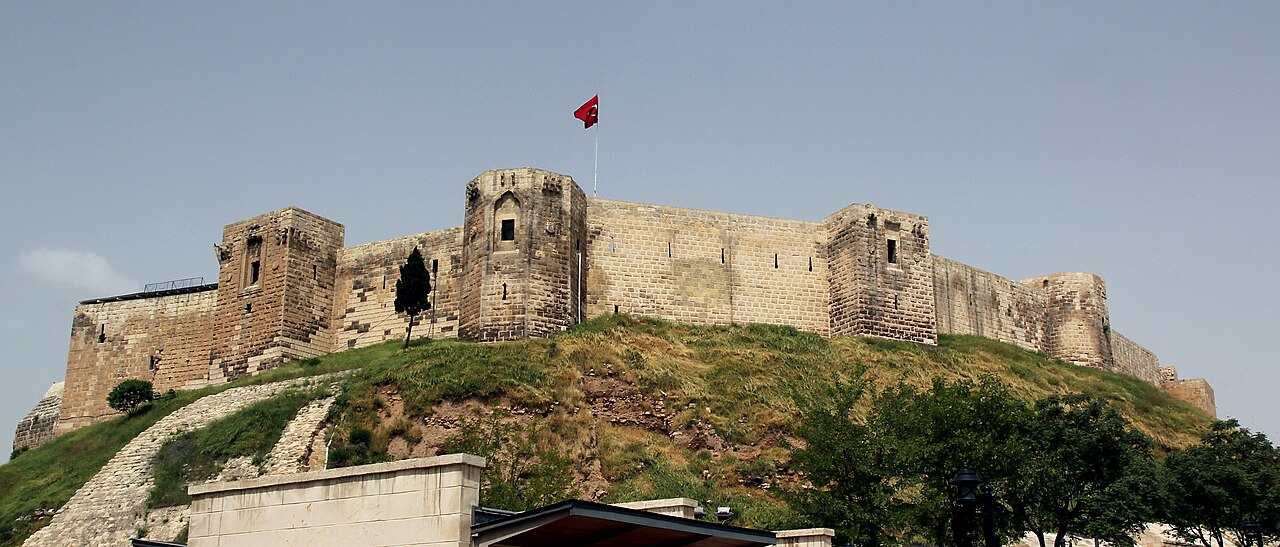
Ravanda Castle
Ravanda Castle, known locally as Ravanda Kalesi and historically as Ravendel, is a notable fortress situated on a high, conical hill west of the village of Belenözü in the province of Kilis, Turkey. Its strategic location overlooking a bend in the Afrin River valley has made it a significant military site through various historical periods, particularly during the medieval era. The castle's origins are somewhat obscure, but the site itself has a long history of occupation, possibly dating back to the Hittite civilization.
Geographical and strategic significance
The castle stands on a hill with a flat summit, providing commanding views of the surrounding landscape, which was crucial for controlling the road between the ancient cities of Antioch and Edessa. This route was a vital corridor for trade and military movements in the region. The hilltop location also allowed for natural defense, with steep slopes making direct assault difficult.
Historical background and ownership transitions
Early medieval period and first recorded mentions
While the exact construction date of Ravanda Castle is uncertain, it is generally attributed to the 7th century, during a time when the Taurus Mountains formed a natural boundary between the Byzantine Empire and emerging Islamic states. However, the castle itself is not mentioned in contemporary records from that period, suggesting it may not have existed or was not significant at that time.
The first explicit historical reference to Ravanda Castle dates to 1097, during the First Crusade. At that time, it was controlled by the Seljuks and served as a defensive post guarding the route between Antioch and Edessa. The castle was captured by Baldwin of Boulogne, who would soon become Baldwin I, King of Jerusalem. Following its capture, Ravanda was incorporated into the newly formed County of Edessa, one of the Crusader states established in the region.
Crusader and armenian control
Throughout the 12th century, Ravanda Castle changed hands between Crusader and Armenian rulers. The castle's strategic importance made it a contested site during the turbulent period of the Crusades. In 1144, the County of Edessa fell to the Seljuks under the leadership of the Turkmen atabeg Imad al-Din Zengi. Although Zengi did not claim Ravanda itself, the castle subsequently fell into neglect.
Due to the Crusaders' inability to maintain control over the region, the castle was sold to the Byzantine Empire. However, in 1151, the castle was retaken by Nur ad-Din, Emir of Aleppo, returning it to Seljuk control. Later, in 1176, the castle was captured by Saladin, the Ayyubid Sultan, during his campaigns in Seljuk Syria. Saladin undertook repairs and fortifications, enhancing the castle's defenses.
Ayyubid, mongol, mamluk, and ottoman periods
The Ayyubid dynasty maintained control of Ravanda Castle until 1261, when the Mongols expanded into the region. Shortly thereafter, around 1268, the castle was seized by the Mamluks, who also invested in its repair and fortification. Their efforts reflected the castle's continued military relevance during this period.
In the early 16th century, the Ottoman Empire under Sultan Selim I conquered the Mamluk Sultanate, bringing Ravanda Castle under Ottoman rule. However, the castle's strategic importance diminished under the Ottomans, leading to its gradual decline and eventual ruin over the following centuries.
Architectural features and current condition
Today, what remains of Ravanda Castle primarily consists of the inner castle situated atop the hill. The original defensive circuit wall that once surrounded the base of the hill has disappeared, likely due to centuries of neglect and natural erosion.
The castle's layout takes advantage of the natural topography, with the flat summit providing space for the main structures and defensive installations. Visitors can observe remnants of cisterns and collapsed underground chambers, indicating sophisticated water storage and possibly refuge areas within the fortress.
Visiting ravanda castle
Ravanda Castle is freely accessible to visitors, though it remains off the main tourist routes, offering a sense of isolation and historical ambiance. The site provides excellent views of the surrounding countryside, making it a rewarding destination for those interested in medieval military architecture and history.
Visitors should exercise caution due to numerous holes and collapsed underground spaces, which are remnants of the castle's ancient cisterns and subterranean chambers. The remote location and rugged terrain add to the adventurous experience of exploring this lesser-known fortress.
Frequently asked questions (FAQ)
- How do I get to Ravanda Castle?
- Ravanda Castle is located west of Belenözü, Turkey, and can be accessed by car or public transportation. There are local buses that connect Belenözü to nearby towns, and from there, you can take a short taxi ride to the castle.
- What is the historical significance of Ravanda Castle?
- Ravanda Castle dates back to the Byzantine era and has been a strategic military site due to its location overlooking the surrounding plains. It played a vital role in the region's defense and has witnessed various historical events throughout the centuries.
- When was Ravanda Castle built?
- The construction of Ravanda Castle is believed to have begun in the 6th century AD during the Byzantine period. Over the years, it underwent several renovations and expansions, reflecting the architectural styles of different eras.
- Can I visit Ravanda Castle year-round?
- Yes, Ravanda Castle is open to visitors throughout the year. However, it is advisable to check local weather conditions and accessibility, as winter weather may affect access to the site.
- Why is Ravanda Castle famous for its architecture?
- Ravanda Castle is renowned for its well-preserved fortifications and unique architectural features, including massive stone walls and intricate battlements. The castle's design reflects the military needs of its time while showcasing the artistry of Byzantine architecture.
- Is it possible to take guided tours of Ravanda Castle?
- Yes, guided tours are available at Ravanda Castle, providing visitors with in-depth knowledge of its history and architecture. Tours are typically offered by local guides who are knowledgeable about the castle's significance and can enhance your visit.
- What are the opening hours of Ravanda Castle?
- Ravanda Castle is generally open from 9 AM to 5 PM, though hours may vary during holidays or special events. It's best to check in advance to ensure you have the most current information before your visit.
- What are the ticket prices for Ravanda Castle?
- Ticket prices for Ravanda Castle are quite affordable, with discounts available for students and seniors. Entry fees usually cover access to the castle grounds and any available guided tours.
- What nearby attractions can I visit while at Ravanda Castle?
- While visiting Ravanda Castle, you can explore nearby attractions such as the scenic landscapes of Belenözü and historical sites in the surrounding region. Additionally, local markets and traditional Turkish cuisine can enhance your experience in the area.
Loading map...
Visitor reviews
No reviews yet. Been here? Write the first review and help other travelers!
Write the first reviewVisited this castle? Share your experience
Your review helps other travelers and adds first-hand knowledge to our encyclopedia.