Warwick Castle
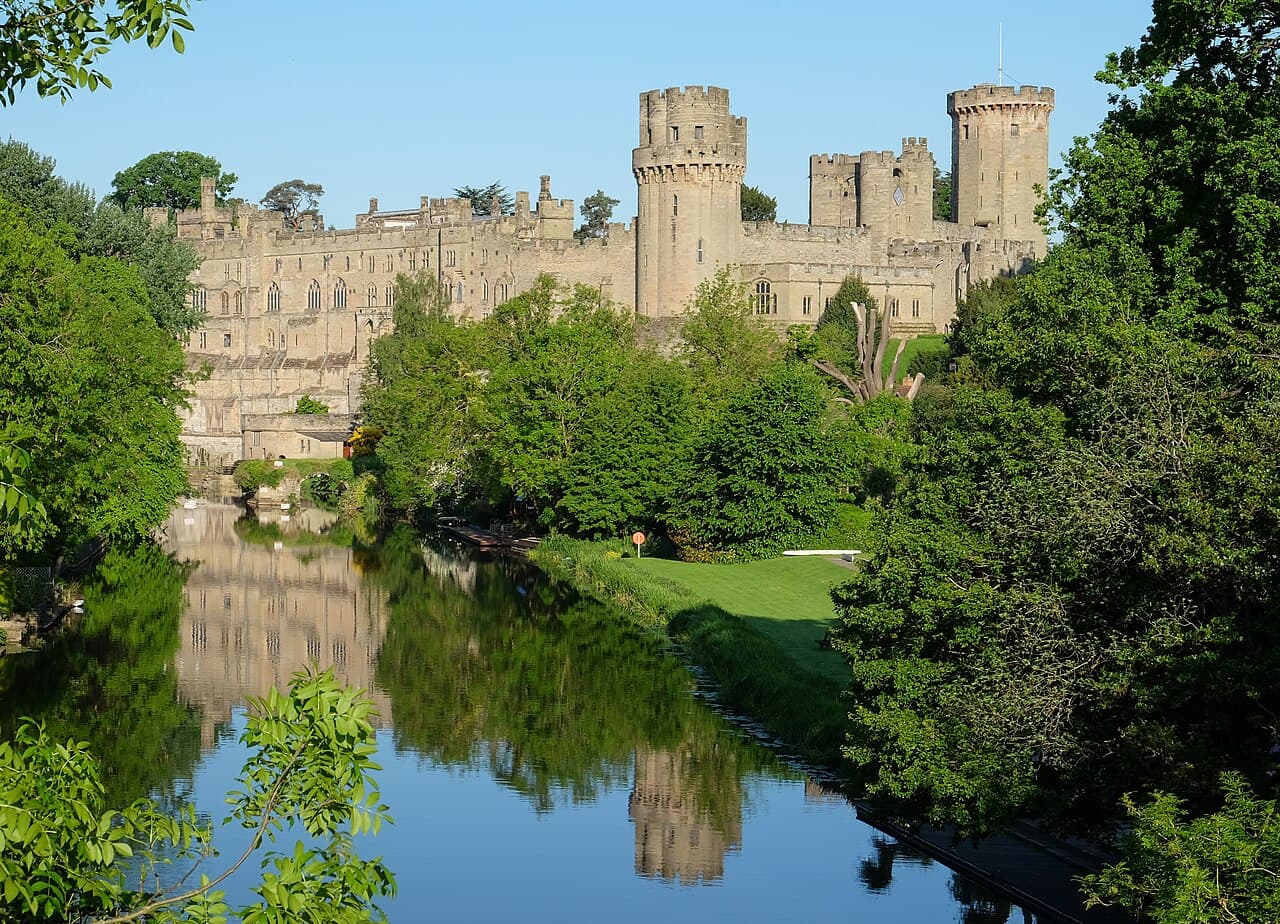
Warwick Castle stands as one of England's most iconic medieval fortresses, located in the historic town of Warwick within the region of England. Founded in 1068 by William the Conqueror, this hill castle was originally constructed as a wooden motte-and-bailey fortress on a sandstone bluff overlooking the River Avon. Its strategic position on a natural rock promontory provided formidable natural defenses, complemented by man-made fortifications that evolved over centuries.
The castle's initial wooden structures were replaced with stone under the reign of King Henry II in the 12th century, marking the transition to a more durable and imposing fortress. This stone castle followed a shell keep design, with buildings constructed against a surrounding curtain wall enclosing a roughly 130 by 82 meters perimeter. The castle features a dry moat on its north side and two principal entrances fortified by gatehouses and towers.
Medieval origins and architectural evolution
The establishment of Warwick Castle was part of William the Conqueror's efforts to secure his newly acquired kingdom after the Norman Conquest. Built on land seized from a nearby Saxon monastery, the castle initially served as a military stronghold and administrative center. Its early wooden motte-and-bailey form was typical of Norman military architecture, designed for rapid construction and defense.
During the 12th century, the wooden keep was replaced with stonework, reflecting the castle's growing importance and the need for stronger defenses. The castle's curtain walls and towers were expanded and reinforced, including the addition of the shell polygon fence around the motte. Though only fragments of this fence remain today, they are incorporated into later reconstructions.
14th-century fortifications and the beauchamp era
The castle reached its architectural zenith in the 14th century during the ownership of the Beauchamp family. This period saw the construction of many of the castle's most distinctive features, including the massive gatehouse flanked by the Bear and Clarence Towers, and the imposing Guy's Tower, which rises to 39.4 meters (128 feet). The gatehouse was equipped with defensive mechanisms such as murder holes, drawbridges, and portcullises, designed to repel attackers.
Another notable addition is Caesar's Tower, a 45.2-meter (147-foot) tall polygonal tower with six storeys, featuring machicolations and stone vaulting on every floor. This tower housed a basement dungeon known as the Poitiers Tower, reputed to have held prisoners captured at the Battle of Poitiers during the Hundred Years War. The castle's curtain walls were complemented by smaller flanking towers, creating a formidable defensive enclosure.
Historical significance and notable events
Warwick Castle served as the residence and military base for the Earls of Warwick, a title held by several influential families including the Beaumonts and the Beauchamps. In the 15th century, it was owned by Richard Neville, the 'Kingmaker', who played a pivotal role in the Wars of the Roses. The castle famously held King Edward IV prisoner in 1469 during the conflict.
The castle also played a role in other major conflicts such as the Barons' Wars and the English Civil Wars. During the Civil War, it was fortified and successfully withstood a Royalist siege in 1642 under the command of Robert Greville, a Parliamentarian commander.
Transition to a stately home
By the late 16th century, Warwick Castle's military importance declined. In 1604, it was granted to Sir Fulke Greville, who transformed the fortress into a grand country house. The Greville family maintained ownership for several centuries, investing in renovations that enhanced the castle's residential and aesthetic qualities.
Architectural features and interior design
The castle's interior includes a Great Hall, library, bedrooms, and a chapel with Gothic-style interiors attributed to Daniel Garrett. The chapel and other interiors were extensively remodeled in the 18th century to reflect contemporary tastes, including the addition of a wooden Gothic bridge over the river designed by the renowned landscape architect Lancelot 'Capability' Brown.
The castle grounds feature formal gardens first recorded in 1534, later redesigned by Brown in a naturalistic style with serpentine drives and clusters of trees, blending the castle with its riverside setting. A watermill, once located near the east wall, was converted to generate electricity before being dismantled in the mid-20th century.
Damage and restoration
A major fire in 1871 devastated the interior of the Great Hall and private apartments, though the main structure remained intact. Restoration was undertaken by Anthony Salvin between 1872 and 1875, preserving the castle's historic fabric while restoring its grandeur.
Modern attractions and preservation status
Today, Warwick Castle is a popular tourist destination attracting over half a million visitors annually. It features one of the world's largest working trebuchets, an 18-meter tall siege engine capable of launching 150-kilogram projectiles up to 300 meters, located near the riverbank.
The castle is protected as a Scheduled Ancient Monument and a Grade I listed building, reflecting its outstanding historical and architectural significance. Its combination of medieval military architecture, later residential enhancements, and extensive grounds make Warwick Castle a unique example of English heritage.
Visitors today can explore the castle's extensive curtain walls, gatehouses, towers, and dungeons, as well as the beautifully landscaped gardens and parkland designed by Capability Brown. The castle's rich history, architectural grandeur, and scenic location continue to captivate historians, architects, and tourists alike.
Frequently asked questions (FAQ)
- How do I get to Warwick Castle?
- Warwick Castle is easily accessible by car and public transport. If you're driving, it's located just off the M40 motorway, with parking available on-site. Alternatively, you can take a train to Warwick station, which is a short walk from the castle.
- What is the historical significance of Warwick Castle?
- Warwick Castle has a rich history dating back to the 11th century, originally built by William the Conqueror. It has played a pivotal role in English history, serving as a royal residence and a military stronghold. Today, it stands as a testament to medieval architecture and history.
- When was Warwick Castle built?
- Warwick Castle was founded in 1068, making it over 950 years old. The castle has undergone numerous renovations and expansions throughout the centuries, reflecting various architectural styles from Norman to Victorian. Its long history makes it one of the best-preserved castles in England.
- Can I take guided tours of Warwick Castle?
- Yes, guided tours are available at Warwick Castle, providing visitors with in-depth insights into its history and architecture. Tour guides are knowledgeable and can answer questions while highlighting significant features of the castle. Audio guides are also available for those who prefer to explore at their own pace.
- Why is Warwick Castle a popular tourist attraction?
- Warwick Castle is popular due to its stunning architecture, rich history, and a variety of attractions including live shows, interactive exhibits, and beautiful gardens. The castle's location in the picturesque town of Warwick adds to its charm, making it a great destination for families and history enthusiasts alike.
- Is it possible to visit Warwick Castle year-round?
- Yes, Warwick Castle is open to visitors throughout the year, although opening hours may vary seasonally. It’s advisable to check the official website for the latest information on opening times and any special events. Visiting during the school holidays or summer months can offer additional activities and events.
- What are the ticket prices for Warwick Castle?
- Ticket prices for Warwick Castle vary depending on the time of year and whether you book in advance. Discounts are often available for families, students, and groups. It's recommended to purchase tickets online to secure the best rates and avoid queues at the entrance.
- What are the best times to visit Warwick Castle?
- The best times to visit Warwick Castle are during the spring and summer months when the gardens are in full bloom and outdoor events are plentiful. Weekdays are generally less crowded than weekends, providing a more relaxed experience. Special events are also held during holidays, making them popular times for family visits.
- Is there accessibility for visitors with disabilities at Warwick Castle?
- Yes, Warwick Castle is committed to providing an accessible experience for all visitors. Ramps and lifts are available throughout the castle, and wheelchairs can be rented on-site. It’s advisable to check the castle's accessibility page before your visit for detailed information on specific facilities.
Photo gallery

Information
Website
Visit websiteFeatured in
Articles on the Castlopedia blog that feature Warwick Castle.
Sources & official resources
Verify the information above using these authoritative references.
Loading map...
Visitor reviews
No reviews yet. Been here? Write the first review and help other travelers!
Write the first reviewVisited this castle? Share your experience
Your review helps other travelers and adds first-hand knowledge to our encyclopedia.