Carlisle Castle
Carlisle Castle stands as a monumental testament to over 900 years of British history, strategically positioned in Carlisle, Cumbria, near the border between England and Scotland. This stone keep fortress occupies the site of the ancient Roman fort known as Luguvalium, established around 72 AD during the Roman occupation of Britain. The location was chosen for its vital role in guarding the northern frontier, adjacent to the famous Hadrian's Wall, which marked the edge of the Roman Empire.
The castle's origins trace back to the reign of William II of England (also known as William Rufus), son of William the Conqueror, who ordered the construction of a Norman motte-and-bailey fortification in 1092 to secure the northern border. This wooden fortification was soon replaced by a more durable stone castle under the direction of King Henry I starting in 1122. The stone construction included the imposing keep, curtain walls, and defensive towers, many of which still stand today.
Architectural evolution and features
The medieval stone keep and fortifications
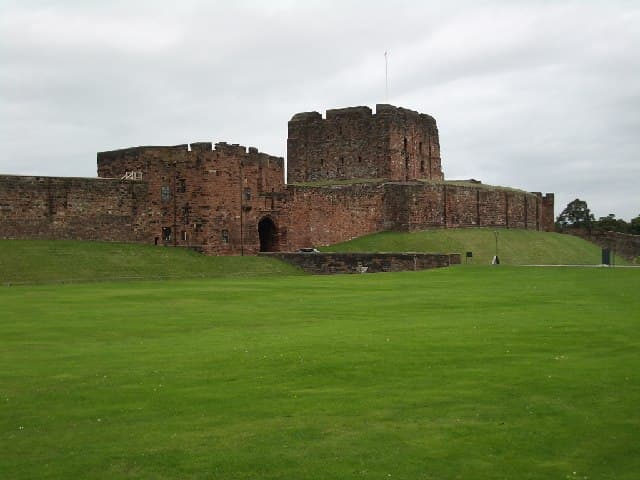
The keep of Carlisle Castle is a dominant feature, originally built between 1122 and 1135. It rises approximately 21 meters tall, though its height was reduced in the 16th century to accommodate artillery defenses. The keep has three floors, with a roof modified to hold cannons, reflecting the evolution of military technology. The entrance was fortified with a portcullis, a heavy grilled door that could be dropped to block attackers.
Inside, a dividing wall supports the weight of artillery on the roof. The first floor housed the king's hall, complete with a latrine and access to a well. The second floor contained a kitchen, chapel, latrine, and a prison cell. The chapel is historically significant as the place where David I of Scotland died in 1153. The walls of the guardroom adjacent to the chapel bear medieval and post-medieval graffiti, including religious imagery and heraldic symbols dating from around 1480.
The third floor was used as a gunpowder store in the 16th century but suffered damage from an explosion in 1547. Today, it hosts an exhibition on the Jacobite Rising. The castle courtyard includes several important structures such as the Captain's Tower, the regimental museum, the arsenal, and the powder magazine.
Defensive adaptations and artillery enhancements
During the reign of Henry VIII, the castle underwent significant adaptations to meet the challenges of artillery warfare. The engineer Stefan von Haschenperg was commissioned in 1541 to design a half-moon shaped underground battery, which was surrounded by a moat and intended to defend against Scottish attacks. The curtain walls were also equipped with cannon emplacements dating from the 17th century, reflecting ongoing military modernization.
One notable lost structure was Queen Mary's Tower, built in 1308 and used as a prison for Mary, Queen of Scots during her brief imprisonment in 1568. The tower was demolished in 1835 due to structural instability, but its appearance is preserved in a 1797 drawing.
Historical significance and military role
Medieval conflicts and border wars
Given its proximity to Scotland, Carlisle Castle was a focal point in the centuries-long conflicts between England and Scotland. It changed hands multiple times, especially during the Wars of Scottish Independence. The castle was seized by David I of Scotland during the reign of Stephen of England amid civil unrest and was used as a royal residence until his death there in 1153.
Throughout the Middle Ages, the castle was besieged and contested repeatedly, reflecting the turbulent history of the Anglo-Scottish border. Its fortifications were continually strengthened to withstand sieges and assaults.
Early modern and jacobite era
In the 16th century, the castle's military importance was updated with artillery defenses under Henry VIII. The castle also played a role in the English Civil War, enduring an eight-month siege in 1644 by Parliamentary forces known as the "Roundheads."
The last major military engagement was during the Jacobite Rising of 1745. The castle was captured and fortified by the Jacobite forces of Prince Charles Edward Stuart as they advanced into England. However, the castle was retaken by government forces led by Prince William Augustus, and the Jacobite cause was decisively defeated. This marked the end of Carlisle Castle's role as a frontline fortress, coinciding with the political union of England and Scotland into the Kingdom of Great Britain.
Post-military use and preservation
After the Jacobite conflicts, Carlisle Castle experienced periods of neglect and partial demolition, with some sections dismantled in the 19th century to provide building materials. From 1873, it served as a military depot and barracks, housing regiments such as the Border Regiment and later the King’s Own Royal Border Regiment until 1959.
The post of Governor of Carlisle, a position with origins in the 12th century, was abolished in 1838. The British Army managed the castle until 1959, after which it was transferred to the Department of the Environment and subsequently to English Heritage, which currently manages the site.
Today, Carlisle Castle is a well-preserved medieval fortress open to the public. It houses the Cumbria Museum of Military Life, preserving the history of local regiments and militias. In 1996, the castle was designated a Scheduled Ancient Monument in recognition of its archaeological and historical significance. Historic England has documented numerous historic graffiti and carvings within the castle, including prisoner inscriptions and a Roman altar stone, highlighting its layered history.
Archaeological importance and visitor experience
Beneath the medieval structures lie the buried remains of the Roman fort Luguvalium, making Carlisle Castle a site of exceptional archaeological interest. Visitors can explore the castle's extensive grounds, including the courtyard, captain's tower, arsenal, and the remnants of the curtain walls and artillery defenses.
The castle offers a rich narrative of England's border history, from Roman times through medieval wars and into the modern era. The exhibitions and preserved architecture provide insight into the evolution of military fortifications and the lives of those who lived and fought there.
Frequently asked questions (FAQ)
- How do I visit Carlisle Castle?
- Carlisle Castle is open to the public under the management of English Heritage. Visitors can explore the castle grounds, exhibitions, and the Cumbria Museum of Military Life. Check the official English Heritage website for current opening hours and ticket prices.
- What is the historical significance of Carlisle Castle?
- Carlisle Castle has been a strategic fortress guarding England's northern border since the 11th century. It played a key role in medieval Anglo-Scottish conflicts, the English Civil War, and the Jacobite Rising of 1745.
- Can I see Mary, Queen of Scots' prison at Carlisle Castle?
- Mary, Queen of Scots was imprisoned in the castle's southeast corner in 1568, but the original prison tower was demolished in the 19th century. Visitors can learn about her imprisonment through exhibitions and historical displays at the castle.
- Is Carlisle Castle accessible for visitors with mobility issues?
- The castle grounds include uneven surfaces and some steep areas, typical of medieval fortifications. English Heritage provides information on accessibility and may offer assistance or alternative routes for visitors with mobility challenges.
- When was Carlisle Castle built and by whom?
- Construction began in 1092 under King William II of England, with major stone work completed under King Henry I in the early 12th century.
Photo gallery

Information
Sources & official resources
Verify the information above using these authoritative references.
Loading map...
Visitor reviews
No reviews yet. Been here? Write the first review and help other travelers!
Write the first reviewVisited this castle? Share your experience
Your review helps other travelers and adds first-hand knowledge to our encyclopedia.