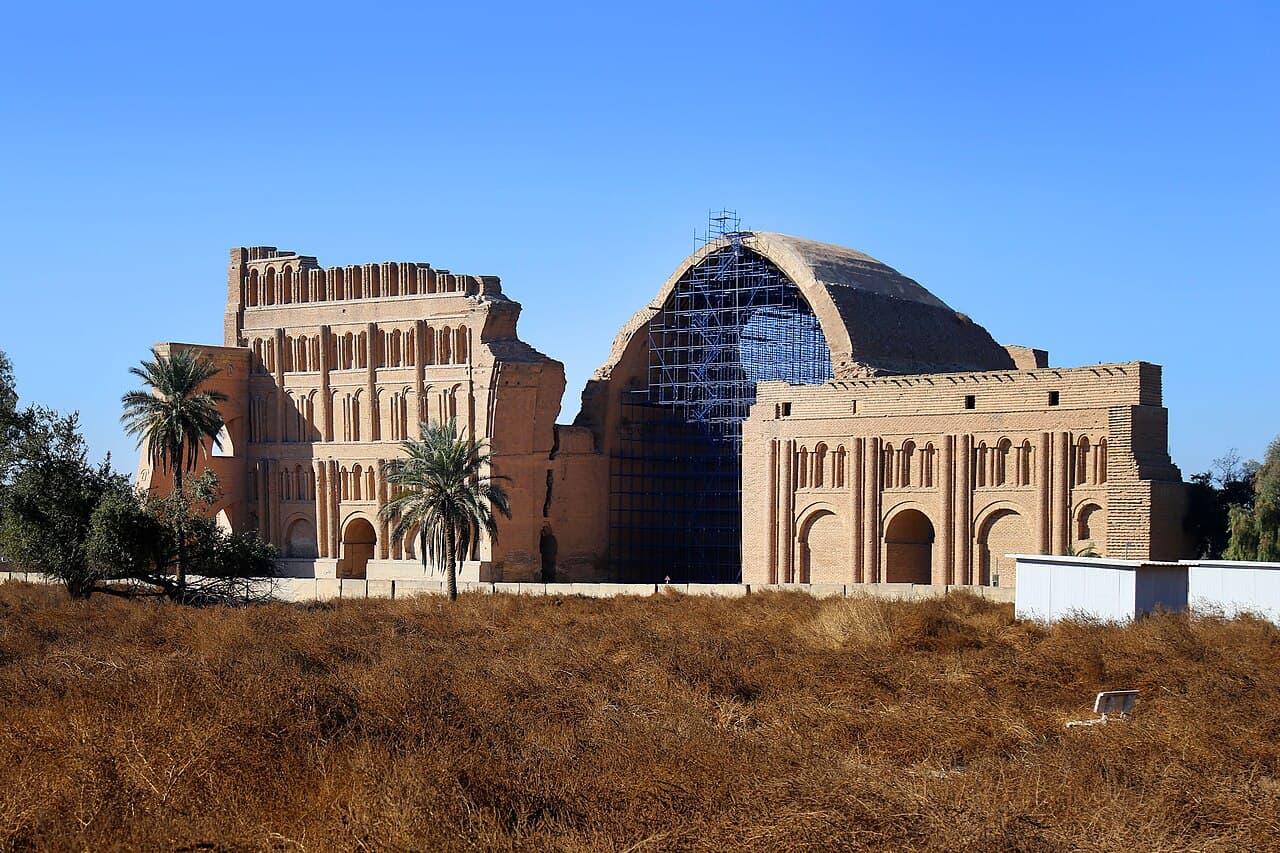
Taq-i Kisra, also known as the Arch of Ctesiphon, stands as a monumental remnant of the Sasanian Empire, located near the modern town of Salman Pak, Iraq. This imposing structure is the only visible surviving element of the ancient city of Ctesiphon, which served as a capital for the Sasanians from the 3rd to the 7th century CE. The arch is renowned for its massive single-span vault, which is the second largest of its kind in the world constructed of unreinforced brickwork, surpassed only by the Gavmishan Bridge in Iran.
Historical context and significance
The Sasanian Empire was the last great Persian empire before the Islamic conquests, flourishing from 224 to 651 CE. Ctesiphon, situated on the eastern bank of the Tigris River, was a major political and cultural center. The palace complex at Ctesiphon was a symbol of imperial power, and the iwan or vaulted hall of Taq-i Kisra formed its grand entrance. This monumental archway was constructed during the reign of Khosrow I (Anushirvan) in the 6th century, although its origins may date back earlier to the 3rd or 4th centuries. The structure exemplifies the architectural ingenuity of the Sasanians and their mastery of large-scale brick vaulting.
Architectural features and construction
The Taq-i Kisra is distinguished by its enormous barrel vault spanning approximately 37 meters (121 feet) wide and rising to a height of about 26 meters (85 feet). The arch was built using thousands of fired bricks arranged without mortar reinforcement, relying on the precision of bricklaying and the weight distribution of the vault to maintain stability. The structure's thickness and the use of buttresses helped counteract the lateral forces exerted by the vault. The design reflects the Sasanian architectural style, which heavily influenced later Islamic architecture, especially in the use of large iwans and vaulted halls.
The iwan and palace complex
The archway was the central feature of the palace's iwan, an enormous vaulted hall open on one side, which served as a throne room and ceremonial space. The palace itself was part of a sprawling complex that included residential quarters, administrative buildings, and gardens. While only the arch remains today, historical records and archaeological evidence suggest the palace was richly decorated with stucco, frescoes, and intricate stonework.
Cultural and architectural legacy
Taq-i Kisra is a landmark in the history of architecture, illustrating the Sasanian mastery of brick vaulting and monumental scale. Its design influenced Islamic architecture, particularly the development of the iwan form seen in mosques and madrasas across Persia and beyond. The arch's survival as a ruin provides valuable insight into pre-Islamic Persian architectural traditions and imperial symbolism.
Preservation and current condition
Today, the Taq-i Kisra stands as archaeological ruins in a state of ruins, with the massive vault partially collapsed but still impressive in scale. The site is vulnerable to environmental and human threats, and conservation efforts have been limited. Despite this, the arch remains a potent symbol of Iraq's ancient heritage and a key attraction for scholars and visitors interested in Sasanian history and architecture.
Visiting information and accessibility
The site is accessible from the nearby town of Salman Pak, though facilities are minimal. Visitors are advised to plan ahead due to limited infrastructure and security considerations. The remote location and fragile condition of the ruins mean that access may be restricted at times. Guided tours are occasionally available through cultural heritage organizations.
Frequently asked questions (FAQ)
- What is Taq-i Kisra and where is it located?
- Taq-i Kisra, also known as the Arch of Ctesiphon, is a monumental Sasanian-era arch located near Salman Pak, Iraq. It is the only remaining visible structure of the ancient city of Ctesiphon.
- When was Taq-i Kisra constructed?
- The arch was constructed primarily during the 6th century under the reign of Khosrow I, though its origins may date back to the 3rd or 4th centuries.
- What architectural style does Taq-i Kisra represent?
- Taq-i Kisra exemplifies Sasanian architecture with its massive unreinforced brick vault and the use of the iwan form, which influenced later Islamic architecture.
- Can visitors access Taq-i Kisra?
- Yes, visitors can access the ruins near Salman Pak, Iraq, but facilities are limited and access may be restricted due to preservation concerns and security.
- Why is Taq-i Kisra historically important?
- Taq-i Kisra is significant as a rare surviving example of Sasanian imperial architecture and as a precursor to architectural elements widely used in Islamic buildings.
Photo gallery

Information
Loading map...
Visitor reviews
No reviews yet. Been here? Write the first review and help other travelers!
Write the first reviewVisited this castle? Share your experience
Your review helps other travelers and adds first-hand knowledge to our encyclopedia.