Round city of Baghdad
The Round City of Baghdad represents the historic and architectural foundation of one of the most influential cities in the Islamic world. Constructed between 762 and 766 AD under the direction of the Abbasid Caliph al-Mansur, this circular fortress city was designed as the official residence of the Abbasid court and the administrative heart of the empire. Known originally as the City of Peace (Madīnat as-Salām), it was a pioneering example of urban planning and fortification in the early medieval Islamic world.
Architectural design and urban planning
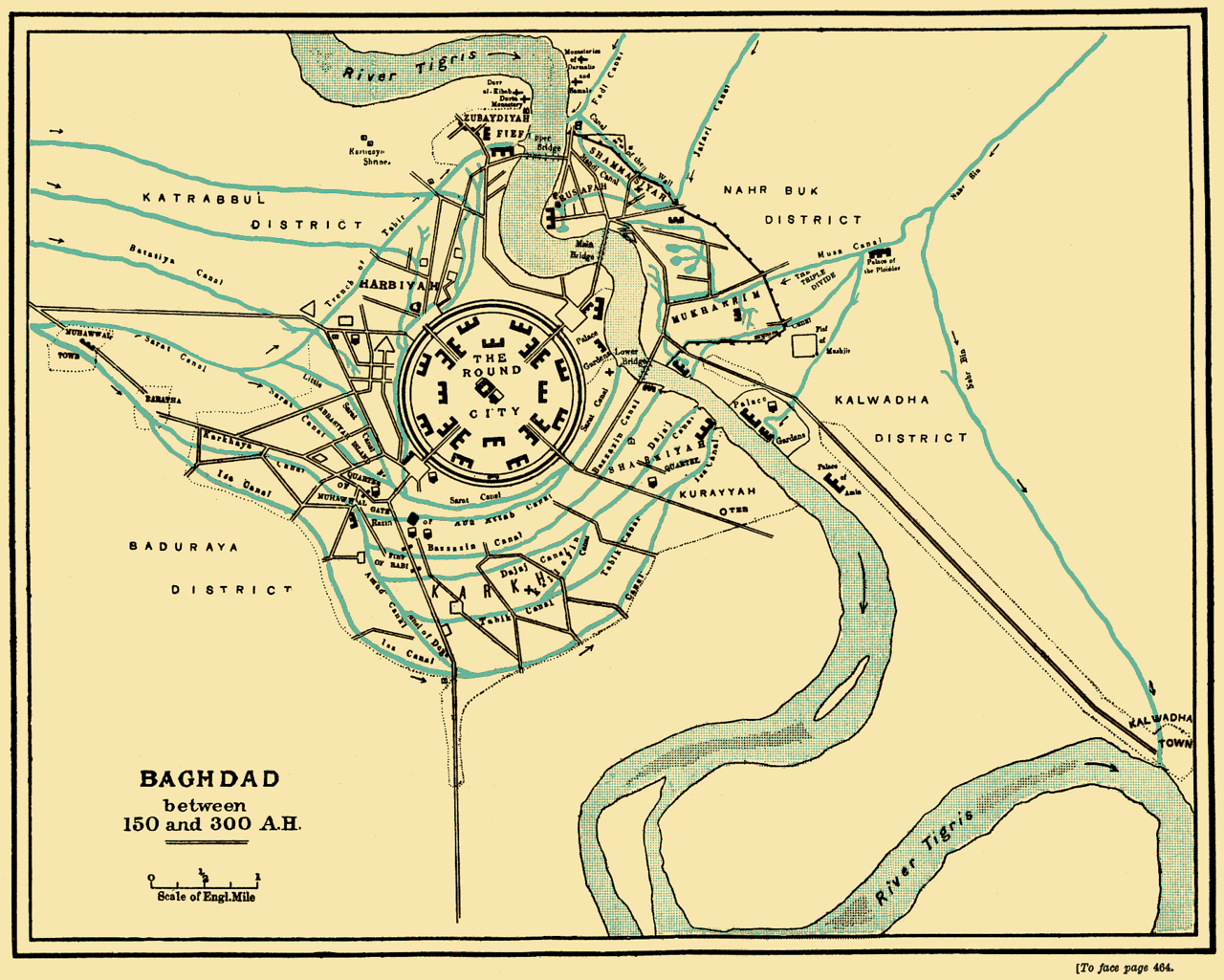
The design of the Round City was highly symbolic and practical. Its circular form was intended to represent the cosmic order and the central authority of the caliphate. The city was surrounded by massive walls punctuated with gates and towers, creating a formidable defensive structure. The walls enclosed a diameter of approximately 2 kilometers, encompassing the caliph's palace, administrative buildings, residential quarters, and markets.
The city’s layout was meticulously planned, with four equidistant gates aligned to the cardinal points, each serving as a major entry and exit point. Inside, the city was divided into sectors with streets radiating from the central palace complex, ensuring efficient movement and communication. The central palace, known as the Golden Gate Palace, was the political and ceremonial core, symbolizing the caliph's power.
Historical significance and cultural impact
The Round City of Baghdad was not only a political and military center but also a cultural and intellectual hub. It housed the House of Wisdom (Bayt al-Hikma), one of the most renowned libraries and centers of learning in the medieval world. Scholars from various parts of the Islamic world and beyond gathered here to translate, study, and expand knowledge in fields such as mathematics, astronomy, medicine, and philosophy.
This institution played a critical role in preserving and enhancing classical knowledge, contributing to the Islamic Golden Age. The city's strategic location along the Tigris River facilitated trade and communication, further enhancing its importance as a commercial center.
Construction techniques and materials
The construction of the Round City utilized traditional materials such as baked bricks and mortar, common in Mesopotamian architecture. The walls were reinforced with towers at regular intervals to improve defense against siege warfare. The circular walls were approximately 30 meters high and 10 meters thick, reflecting advanced engineering skills for the period.
Inside, buildings were constructed with a combination of mudbrick and fired brick, with wood used for roofing and interior structures. The city’s infrastructure included water channels and drainage systems, demonstrating a sophisticated approach to urban living.
Decline and legacy
Despite its initial grandeur, the Round City of Baghdad suffered damage and decline over the centuries due to invasions, internal strife, and natural disasters. The Mongol invasion of 1258 AD led to significant destruction, including the sacking of the city and the loss of many cultural treasures.
Today, few physical remains of the original Round City survive, but its legacy endures in the layout and historical identity of modern Baghdad. The concept of a planned, fortified city influenced later Islamic urban design and remains a subject of study for historians and archaeologists.
Cultural and historical importance
The Round City stands as a symbol of the Abbasid Caliphate's power and the flourishing of Islamic civilization during the early medieval period. It reflects the integration of political authority, military strategy, and cultural advancement. Its role as a center of knowledge and governance marks it as a key milestone in the history of urban development.
Frequently asked questions (FAQ)
- What is the historical significance of the Round City of Baghdad?
- The Round City of Baghdad was the original core of Baghdad and the official residence of the Abbasid Caliphate, built in the 8th century. It was a political, cultural, and intellectual center, housing the famous House of Wisdom.
- Can I visit the remains of the Round City today?
- Today, only archaeological remains of the Round City survive, as much of the original structure was destroyed. Visitors can explore the general area in Baghdad where the city once stood, though few physical structures remain.
- When was the Round City of Baghdad built?
- The Round City was constructed between 762 and 766 AD under Caliph al-Mansur's orders as the administrative and political center of the Abbasid Caliphate.
- What architectural features characterized the Round City?
- The Round City was notable for its circular walls with four main gates aligned to cardinal points, a central palace complex, and fortified towers. Its design symbolized cosmic order and caliphal authority.
- Why is the House of Wisdom important?
- The House of Wisdom was a major intellectual center within the Round City, where scholars translated and advanced knowledge in sciences, philosophy, and medicine, significantly contributing to the Islamic Golden Age.
Photo gallery

Photo by William Muir•Public domain
Information
Current owner
Government of Iraq
Loading map...
Visitor reviews
No reviews yet. Been here? Write the first review and help other travelers!
Write the first reviewVisited this castle? Share your experience
Your review helps other travelers and adds first-hand knowledge to our encyclopedia.