Ishtar Gate
The Ishtar Gate stands as one of the most remarkable architectural and cultural monuments of ancient Mesopotamia. Constructed around 569 BC under the reign of King Nebuchadnezzar II, it served as the eighth and most magnificent gate to the inner city of Babylon, located in what is now Hillah, Babylon Governorate, Iraq. This gate was not only a defensive structure but also a ceremonial entrance, symbolizing the grandeur and religious devotion of the Neo-Babylonian Empire.
The gate formed part of a vast fortified complex, including the famous Processional Way—a broad, paved avenue lined with walls adorned with glazed bricks and reliefs of sacred animals and deities. The Ishtar Gate itself was built as a double gate, featuring a smaller frontal gate and a larger, more imposing posterior gate that together reached a height of approximately 15 meters. Its foundations extended deeply into the ground, about 14 meters, providing substantial stability to the massive structure.
Architectural design and materials
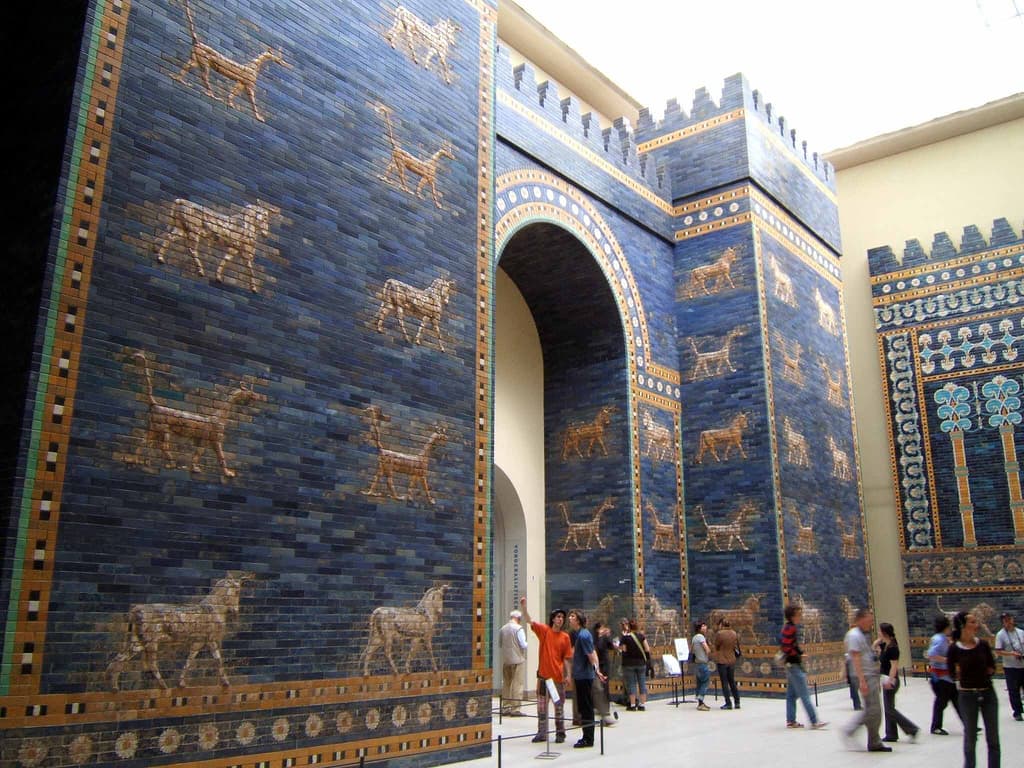
The gate's walls were constructed using glazed bricks predominantly in a rich blue color, achieved through the use of lapis lazuli-like pigments. These bricks were carefully arranged to create a vivid and enduring facade. Interspersed along the walls were low reliefs of dragons (symbolizing the god Marduk) and aurochs (representing the god Adad), as well as images of the goddess Ishtar, after whom the gate was named. These reliefs were formed from colored bricks, adding texture and depth to the surface. The use of such decorative elements was both symbolic and functional, demonstrating the power and divine protection of the city.
Structural features
The gate's double structure allowed for a controlled passage into the city, enhancing its defensive capabilities. The frontal gate was smaller and served as the initial checkpoint, while the rear gate was grander, designed to impress visitors and processions entering the city. The gate was flanked by massive towers and incorporated battlements, which provided vantage points for guards and archers.
Historical context and significance
The Ishtar Gate was constructed during the height of the Neo-Babylonian Empire, a period marked by extensive building projects and cultural flourishing under Nebuchadnezzar II. This era saw Babylon transformed into one of the ancient world's most splendid cities, with the Ishtar Gate symbolizing its wealth, religious devotion, and military strength.
The gate was part of a larger urban plan that included the Processional Way, which was used for religious festivals, including the New Year celebrations where statues of deities were paraded through the city. The gate's imposing presence and elaborate decoration underscored the importance of these events in Babylonian society.
Excavation and modern legacy
Between 1904 and 1914, the German archaeologist Robert Koldewey led excavations at Babylon, uncovering the remains of the Ishtar Gate and the Processional Way. His meticulous work revealed the gate's original grandeur and construction techniques. After World War I, the smaller frontal gate was reconstructed and is now displayed in the Pergamon Museum in Berlin, where it remains one of the museum's most popular exhibits.
Fragments of the gate's facade, including glazed bricks and relief panels, are dispersed in various museums worldwide, including the British Museum and the Metropolitan Museum of Art. These pieces continue to inform our understanding of Babylonian art and architecture.
Replicas and cultural influence
The Ishtar Gate's iconic design has inspired replicas and architectural motifs beyond Iraq. The facade of the Iraqi embassy in Beijing, China, features a replica of the gate, as do the Iraqi embassies in Amman, Jordan, and Islamabad, Pakistan. These modern reproductions pay homage to Babylon's historical significance and the enduring legacy of its monumental architecture.
Preservation and current condition
Today, the original site of the Ishtar Gate remains an archaeological site in Iraq, with much of the structure lost or buried. Political instability and environmental factors have affected preservation efforts. However, the gate's reconstructed portions and surviving artifacts continue to be studied and admired for their artistic and historical value.
The Ishtar Gate exemplifies ancient Mesopotamian architectural innovation, combining defensive function with religious symbolism and artistic expression. Its use of glazed bricks and detailed reliefs set a precedent for monumental construction in the ancient world.
Frequently asked questions (FAQ)
- When was the Ishtar Gate constructed and by whom?
- The Ishtar Gate was constructed around 569 BC by order of King Nebuchadnezzar II during the Neo-Babylonian Empire.
- What materials were used in the construction of the Ishtar Gate?
- The gate was built using glazed bricks predominantly in blue, decorated with colored brick reliefs of dragons, aurochs, and deities.
- Where can I see the reconstructed Ishtar Gate today?
- The smaller frontal gate was reconstructed and is displayed in the Pergamon Museum in Berlin, Germany.
- What was the purpose of the Processional Way connected to the Ishtar Gate?
- The Processional Way was a ceremonial avenue used for religious festivals and parades, leading from the Ishtar Gate into Babylon.
- Are there replicas of the Ishtar Gate outside Iraq?
- Yes, replicas of the Ishtar Gate appear on the facades of the Iraqi embassies in Beijing, Amman, and Islamabad.
Photo gallery

Information
Loading map...
Visitor reviews
No reviews yet. Been here? Write the first review and help other travelers!
Write the first reviewVisited this castle? Share your experience
Your review helps other travelers and adds first-hand knowledge to our encyclopedia.