Rochester Castle
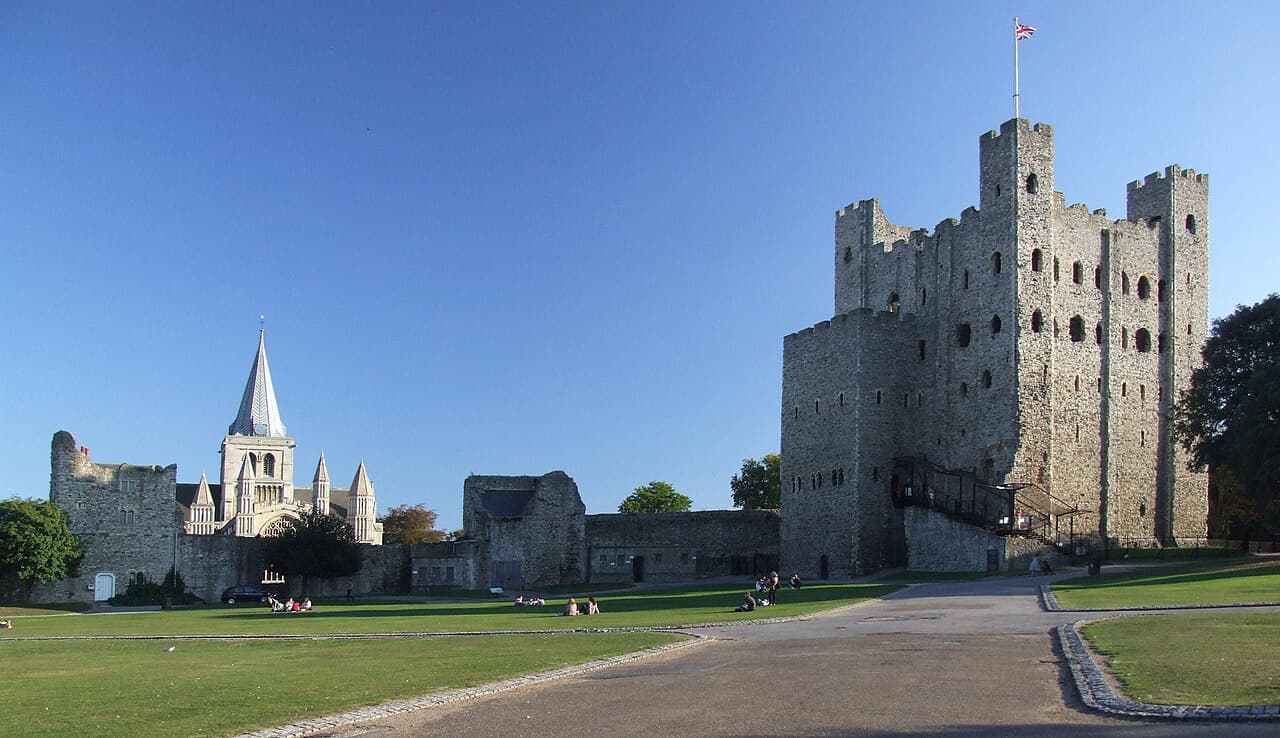
Rochester Castle stands prominently on the east bank of the River Medway in Rochester, Kent, England. This 12th-century hill castle is renowned for its imposing stone keep, one of the tallest and best preserved in England, rising approximately 125 feet (34 meters) above the surrounding landscape. Its strategic location near the river and the historic Watling Street made it a vital defensive stronghold throughout the medieval period, playing a crucial role in the military and political history of England.
Early origins and construction
The origins of Rochester Castle date back to shortly after the Norman Conquest of 1066, when a wooden motte-and-bailey castle was initially constructed near the River Medway, possibly on Boley Hill. This early timber fortification was granted to Bishop Odo, half-brother of William the Conqueror, who used it as a base during the Rebellion of 1088. The castle and town were besieged by King William Rufus, leading to the garrison's surrender and the abandonment of the first wooden structure.
Between 1087 and 1089, King William Rufus commissioned Bishop Gundulf of Rochester to build a new stone castle on the current site. This stone fortress incorporated parts of the ancient Roman town walls as foundations, marking a significant upgrade from timber to stone fortifications. The curtain wall, approximately 4.5 feet thick and 22 feet high, enclosed the castle and survives in parts, especially along the western side facing the river.
In 1127, King Henry I granted Rochester Castle in perpetuity to the Archbishop of Canterbury, William de Corbeil. Under his direction, the massive stone keep or donjon was constructed and completed before 1141. This keep, a square tower roughly 70 feet wide on each side with walls up to 12 feet thick at the base, became the castle's defining feature. Its design prioritized military utility over ornamental aesthetics, reflecting the turbulent times.
Medieval military significance and sieges
Rochester Castle was a key royal fortress during the High Medieval period, strategically positioned to protect England's southeast from invasion and to control the important river crossing and road network. The castle witnessed several major sieges, most notably during the First Barons' War (1215–1217). In 1215, rebellious barons seized the castle from Archbishop Stephen Langton, prompting King John to lay siege for over seven weeks. The siege severely damaged the castle, including the collapse of the southeast corner of the keep. The defenders ultimately surrendered due to starvation.
In 1216, the French Prince Louis, allied with the barons, captured the castle. Following King John's death and the war's end in 1217, the castle returned to royal control. Another significant siege occurred during the Second Barons' War (1264), when rebel forces led by Simon de Montfort besieged the castle. The royalist garrison held out until relieved by King Henry III's forces. The castle sustained extensive damage during this conflict, which was only repaired in the 14th century.
The castle's last military action was during the Peasants' Revolt of 1381, when rebels captured and ransacked the fortress. After this period, Rochester Castle's military importance declined, and parts of its stone were repurposed for other constructions, including Upnor Castle built between 1599 and 1601.
Architectural features and layout
The castle's layout centers around the colossal 12th-century stone keep, surrounded by a curtain wall that incorporates Roman foundations. The keep's walls are approximately 12 feet thick at the base, tapering to 10 feet at the top, with pilaster buttresses at each corner and turrets rising 12 feet above the battlements. The southeast corner, rebuilt as a rounded tower after the 1215 siege, contrasts with the otherwise square design.
Internally, the keep is divided vertically by a strong east-west wall, separating the lord's quarters from those of his retinue. The ground floor served as storage, while the upper floors provided accommodation, including a great hall, chambers such as "Gundulf's Chamber", and two chapels. A well shaft with access on each floor ensured a water supply during sieges. The entrance is located on the north side at first-floor level, protected by a forebuilding with a drawbridge and originally a portcullis.
Additional defensive structures include two surviving two-storey mural towers from the late 14th century, one of which was later converted into a cottage. A large rounded tower fills a breach in the curtain wall caused by the 1215 siege. The main gatehouse, built by Bishop Gundulf and rebuilt in the mid-13th century, was demolished in the 19th century, but historical engravings depict it as an archway flanked by projecting towers accessed via a stone causeway over a ditch.
Originally, the castle was surrounded by a defensive ditch on all sides except the west, most of which has since been filled in. The keep suffered a post-medieval fire that gutted its interior, leaving it roofless and without floors. Conservation efforts in the 19th and 20th centuries have stabilized the structure, but the keep remains fragile with restricted public access.
Preservation and public access
In the 1870s, Rochester Castle's grounds were opened to the public as a park, allowing visitors to explore the historic site. The castle is protected as a Grade I listed building and a Scheduled Monument, reflecting its outstanding heritage significance. English Heritage currently manages the site, overseeing ongoing conservation efforts to preserve the castle's fabric.
Due to the fragile condition of the keep, public access inside the tower is limited, but visitors can appreciate its impressive scale and architectural details from the exterior. The castle remains a prominent landmark in Kent and a testament to England's medieval military architecture and turbulent history.
Technical details
- Height of keep: approximately 34 meters (125 feet)
- Keep dimensions: roughly 70 feet (21 meters) square
- Wall thickness: up to 12 feet (3.7 meters) at base
- Construction materials: Kentish Ragstone and Caen limestone
- Period of major construction: late 11th to early 12th century
Frequently asked questions (FAQ)
- What is the historical significance of Rochester Castle?
- Rochester Castle is one of the best-preserved Norman castles in England, built in 1087. It played a crucial role in the conflicts during the medieval period, including the siege of 1215 during the First Barons' War, making it a site of great historical importance.
- When was Rochester Castle built?
- Rochester Castle was constructed in 1087 by Bishop Gundulf, shortly after the Norman Conquest. The castle's strategic location has made it a focal point for defense and control throughout its history.
- Can I visit Rochester Castle year-round?
- Yes, Rochester Castle is open to visitors throughout the year, but opening hours may vary seasonally. It is advisable to check the official website for specific hours before planning your visit.
- What are the ticket prices for Rochester Castle?
- As of 2023, adult tickets are priced at £7.50, while concessions and children can enter for a reduced fee. Family tickets are also available for those visiting with children, providing a cost-effective option.
- Is Rochester Castle accessible for individuals with disabilities?
- Yes, Rochester Castle aims to be accessible for all visitors. There are ramps and designated pathways to help those with mobility issues, although some areas may have limitations due to the castle's historic structure.
- When is the best time to visit Rochester Castle?
- The best time to visit Rochester Castle is during the spring and summer months when the weather is pleasant, and the gardens are in full bloom. Visiting during weekdays can also help you avoid the crowds.
- What nearby attractions should I explore while visiting Rochester Castle?
- While visiting Rochester Castle, you can also explore the historic Rochester Cathedral, which is just a short walk away. The city of Rochester itself offers charming shops, cafes, and additional historical sites to enjoy.
- What architectural features can I expect to see at Rochester Castle?
- Rochester Castle features impressive Norman architecture, including its massive stone keep, which stands at around 113 feet tall. Visitors can also admire the castle's well-preserved walls and the iconic round towers that define its imposing silhouette.
Photo gallery

Information
Website
Visit websiteFeatured in
Articles on the Castlopedia blog that feature Rochester Castle.
Sources & official resources
Verify the information above using these authoritative references.
Loading map...
Visitor reviews
No reviews yet. Been here? Write the first review and help other travelers!
Write the first reviewVisited this castle? Share your experience
Your review helps other travelers and adds first-hand knowledge to our encyclopedia.