Chipchase Castle
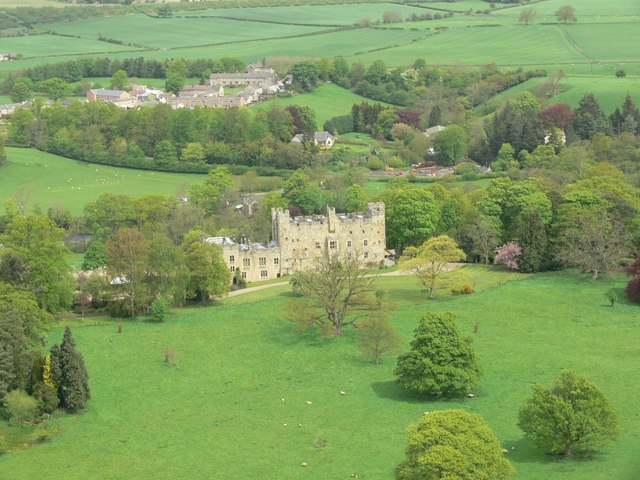
Chipchase Castle stands as a remarkable example of England's layered architectural and historical heritage, located near the village of Wark in Northumberland. This castle uniquely combines a 14th-century stone pele tower with an early 17th-century Jacobean mansion, reflecting centuries of evolving defensive needs and domestic tastes. Its position north of Hadrian's Wall situates it within a region rich in border history and medieval conflict, which shaped much of its original design and subsequent modifications.
Medieval origins and defensive architecture
The origins of Chipchase Castle trace back to the mid-14th century when Walter Heron, having married the heiress of the manor, constructed a substantial stone pele tower on the site of an earlier dwelling. This four-storey fortified tower was built primarily for defense during a period marked by frequent border skirmishes between England and Scotland. The tower's battlemented roofline and thick stone walls exemplify the typical features of a pele tower, which served as a refuge and stronghold against raids common in northern England during the medieval period.
The tower's vertical emphasis and robust construction demonstrate the practical military architecture of the time, designed to withstand attacks and provide a vantage point over the surrounding landscape. Its survival in largely original form is a testament to the quality of its medieval masonry and its importance in regional defense.
Jacobean transformation and domestic expansion
By the early 17th century, the defensive function of the tower was supplemented by a desire for more comfortable and prestigious living quarters. Around 1621, Cuthbert Heron, who later served as High Sheriff of Northumberland, undertook significant redevelopment of the estate. He replaced the existing manor house with a Jacobean mansion that was attached to the original pele tower, preserving the medieval structure while introducing the architectural style and domestic amenities characteristic of the Jacobean period.
The mansion features elements typical of Jacobean architecture, including symmetrical layouts, ornate stonework, and large mullioned windows, which contrasted with the stark defensiveness of the earlier tower. This blend of styles at Chipchase Castle highlights the transition from martial necessity to genteel country living among the English gentry in the early modern era.
18th-century classical modifications and later ownership
Economic challenges led the Heron family to sell Chipchase Castle in 1727 to George Allgood, a merchant from Newcastle. Subsequently, the castle passed to John Reed, a Newcastle banker, who implemented significant alterations reflecting the architectural tastes of the 18th century. Reed added a classical-style frontage to the medieval pele tower, introducing elements of symmetry and classical proportions that softened the fortress-like appearance and aligned the building with contemporary aesthetic trends.
Throughout the 19th century, ownership changed hands several times, including to the Greys of Backworth and later to Hugh Taylor. In more recent decades, the estate has been privately owned by individuals connected to the author Paul Torday and his wife, Penelope Taylor, who have contributed to managing and preserving the grounds.
Geographical setting and landscape context
Chipchase Castle is situated approximately 113 meters above sea level within a picturesque valley surrounded predominantly by grassland. The surrounding terrain transitions from relatively flat land to the northwest to more hilly areas to the southeast, providing both scenic beauty and strategic advantage. The nearest significant town is Hexham, located nearly 13 kilometers to the south, while the immediate vicinity remains sparsely populated, preserving the castle's historic rural ambiance.
Heritage status and preservation
Today, Chipchase Castle is recognized as a Scheduled Ancient Monument and a Grade I listed building, designations that underscore its exceptional historical and architectural significance. These protections help ensure the conservation of its well-preserved medieval pele tower, Jacobean mansion, and classical 18th-century additions. The castle's layered architectural fabric offers valuable insight into the evolution of English country houses from fortified medieval structures to elegant early modern residences.
Visitors and scholars alike appreciate Chipchase Castle for its unique synthesis of defensive and domestic architecture, its connection to notable historical figures such as the Heron family, and its role in the turbulent history of the Anglo-Scottish border region.
Historical significance of the heron family
The Heron family, who were the castle's original medieval builders and long-term occupants, played a prominent role in Northumberland's history. Cuthbert Heron, responsible for the Jacobean expansion, served as High Sheriff of Northumberland, a position of considerable local authority. His eldest son, George Heron, died fighting for King Charles I during the Battle of Marston Moor in 1644, a pivotal conflict in the English Civil War. Another son was later granted a baronetcy by King Charles II, reflecting the family's continued prominence despite the political upheavals of the 17th century.
Architectural features in detail
The pele tower
The pele tower at Chipchase Castle is a prime example of northern England's border fortifications. Its four-storey height and battlemented parapet provided both defense and surveillance capabilities. The thick stone walls, narrow windows, and elevated entrances were typical defensive measures designed to resist assault and protect inhabitants during raids.
The jacobean mansion
The Jacobean mansion attached to the tower features characteristic elements such as large mullioned windows, ornamental stonework, and a balanced façade. This building reflects the changing priorities of the early 17th century, where comfort and status began to outweigh purely defensive concerns. The mansion's layout likely included formal reception rooms, private chambers, and service areas arranged to suit the lifestyle of a prominent gentry family.
18th-century classical frontage
The classical frontage added to the medieval tower in the 18th century introduced symmetry and classical architectural motifs, including pilasters and cornices, which contrasted with the original fortress-like appearance. This modification represents the influence of Georgian architectural ideals and the desire to modernize the castle's appearance in line with contemporary tastes.
Frequently asked questions (FAQ)
- How do I get to Chipchase Castle?
- Chipchase Castle is located in Northumberland, United Kingdom. The nearest major town is Hexham, which is approximately 12 miles away. Visitors can reach the castle by car via the A69 road, and there are local bus services available that connect to nearby towns.
- What is the historical significance of Chipchase Castle?
- Chipchase Castle dates back to the 12th century and has a rich history associated with the border conflicts between England and Scotland. Originally built as a defensive fortress, it has been home to various noble families over the centuries and showcases the architectural evolution from a stronghold to a stately home.
- When was Chipchase Castle last renovated?
- Chipchase Castle has undergone several renovations over the years, with significant restoration work completed in the 19th century. The most recent updates were made in the 20th century to preserve its historical integrity while making it suitable for modern visitors.
- Can I take guided tours of Chipchase Castle?
- Yes, guided tours are available at Chipchase Castle, offering visitors a deeper understanding of its history and architecture. These tours are typically conducted by knowledgeable guides who share fascinating stories and insights about the castle's past.
- Why is Chipchase Castle considered an architectural gem?
- Chipchase Castle is celebrated for its unique blend of medieval and Victorian architectural styles, which reflect the various periods of its construction and renovation. The intricate stonework, imposing towers, and beautifully landscaped gardens contribute to its reputation as a remarkable example of historical architecture.
- Is it possible to host events at Chipchase Castle?
- Yes, Chipchase Castle offers facilities for hosting a variety of events, including weddings, corporate meetings, and private celebrations. The stunning surroundings and historic ambiance make it a popular choice for special occasions.
- What are the opening hours for Chipchase Castle?
- Chipchase Castle typically opens to the public from April to October, with specific hours varying by day. It is advisable to check the castle's official website or contact them directly for the most current information on opening hours.
- What are the ticket prices for visiting Chipchase Castle?
- Ticket prices for Chipchase Castle vary depending on the age of the visitor and whether they are part of a group. Discounts are often available for children, seniors, and families, so be sure to check the official website for up-to-date pricing and any special offers.
- What is the best time to visit Chipchase Castle?
- The best time to visit Chipchase Castle is during the spring and summer months when the weather is generally pleasant, and the gardens are in full bloom. Additionally, special events and activities often take place during this time, enhancing the visitor experience.
- Are there any nearby attractions to Chipchase Castle?
- Yes, there are several nearby attractions, including the scenic Northumberland National Park and the historic town of Hexham, which is known for its Abbey and market. Visitors can also explore other castles in the region, such as Housesteads Roman Fort and Prudhoe Castle.
Information
Website
Visit websiteSources & official resources
Verify the information above using these authoritative references.
Loading map...
Visitor reviews
No reviews yet. Been here? Write the first review and help other travelers!
Write the first reviewVisited this castle? Share your experience
Your review helps other travelers and adds first-hand knowledge to our encyclopedia.