Elsdon Castle
Elsdon Castle is a significant example of a Norman motte and bailey fortress located in the village of Elsdon, Northumberland, England. Established around 1076 by Robert de Umfraville, it was constructed shortly after the Norman Conquest of England as part of efforts to consolidate Norman control over the northern territories. The castle's strategic position on a natural hill spur provided commanding views of the surrounding landscape, crucial for defense and regional dominance.
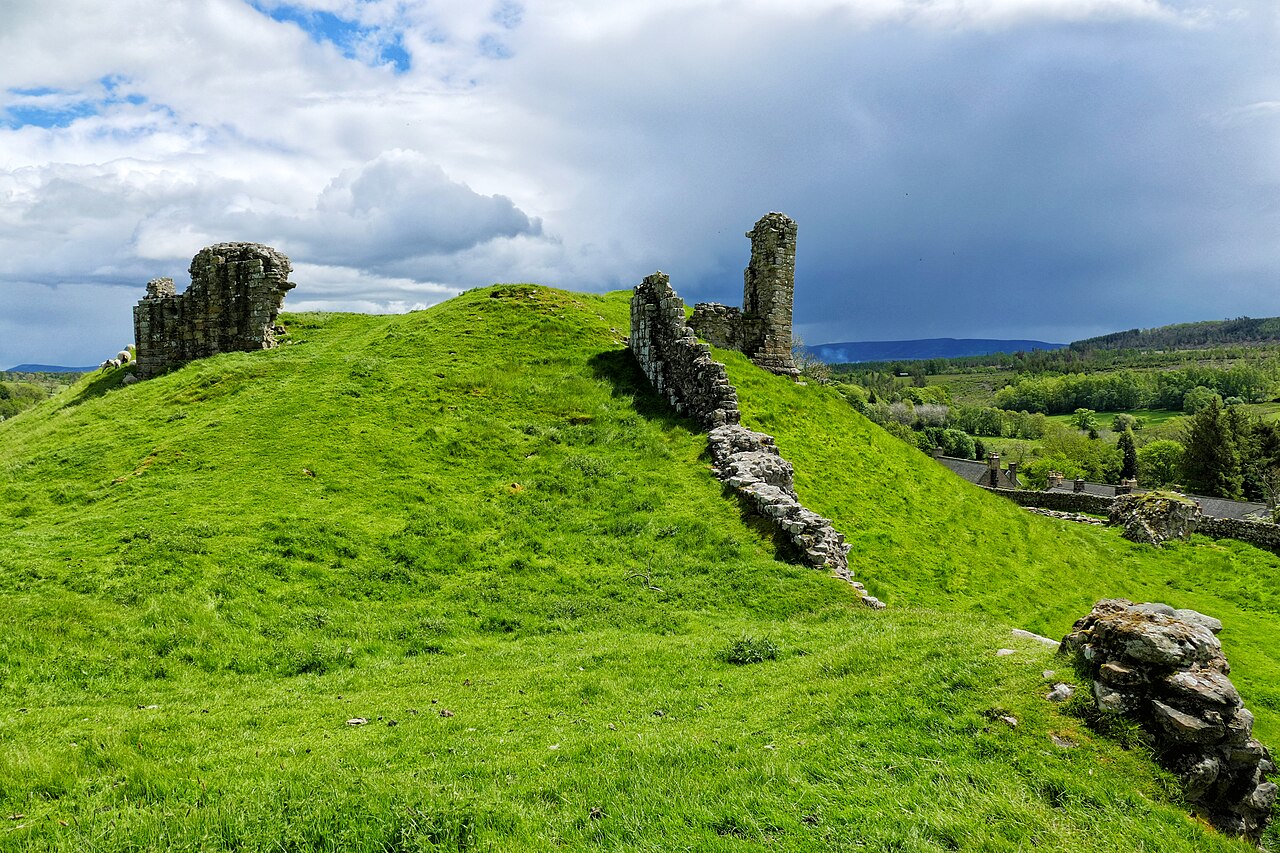
The castle's design follows the typical motte and bailey layout prevalent in the 11th century, featuring a large raised earth mound, or motte, topped originally by a wooden or stone keep. This motte rises approximately 15 metres (49 feet) high and spans about 80 metres (260 feet) across on its southern side. Adjacent to the motte lies the bailey, an enclosed courtyard protected by an embanked earthwork arranged in a crescent shape. This bailey would have housed essential buildings and served as the living and working space within the castle's defenses.
Historical context and significance
Elsdon Castle was a key element in the de Umfraville family's efforts to establish their authority in Northumberland during the turbulent years following the Norman Conquest. The castle's construction in the late 11th century reflects the rapid Norman strategy of fortifying key locations to control local populations and secure borders.
By the mid-12th century, however, Elsdon's strategic importance diminished with the erection of Harbottle Castle around 1160, which became the primary stronghold in the region. Consequently, Elsdon Castle was gradually abandoned and fell out of use, with no mention in estate records following the death of Gilbert de Umfraville in 1245. This suggests the castle ceased to function as a residence or military fortification by the mid-13th century.
Architecture and archaeological remains
The surviving earthworks of Elsdon Castle offer a well-preserved insight into medieval military architecture. The motte remains prominent in the landscape, retaining its height and shape, while the surrounding bailey is clearly defined by the crescent-shaped embankment. This configuration exemplifies the defensive principles of early Norman castles, combining elevated vantage points with enclosed courtyards.
Archaeological investigations in the 18th century uncovered a carved Roman stone embedded within the castle's earthworks, likely repurposed from the nearby Roman fort at High Rochester. This reuse of Roman materials illustrates the continuity of occupation and the practical recycling of building resources through successive historical periods. Additionally, a pottery vessel found in the 19th century adds to the evidence of ongoing human activity at the site over centuries.
Elsdon Tower and later developments
Close to the castle site stands Elsdon Tower, a fortified pele tower probably constructed between the late 14th and early 15th centuries. This tower is thought to be connected to the later generations of the de Umfraville family and served defensive and residential purposes during the border conflicts of the medieval period. It was later adapted as the local rectory until the 20th century, reflecting the evolving use of fortified structures in the region.
Folklore and cultural significance
Elsdon Castle is also associated with local folklore, including tales of a Danish giant who once terrorized the area. This legend may be linked to Siward the Dane, Earl of Northumberland under King Edward the Confessor in the mid-11th century. While not historically verified, these stories contribute to the cultural heritage and mystique surrounding the castle site.
Preservation and current status
Today, Elsdon Castle's earthworks remain a prominent feature in the Northumberland landscape. The site is designated as a Scheduled Ancient Monument, ensuring legal protection and recognition of its historical importance. The preservation of the motte and bailey layout allows visitors and scholars to understand the castle's original form and defensive function clearly.
As a hill castle typical of the Norman period, Elsdon Castle provides valuable insights into early medieval fortification techniques and the Norman strategy of territorial control. Its enduring presence offers a tangible link to England's medieval past and the complex history of the Anglo-Scottish border region.
Frequently asked questions (FAQ)
- When was Elsdon Castle built and by whom?
- Elsdon Castle was built around 1076 by Robert de Umfraville shortly after the Norman Conquest to secure Norman control in Northumberland.
- What architectural style characterizes Elsdon Castle?
- Elsdon Castle is a typical Norman motte and bailey castle, featuring a raised earth mound (motte) and an enclosed courtyard (bailey).
- Is Elsdon Castle accessible to visitors today?
- The castle remains are visible as earthworks and are protected as a Scheduled Ancient Monument, but there are no specific visitor facilities or opening hours.
- What is the significance of the Roman stone found at Elsdon Castle?
- A carved Roman stone found in the castle earthworks was likely reused from the nearby Roman fort at High Rochester, showing the recycling of materials from earlier periods.
- How does Elsdon Castle relate to local folklore?
- Local legends speak of a Danish giant associated with the site, possibly linked to Siward the Dane, an 11th-century Earl of Northumberland, enriching the castle's cultural narrative.
Information
Website
Visit websiteSources & official resources
Verify the information above using these authoritative references.
Loading map...
Visitor reviews
No reviews yet. Been here? Write the first review and help other travelers!
Write the first reviewVisited this castle? Share your experience
Your review helps other travelers and adds first-hand knowledge to our encyclopedia.