Harbottle Castle
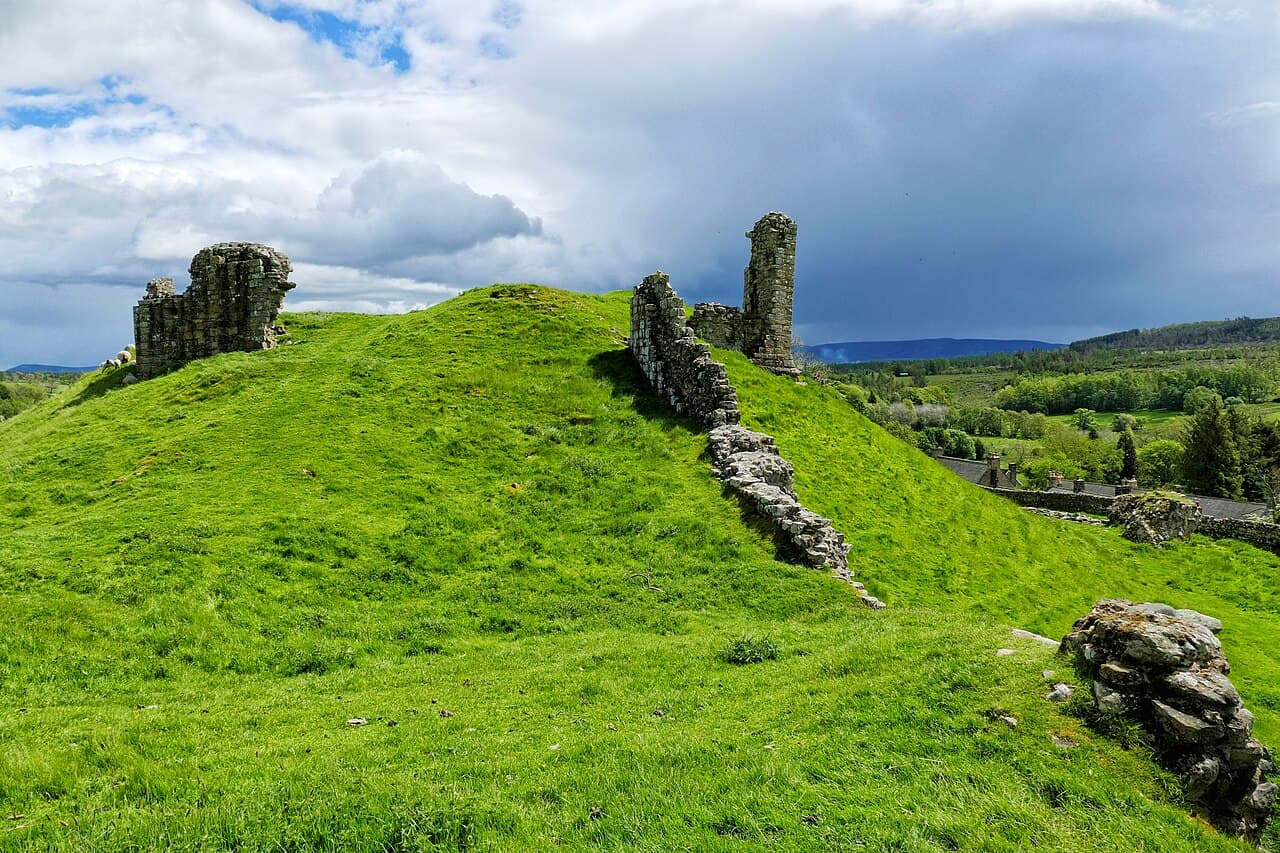
Harbottle Castle is a ruined medieval hill castle located at the western end of the village of Harbottle in Northumberland, England. Perched overlooking the River Coquet, it lies approximately 9 miles west-north-west of Rothbury. This site is recognized as a Scheduled Ancient Monument and holds the status of a Grade I listed building, reflecting its historical and architectural significance.
The origins of the site date back well before the castle's construction, with evidence suggesting that the mound on which the castle's keep stands was once used by the ancient Britons. During the Anglian period, the location was reportedly a stronghold held by Mildred, son of Ackman. The current castle was constructed around 1160 by the powerful Umfraville family under the directive of King Henry II. This construction followed the Norman Conquest and was intended primarily as a defensive fortress against incursions from Scotland.
Medieval origins and early conflicts
The initial structure of Harbottle Castle was typical of 12th-century defensive architecture, featuring a keep on a motte, surrounded by curtain walls and likely a moat or ditch. However, the castle's strategic position made it a target early on; in 1174, it was captured by Scottish forces during one of the many border conflicts of the period. Following this, the castle was rebuilt with stronger fortifications to better withstand assaults.
Harbottle Castle's military importance continued through the late 13th century. In 1296, the castle endured a significant siege led by Robert de Ros and a force of some 40,000 men supporting John Balliol's claim to the Scottish throne. Despite the overwhelming numbers, the castle's defenders successfully resisted the siege. Yet, in the early 14th century, the castle fell to Robert the Bruce during his campaigns to assert Scottish independence.
Decline and restoration efforts
After its capture by Robert the Bruce, Harbottle Castle was restored in 1336 but had fallen into ruin again by 1351. The castle was repaired towards the end of the 14th century, reflecting ongoing efforts to maintain its defensive role on the volatile Anglo-Scottish border.
In the mid-15th century, around 1436, ownership passed to the Tailleboys family. The castle became the residence of the Warden of the Middle Marches, a key official responsible for border security and law enforcement. During this period, the castle also functioned as a prison, highlighting its role in regional governance and control.
Royal connections and later history
One of the castle's most notable historical episodes occurred in 1515 when Margaret Tudor, widow of King James IV of Scotland and sister to King Henry VIII of England, took refuge at Harbottle Castle. Banished by the Scottish regent, John Stewart, Duke of Albany, she arrived with her second husband, Archibald Douglas, 6th Earl of Angus. Their daughter, also named Margaret Douglas, was born at the castle. She later became the mother of Lord Darnley, the second husband of Mary, Queen of Scots, and grandmother to King James VI of Scotland and I of England.
Between 1541 and 1551, the castle underwent further building work, with additional repairs recorded in 1563 and 1585. It became a royal property in 1546, with repairs overseen by Sir John Forster, the warden of the Middle Marches. A survey from 1596 notes the construction of a new gatehouse and a tower serving as lodging for the castle's captain, reflecting continued strategic importance.
Final decline and current status
In 1605, King James I granted Harbottle Castle and its manor to George Home, 1st Earl of Dunbar, who was Lord Treasurer of Scotland. After this transfer, the castle fell into disrepair, and much of its masonry was repurposed for other buildings in the area. By 1715, surveys described the castle as ruinous, with only earthworks and fragments of masonry remaining visible.
Today, Harbottle Castle is managed by the Northumberland National Park Authority. Visitors can freely access the site, which serves as a valuable historical landmark illustrating the turbulent history of the Anglo-Scottish border region.
Architectural features and layout
The castle originally featured a motte-and-bailey design common to Norman fortifications of the 12th century. The keep was situated atop an artificial mound, providing commanding views over the surrounding landscape and the River Coquet. Defensive elements likely included curtain walls, battlements, and a gatehouse added in later centuries. The tower added in the late 16th century served as residential quarters for the captain, indicating some adaptation from purely military to administrative and residential functions.
Despite its ruined state, the surviving masonry offers insight into medieval construction techniques and defensive priorities. The use of local stone and the castle's positioning reflect strategic considerations in controlling the border and monitoring movement along the river valley.
Harbottle castle mansion and later developments
Following the abandonment of the medieval castle as a residence, the name Harbottle Castle was reused for a 19th-century mansion house located at the eastern end of Harbottle village. This mansion was built on the site of a 17th-century manor house, which itself had incorporated stone taken from the medieval castle ruins.
The manor was acquired by Percival Clennell in 1796, and in 1829, the old house was replaced by a two-story, five-bayed mansion designed by the noted architect John Dobson for Fenwick Clennell. This mansion holds a Grade II listed building status. The stable block was converted into a separate residence in 1890, demonstrating the continued evolution of the site beyond its medieval origins.
Frequently asked questions (FAQ)
- How do I get to Harbottle Castle?
- Harbottle Castle is located in the Northumberland National Park, accessible by car or public transport. The nearest major town is Rothbury, from where you can take a short drive or a scenic walk to the castle.
- What is the historical significance of Harbottle Castle?
- Harbottle Castle dates back to the 12th century and played a crucial role in the defense against Scottish invasions. It was a stronghold for the Percy family and has witnessed significant historical events, making it a key site in English history.
- When was Harbottle Castle built?
- Harbottle Castle was constructed in the early 12th century, with its foundation believed to have been laid around 1130. Over the centuries, it underwent various modifications and expansions, reflecting the architectural styles of different eras.
- Can I enter Harbottle Castle?
- Visitors can explore the ruins of Harbottle Castle, as it is open to the public. However, it is advisable to check local guidelines or restrictions before your visit, as access may vary depending on weather conditions and preservation efforts.
- Why is Harbottle Castle a popular tourist attraction?
- Harbottle Castle attracts visitors due to its rich history, stunning countryside views, and the opportunity to explore medieval architecture. The surrounding Northumberland National Park also offers numerous walking trails and natural beauty, enhancing the overall experience.
- Is it possible to visit Harbottle Castle year-round?
- Yes, Harbottle Castle is accessible to visitors year-round, although certain facilities may be limited during the winter months. The best time to visit is during the spring and summer when the weather is pleasant, and the landscape is at its most beautiful.
- What are the opening hours for Harbottle Castle?
- Harbottle Castle is generally open from dawn until dusk, allowing visitors to enjoy the site throughout the day. For any specific seasonal changes in hours, it is recommended to check the official website or local tourism information before your visit.
- Are there any nearby attractions to Harbottle Castle?
- Yes, nearby attractions include the picturesque village of Rothbury and the stunning Cragside House and Gardens, which is a short drive away. Additionally, the Northumberland National Park offers many outdoor activities, including hiking and birdwatching.
- What are the ticket prices for Harbottle Castle?
- Harbottle Castle is free to visit, allowing everyone to enjoy its historical significance without an entry fee. However, donations for the maintenance and preservation of the site are always appreciated.
Photo gallery

Information
Loading map...
Visitor reviews
No reviews yet. Been here? Write the first review and help other travelers!
Write the first reviewVisited this castle? Share your experience
Your review helps other travelers and adds first-hand knowledge to our encyclopedia.