Kyrenia Castle
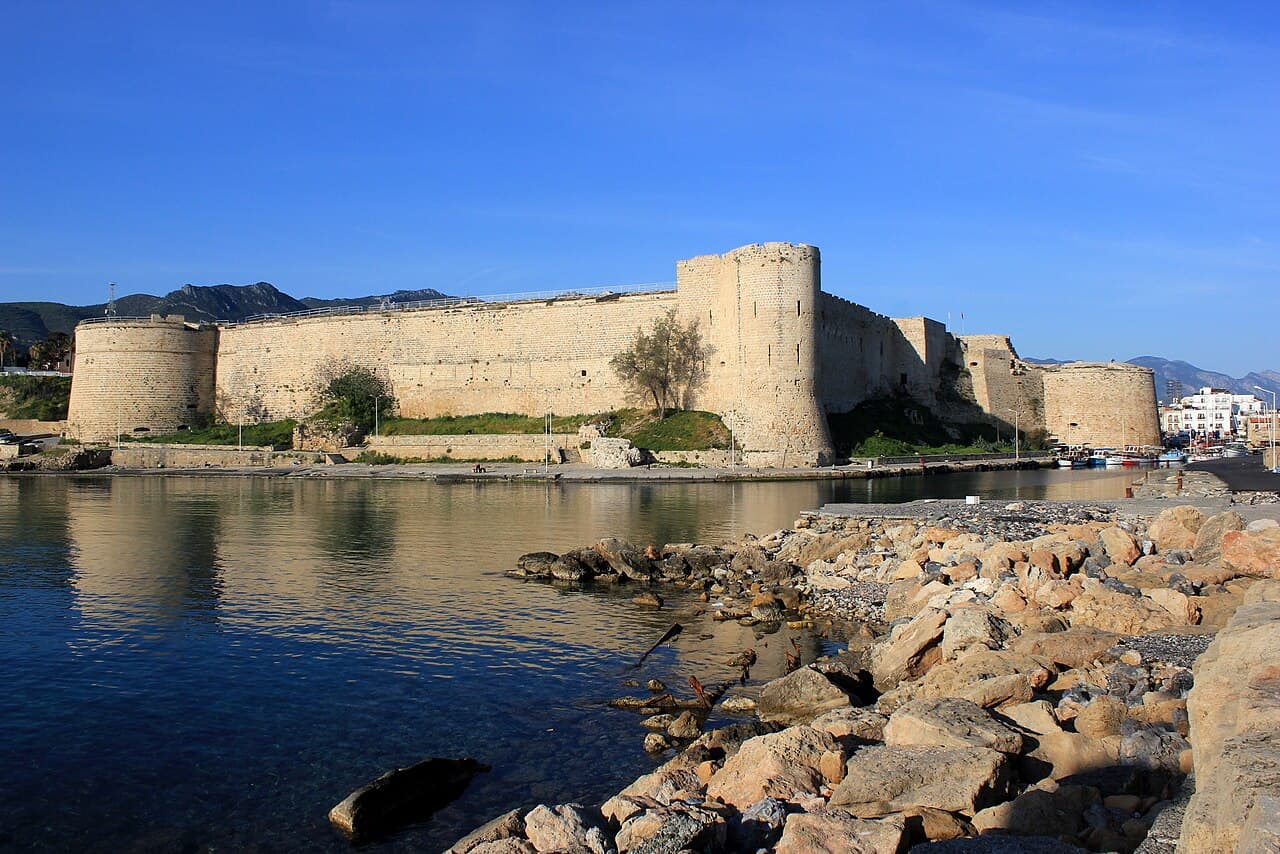
Kyrenia Castle, located in the north-east of Kyrenia in Northern Cyprus, is a striking example of a well-preserved Renaissance fortress that dominates the harbor with its imposing tetragonal form. The castle's history spans several centuries, reflecting the strategic importance of Cyprus in the Mediterranean and the island's complex political and military past.
The earliest historical mention of the castle dates back to 1191, when the English King Richard the Lionheart captured it during his passage to the Third Crusade. He defeated the local ruler, Isaac Comnenus, who had declared himself emperor, marking the beginning of a significant chapter in the castle's history. However, archaeological evidence suggests that the site was originally fortified much earlier, likely in the 7th century AD by the Byzantines as a defense against Arab maritime threats. Excavations around the castle reveal layers of occupation and fortification dating back to the Hellenistic and Roman periods, though the exact date of the initial construction remains uncertain.
Architectural evolution through three major periods
Byzantine foundations (7th - 12th centuries)
The original Kyrenia Castle was probably constructed in the Byzantine period to protect the city and harbor from Arab invasions. Its earliest fortifications were likely modest in scale but strategically positioned to control access to the coast. Remnants of these foundations survive within the current structure, particularly in the southern parts of the castle, where Byzantine masonry and defensive walls can still be seen. This phase established the castle's initial role as a coastal stronghold.
Lusignan enhancements (1208 - 1211 AD)
Following the castle's capture by Richard the Lionheart, it was sold to the Knights Templar and then to Guy de Lusignan, initiating the Lusignan Kingdom of Cyprus era (1192–1489). The Lusignans undertook significant expansions under King John d'Ibelin between 1208 and 1211. These improvements included the construction of a new entrance, the addition of square and horseshoe-shaped towers, embrasures for archers, and the establishment of dungeons. The castle's military function was emphasized, serving both as a refuge in times of war and a residence during peace.
The Lusignan period also saw the castle endure several sieges. Notably, a Genoese attack in 1373 nearly destroyed the fortress, and a prolonged siege in the 15th century lasted nearly four years, during which the defenders suffered extreme hardship. The Lusignan architectural legacy remains evident in the castle's arched rooms, royal guard quarters, and the Latin Temple's large windows.
Venetian fortifications (1489 - 1570 AD)
When the Venetians took control of Cyprus in 1489, they initiated a major reconstruction of Kyrenia Castle, completed around 1540. This phase transformed the castle into a formidable bastioned fortress adapted to the era of gunpowder artillery. The Venetians thickened the walls, added embrasures for cannons, and installed gun ports at multiple levels to defend against land-based attacks, reflecting their concern over local uprisings as much as foreign invasions.
The castle's entrance was fortified with a bridge over a moat, which originally served as a harbor until the 14th century. Inside, the Venetians constructed long ramps to facilitate moving artillery to the battlements. They also enclosed the small Church of St. George, whose dome rests on marble columns with Corinthian capitals, likely salvaged from earlier Byzantine structures.
Later history and uses
In 1570, the castle surrendered to the Ottoman Empire without resistance. The Ottomans made some modifications, including the addition of the tomb of Admiral Sadik Pasha, who led the conquest of Kyrenia. However, many Ottoman alterations were removed during the British colonial period when the castle was repurposed as a police barracks, training school, and prison, notably for members of the Greek Cypriot EOKA organization.
Since Cyprus gained independence in 1960, Kyrenia Castle has been open to the public as a cultural and historical monument. It briefly served as a military headquarters for the Cypriot National Guard between 1963 and 1967. After the 1974 Turkish invasion, the castle came under the care of the Girne Department of Antiquities and Museums, which has preserved its structure and houses important collections, including icons from local churches.
Architectural features and interior highlights
Defensive structures and layout
The castle's tetragonal layout includes thick defensive walls, multiple towers, and a moat on the landward side. Visitors enter through the north-west gate, crossing a bridge over the moat into a vaulted corridor leading to the Lusignan castle's main entrance. The castle's fortifications reflect layered construction from Byzantine, Lusignan, and Venetian periods, each contributing to its complex defensive system.
Church of st. george
Within the castle grounds stands the Church of St. George, a cruciform structure possibly dating from the 11th or 12th century Byzantine era. Its dome is supported by marble columns with intricately carved Corinthian capitals, demonstrating the reuse of classical architectural elements. The church was incorporated into the castle during the Venetian modifications, emphasizing its religious as well as military significance.
Courtyard and living quarters
The large inner courtyard is surrounded by arched rooms that served as guardrooms, stables, and living quarters during the Lusignan period. The royal apartments, located to the west of the courtyard, feature large arched windows characteristic of Lusignan Gothic architecture. Ramps and stairways lead to the battlements, dungeons, and powder magazines below, illustrating the castle's comprehensive defensive and residential functions.
Shipwreck museum
One of the castle's most notable modern attractions is the Shipwreck Museum, which houses the remains of a 4th-century BC Greek merchant ship discovered off Kyrenia's coast in 1965. The shipwreck, preserved in a controlled environment, includes the wooden hull made of Aleppo pine and its cargo of amphorae and millstones, providing invaluable insight into ancient maritime trade in the Mediterranean.
Cultural and historical significance
Kyrenia Castle stands as a testament to the island's strategic importance and the succession of civilizations that have ruled Cyprus. Its well-preserved architecture offers a unique glimpse into the military, religious, and domestic life from the Byzantine through the Venetian periods. The castle also serves as a guardian of cultural heritage, housing archaeological finds and religious icons that reflect the rich history of the Kyrenia region.
Visitors today can explore the castle's extensive fortifications, historic church, and museum collections, making it a key destination for those interested in medieval architecture, Mediterranean history, and maritime archaeology. Its commanding position overlooking Kyrenia harbor continues to captivate and inspire, linking the past with the present in a vivid narrative of resilience and adaptation.
Frequently asked questions (FAQ)
- What is the historical significance of Kyrenia Castle?
- Kyrenia Castle, built during the Byzantine period, has played a crucial role in the defense of the region throughout history. It served as a strategic military stronghold and underwent various modifications by different rulers, including the Venetians and Ottomans, reflecting the castle's rich and diverse heritage.
- When was Kyrenia Castle built?
- Kyrenia Castle was originally constructed in the 7th century A.D., with subsequent renovations and expansions occurring over the centuries. The castle showcases architectural styles from various eras, making it a fascinating site for visitors interested in history and architecture.
- What are the opening hours for Kyrenia Castle?
- Kyrenia Castle is open to visitors daily from 9:00 AM to 5:00 PM. However, it's advisable to check for any seasonal changes or special holiday hours before planning your visit.
- Can I access Kyrenia Castle by public transportation?
- Yes, Kyrenia Castle is accessible by public transportation, including local buses that connect various parts of Cyprus. Additionally, taxis and rideshare options are available for a more direct route to the castle.
- Is it possible to explore the interior of Kyrenia Castle?
- Yes, visitors can explore the interior of Kyrenia Castle, which includes various halls, towers, and exhibits that showcase the castle's history. Guided tours are also available for those who wish to learn more about the castle's past and architectural features.
- What is the best time to visit Kyrenia Castle?
- The best time to visit Kyrenia Castle is during the spring and fall months when the weather is mild and pleasant. Summer can be quite hot, and visiting early in the morning or later in the afternoon is recommended during that season.
- What are the ticket prices for Kyrenia Castle?
- As of now, the entrance fee for Kyrenia Castle is approximately €5 per adult, with discounts available for students and children. It's always a good idea to check for any updates on pricing before your visit.
- Are there nearby attractions to Kyrenia Castle?
- Yes, there are several nearby attractions, including the picturesque Kyrenia Harbor and the ancient Bellapais Abbey. These sites complement your visit to the castle and offer additional insights into the rich history of the region.
Photo gallery

Information
Featured in
Articles on the Castlopedia blog that feature Kyrenia Castle.
Loading map...
Visitor reviews
No reviews yet. Been here? Write the first review and help other travelers!
Write the first reviewVisited this castle? Share your experience
Your review helps other travelers and adds first-hand knowledge to our encyclopedia.