Buffavento Castle
Buffavento Castle stands as the highest of the three famed Crusader castles in Cyprus, perched at an impressive altitude of approximately 955 meters above sea level. This commanding hill castle occupies a strategic position on the rugged Kyrenia mountain range, overlooking vast stretches of the northern coastline and inland regions. Its elevated location made it a critical watchtower and fortress throughout its history, providing both military defense and political control.
The origins of Buffavento Castle can be traced back to the Byzantine period, with its initial construction likely dating to the 10th century. It was originally built as a watchtower designed to guard against frequent Arab raids along the coast and to secure the mountain passages leading from the interior town of Kythrea toward the northern shore. This early Byzantine fortification formed part of a defensive chain alongside St. Hilarion Castle to the west and Kantara Castle to the east, collectively protecting crucial routes and providing early warning signals.
With the arrival of the Crusaders and the subsequent Lusignan dynasty rule from 1192 to 1489, Buffavento underwent significant extensions and modifications. The castle was transformed from a simple watchtower into a more complex fortress with multiple wards and defensive structures. The Lusignan kings primarily used Buffavento as a political prison, imprisoning notable figures within its austere walls. One infamous episode involves King Peter I, who, after being warned of his queen’s infidelity by his friend John Visconti, imprisoned and tortured Visconti at Kyrenia before locking him in Buffavento to starve to death.
By the 16th century, the strategic importance of Buffavento Castle declined as the focus of defense shifted to coastal strongholds like Kyrenia and Famagusta under Venetian rule. The Venetians partially dismantled the castle to prevent its use by enemies, leaving it in a state of ruin. Despite this, the castle’s location and remains continue to captivate visitors, offering spectacular panoramic views of Kyrenia, Famagusta, Nicosia, and on clear days, the distant Troodos Mountains.
Historical significance and medieval conflicts
Buffavento Castle’s history is deeply intertwined with the turbulent medieval period of Cyprus. Its position on the Kyrenia mountain range made it a vital defensive outpost against both external invasions and internal power struggles. The fortress was captured by Richard the Lionheart during his 1191 campaign against the Byzantine ruler Isaac Komnenos, marking the castle’s transition from Byzantine to Crusader control. Richard subsequently sold the castle to the Knights Templar, who maintained it as a military and administrative site.
Throughout the 13th century, Buffavento became a contested site amid the political rivalries involving the House of Ibelin and factions loyal to Frederick II, Holy Roman Emperor. The castle also served as a prison for prominent figures, including the Knights Templar leader Anseau of Brie, who was incarcerated there in 1308 during the trials against the order. These events underscore the castle’s role not only as a military bastion but also as a symbol of political authority and control.
Architectural features and layout
Location and structural divisions
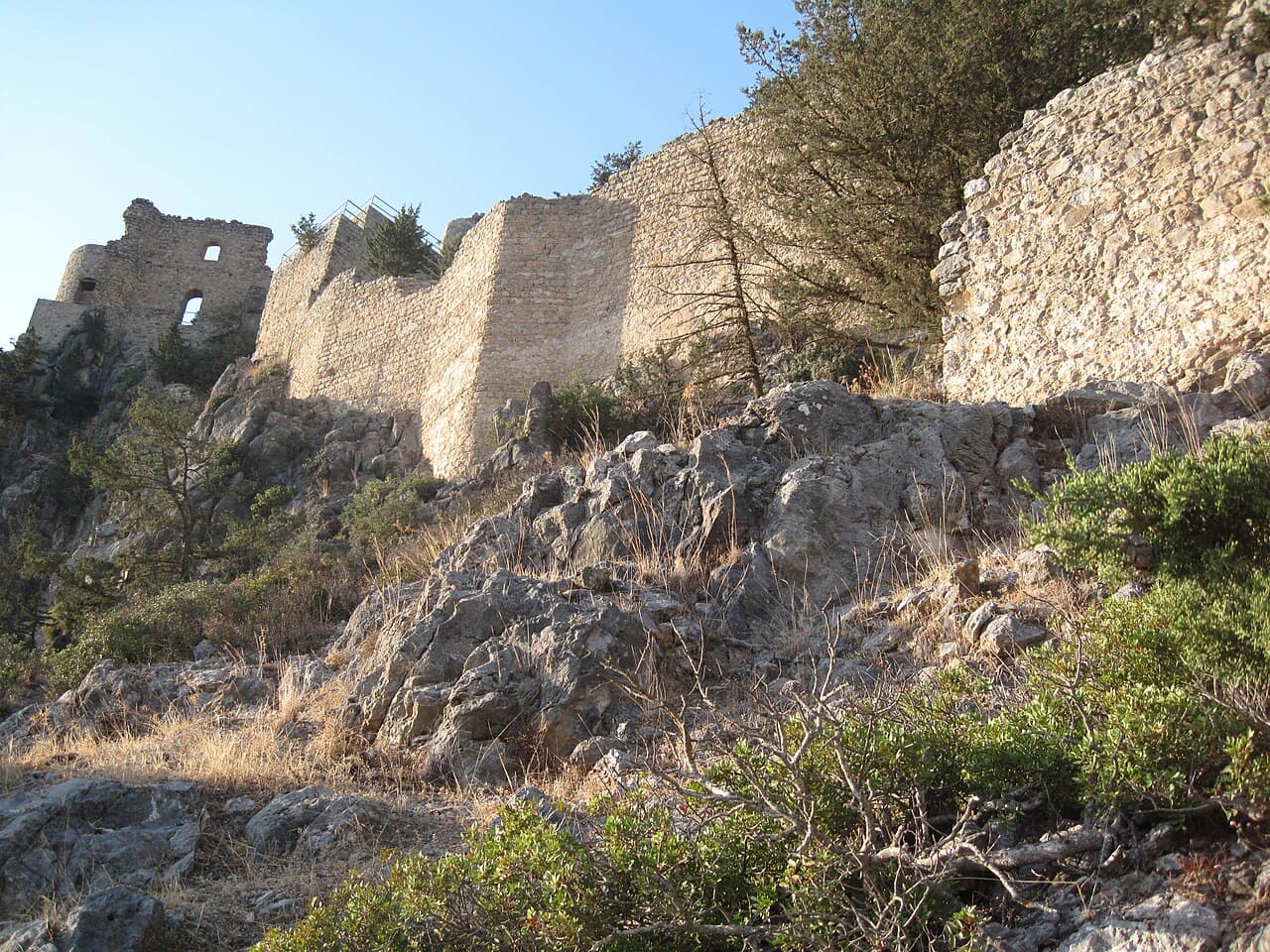
Buffavento Castle crowns a rocky peak that rises sharply above the surrounding landscape, with steep cliffs on most sides making the fortress naturally defensible. The only accessible approach is from the south, reached by a challenging climb of approximately 600 steps. The castle is divided into two main sections: the upper ward facing the sea and the lower ward facing the plain below. Originally, these two parts were connected by a long staircase, which was later destroyed, likely by Venetian occupants aiming to disrupt internal movement within the fortress.
Construction materials and techniques
The castle’s construction is notable for its use of both dressed limestone quarried from Cyprus’s coastal areas and rough stones sourced directly from the mountain. This combination reflects practical building techniques adapted to the rugged terrain. Unlike many castles designed for display or grandeur, Buffavento’s architecture is functional and austere, emphasizing defense over decoration.
Key architectural elements
- The main entrance is located within a two-storey rectangular tower featuring a pointed arch, a hallmark of Frankish architecture. This gatehouse provided the primary controlled access point.
- West of the gatehouse are three barrel-vaulted buildings dating to the Frankish period, likely serving as storerooms or barracks.
- Behind the entrance tower lie three irregular chambers with the ruins of a fourth, indicating phases of modification and adaptation over time.
- A large two-storey Byzantine building with unvaulted interiors lies to the west of the main stairway. It is divided into three spacious rooms, showcasing earlier architectural styles predating the Frankish additions.
- A rectangular cistern near the upper ward was ingeniously designed to collect rainwater, connected to smaller compartments with water pipes, reflecting the importance of water management for sustaining the garrison.
- An eastern short tower with groin vaulting served as a guard post, demonstrating Frankish defensive architectural techniques.
- Nearby stands a building believed to be a chapel or small church, linking the fortress to its religious functions during the medieval period.
- At the western edge, an isolated ruined tower likely functioned as an additional lookout or defensive position.
The castle’s decline and modern condition
Following the Venetian takeover in the 16th century, Buffavento Castle was deliberately dismantled to prevent its use by potential invaders. This strategic decision reflected a shift in military priorities toward coastal fortifications. Over the subsequent centuries, the castle fell into ruin, with many structures collapsing or becoming overgrown.
Today, Buffavento remains a site of significant historical and architectural interest, although it is classified as a ruin. Visitors who undertake the strenuous climb are rewarded with breathtaking views and a tangible connection to Cyprus’s medieval past. The surviving remnants, including the chapel ruins, cisterns, and defensive towers, provide valuable insights into the castle’s multifaceted role as a fortress, prison, and refuge.
Visitor experience and accessibility
Access to Buffavento Castle requires a challenging ascent along steep mountain paths and roughly 600 steps, making it suitable for visitors with good physical fitness. The castle is largely open to the elements, with no modern facilities on site, emphasizing its rugged and authentic medieval character. The panoramic views from the summit are among the most spectacular in Cyprus, encompassing the cities of Kyrenia, Famagusta, and Nicosia, as well as the Troodos Mountains on clear days.
While the castle is not extensively developed for tourism, it attracts history enthusiasts, hikers, and photographers drawn by its dramatic setting and rich historical narrative. Visitors are advised to wear sturdy footwear and bring water, especially during warmer months. The site’s preservation as a ruin allows for an evocative exploration of medieval military architecture and the enduring legacy of Byzantine and Crusader influences on Cyprus.
Frequently asked questions (FAQ)
- How do I get to Buffavento Castle?
- Buffavento Castle is accessible via a hiking trail from the southern approach, involving a climb of about 600 steps. Visitors should be prepared for a steep ascent and wear appropriate footwear.
- What is the historical significance of Buffavento Castle?
- Buffavento Castle played a crucial role in medieval Cyprus as a Byzantine watchtower and later a Crusader fortress and prison, guarding mountain passes and serving political purposes.
- Is Buffavento Castle suitable for families with children?
- Due to the steep and challenging climb, Buffavento Castle is best suited for visitors with good physical fitness. Families with young children should consider this before planning a visit.
- When is the best time to visit Buffavento Castle?
- The best time to visit is during the cooler months of spring and autumn when the weather is mild, making the climb more comfortable and the views clearer.
- Are there any facilities at Buffavento Castle?
- The castle is largely in ruins with no modern facilities on site. Visitors should bring their own water and supplies and be prepared for a rugged outdoor experience.
Photo gallery

Information
Current owner
State museum
Loading map...
Visitor reviews
No reviews yet. Been here? Write the first review and help other travelers!
Write the first reviewVisited this castle? Share your experience
Your review helps other travelers and adds first-hand knowledge to our encyclopedia.