Kerak Castle
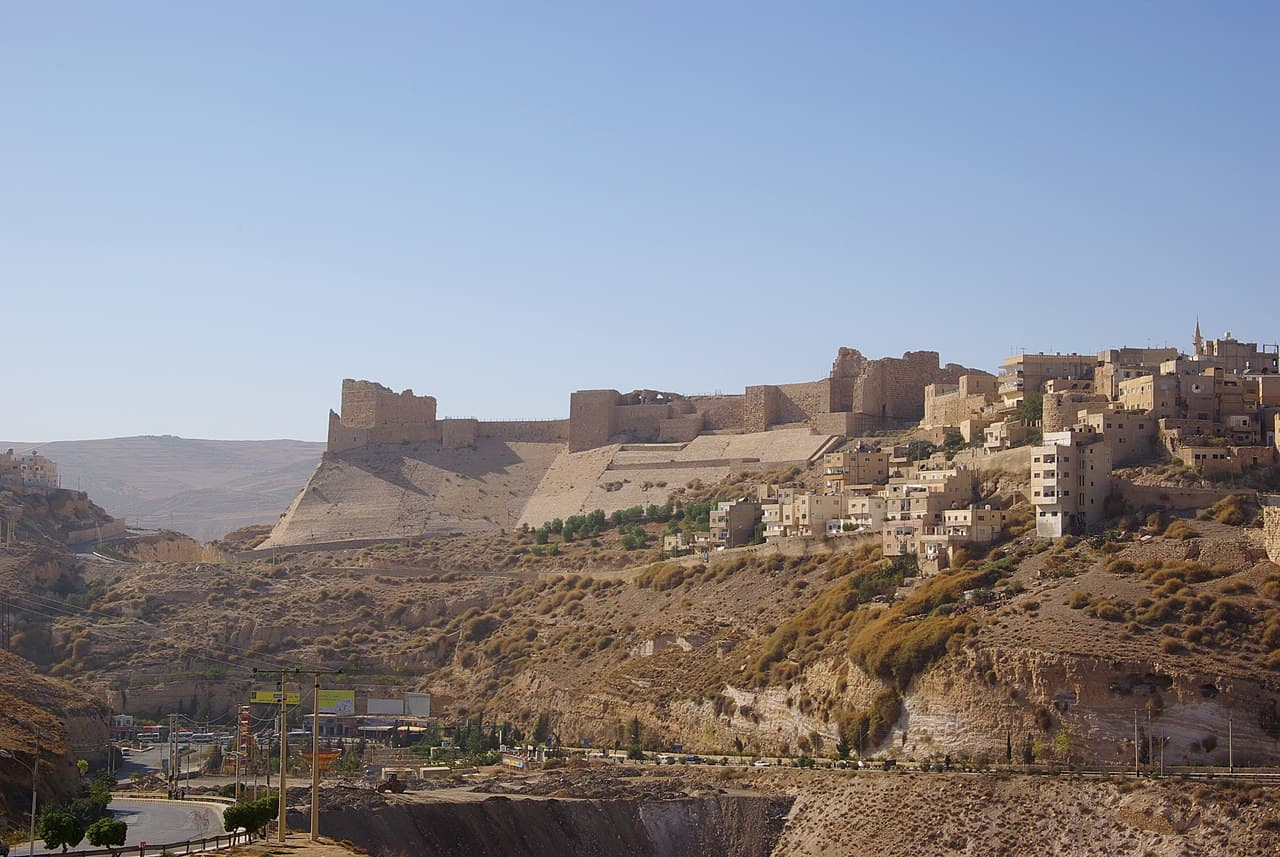
Kerak Castle, perched high on a strategic hilltop in Al Karak, Jordan, is one of the largest and most historically significant medieval fortresses in the Levant. Constructed in the 1140s by Crusader lords Pagan the Butler and King Fulk of Jerusalem, this hill castle was designed to control vital trade routes linking Damascus, Egypt, Mecca, and the Dead Sea region. Its commanding position allowed it to oversee the movement of Bedouin herders and merchants, making it a key military and administrative stronghold for successive rulers.
The castle’s architecture is a remarkable blend of European Crusader, Byzantine, and Arab influences. The original Crusader construction prominently features dark volcanic stone, particularly in the upper levels and defensive walls, while later Muslim and Ottoman additions employed lighter white limestone. This contrast visually narrates the castle’s layered history of occupation and adaptation over centuries.
Historical significance and strategic role
Kerak’s foundation marked a shift in regional power during the High Medieval period. It replaced the less defensible Montreal Castle to the south and became the principal fortress of the Crusader lordship of Oultrejordain. The castle’s control over the eastern approaches to the Kingdom of Jerusalem made it a frequent target of military campaigns, especially by the Muslim leader Saladin.
Sieges and military engagements
The fortress endured several notable sieges during the late 12th century. Saladin’s forces unsuccessfully besieged Kerak in 1183 and 1184. However, in 1188, following his decisive victory at the Battle of Hattin, Saladin’s nephew Sa’d al-Din led a siege that cut off supplies and forced the Crusaders to surrender after months of resistance. This surrender marked a significant turning point in the Crusader-Muslim conflicts in the region.
Under subsequent Ayyubid rule, Kerak served as an administrative center for Jordan. The castle saw expansions and fortification enhancements, including the construction of an underground tunnel linking it to the adjacent town, commissioned by Sultan al-Mu'azzam 'Isa in 1227. The fortress also played a role in internal Ayyubid power struggles and later came under Mamluk control.
Architectural features and layout
Kerak Castle exemplifies a spur castle design, built on a plateau with steep hills surrounding it on three sides, concentrating defense on the accessible northern side. The castle covers approximately 25,300 square meters, with a length of about 220 meters and a width varying from 125 meters on the north to 40 meters on the south.
Defensive structures
The castle’s defenses are formidable, featuring thick stone walls reinforced by rectangular projecting towers. These towers reflect early Crusader architectural preferences influenced by Byzantine square tower designs, predating the later adoption of rounded towers. Two deep rock-cut ditches protect the northern side; one also serves as a large cistern collecting rainwater. A glacis—a steep masonry slope—at the base of the walls further impedes attackers by making scaling difficult and keeping siege engines at bay.
Interior spaces and functional areas
On the northern side, two levels of large arched halls remain intact. These halls served multiple purposes, including living quarters, stables, and a fighting gallery. The design allowed defenders to observe and repel attackers while sheltered from missile fire. A chapel is located along the eastern curtain wall, reflecting the castle’s religious significance during the Crusader period.
Subterranean passageways and fortified rooms beneath the castle hint at complex defensive and logistical arrangements, though their precise functions vary according to the castle’s phases of occupation by Crusader, Ayyubid, Mamluk, and Ottoman rulers.
Later modifications and cultural importance
The Mamluk Sultan Baibars enhanced the castle in 1263, adding a tower on the northwest corner and incorporating the fortress into the Mamluk military and administrative network. During the Ottoman period, Kerak retained strategic importance at the crossroads of the Arabian Peninsula, Egypt, and Greater Syria. It was besieged and partially damaged in 1834 during a peasants’ revolt but was restored to Ottoman control later in the century, hosting a substantial garrison.
The castle’s multi-layered history is also reflected in its religious significance, with graves near the southern area believed to belong to companions of the Prophet Muhammad. This adds a spiritual dimension to the site’s cultural heritage.
Archaeological research and preservation
In the early 20th century, scholars such as Paul Deschamps and architect François Anus conducted detailed studies, producing the first reliable architectural plans in 1929. Today, Kerak Castle is well preserved in many areas, though it is not a UNESCO World Heritage site. The castle remains a major tourist attraction and an emblem of Jordan’s rich medieval heritage.
Nearby, the Al Karak Archaeology Museum houses artifacts spanning from Neolithic times through the Islamic periods, showcasing the region’s layered history that Kerak Castle physically embodies.
Visitor information and accessibility
Visitors to Kerak Castle can explore its extensive halls, towers, and defensive works, gaining insight into the military architecture of the Crusader and Islamic periods. The castle’s elevated location offers panoramic views of the surrounding landscape, emphasizing its strategic importance. The site is accessible year-round, with guided tours available to enhance the visitor experience.
Frequently asked questions (FAQ)
- What is the historical significance of Kerak Castle?
- Kerak Castle, built in the 12th century, is an important example of Crusader architecture and played a vital role in the region during the Crusades. It served as a strategic stronghold for the Crusaders and later for the Ayyubids, reflecting the tumultuous history of the area. Today, it stands as a testament to the medieval military architecture and the cultural exchanges between different civilizations.
- When was Kerak Castle built?
- Kerak Castle was originally constructed in 1142 by the Crusaders as part of their defensive network in the Holy Land. Over the years, it underwent various renovations and expansions, particularly under the Ayyubid Sultan Saladin in the late 12th century. This rich history adds to its allure as a major historical site in Jordan.
- Can I visit Kerak Castle year-round?
- Yes, Kerak Castle is open to visitors throughout the year, allowing guests to explore its rich history and stunning architecture. However, it is advisable to check local conditions or any special events that may affect access. The castle's expansive grounds and numerous chambers make it a fascinating place to visit regardless of the season.
- What are the opening hours for Kerak Castle?
- Kerak Castle is typically open from 8:00 AM to 6:00 PM during the summer months and 8:00 AM to 4:00 PM in the winter months. It is recommended to arrive early to fully enjoy the site and avoid crowds. Please verify the current hours before your visit, as they may change on public holidays.
- Is it possible to access Kerak Castle with a wheelchair?
- While Kerak Castle has some accessible pathways, the terrain can be uneven and steep in certain areas, which may pose challenges for wheelchair users. It is advisable to check in advance for the best routes and any assistance that may be available. Staff on-site can provide guidance to help make your visit more comfortable.
- What is the best time to visit Kerak Castle?
- The best time to visit Kerak Castle is during the spring (March to May) and fall (September to November) when the weather is mild and pleasant. These seasons not only offer comfortable temperatures for exploring but also provide beautiful views of the surrounding landscape. Avoiding the peak summer heat will enhance your overall experience.
- Are there any nearby attractions to visit after Kerak Castle?
- Yes, after visiting Kerak Castle, you can explore nearby attractions such as the ancient city of Petra, which is about an hour's drive away, and the stunning landscapes of Wadi Mujib. Additionally, the Dead Sea is also a fantastic option for a relaxing experience after your castle tour. Each of these sites offers a unique glimpse into Jordan's rich history and natural beauty.
- How much are the ticket prices for Kerak Castle?
- The entrance fee for Kerak Castle is generally quite affordable, typically around 2 Jordanian Dinars for adults. Discounts may be available for students and children, making it accessible for families. Keep in mind that prices and policies can change, so it's a good idea to check ahead before your visit.
Photo gallery

Information
Website
Visit websiteFeatured in
Articles on the Castlopedia blog that feature Kerak Castle.
Sources & official resources
Verify the information above using these authoritative references.
Loading map...
Visitor reviews
No reviews yet. Been here? Write the first review and help other travelers!
Write the first reviewVisited this castle? Share your experience
Your review helps other travelers and adds first-hand knowledge to our encyclopedia.