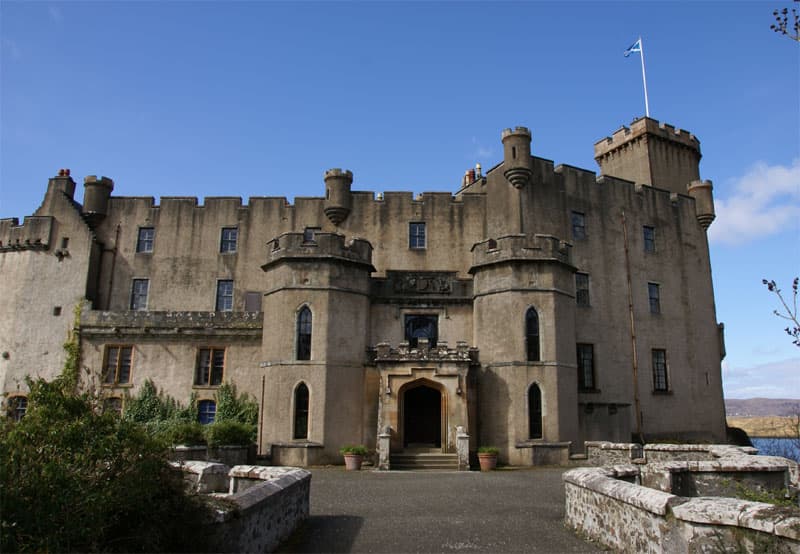
Dunvegan Castle
Dunvegan Castle stands prominently on the Isle of Skye, Scotland, as a remarkable symbol of Scottish heritage and clan history. Situated about a mile and a half north of Dunvegan village, this hill castle has served as the ancestral home and stronghold of the MacLeod of MacLeod, chiefs of Clan MacLeod, for more than eight centuries. Its continuous occupation makes it the oldest continuously inhabited castle in Scotland, a testament to its enduring strategic and cultural significance.
The castle's origins trace back to the 13th century when a curtain wall was constructed around a basalt outcrop overlooking Loch Dunvegan. This fortification enclosed an earlier Norse fortification and was initially accessible only by a sea gate, emphasizing its defensive maritime position. Around 1350, Malcolm MacLeod, the clan's third chief, built the core of the castle—a robust four-story medieval tower house or donjon—which remains the centerpiece of the complex today. This tower was built using local stone and designed to serve both defensive and residential purposes, anchoring the clan's control over their territories in Skye and the Outer Hebrides.
Medieval foundations and clan stronghold
The castle's earliest phase reflects the turbulent high medieval period, characterized by clan rivalries and Norse-Scottish interactions. The curtain wall and sea gate provided formidable protection, while the tower house embodied the typical fortified residence of Scottish clans during the era. The castle's strategic location atop a 15-meter basalt rock offered commanding views and natural defenses, vital for maintaining control over the surrounding lands and waterways.
The fairy tower and 16th-century expansions
Circa 1500, Alasdair Crotach MacLeod, a notable clan chief, expanded the castle by adding the Fairy Tower, a separate four-story structure distinguished by its narrow spiral staircases. This addition enhanced both the defensive capabilities and residential space of the castle, reflecting ongoing concerns about security and comfort during the late medieval period. The Fairy Tower's design allowed defenders to efficiently maneuver while complicating any attackers' progress.
17th-century developments and domestic improvements
In 1623, Roderick MacLeod (Rory Mor) further developed the castle by filling the space between the main tower and the Fairy Tower with new buildings, creating a more cohesive and expansive living area. This expansion marked a shift from purely military functions to increased domestic comfort, aligning with broader trends in Scottish castle architecture during the early modern period.
Historical significance and clan legacy
Dunvegan Castle has played a pivotal role in Scottish history, particularly in relation to the MacLeod clan's fortunes and the wider political landscape. The clan supported Charles II during the Battle of Worcester in 1651, demonstrating their royalist allegiance during the English Civil Wars. Later, during the Jacobite uprising of 1745, the clan's loyalties were complex and divided, reflecting the nuanced political dynamics of the Highlands at the time.
By the 18th century, the castle's defensive importance waned, leading to architectural adaptations that prioritized comfort and accessibility. Notably, in 1748, a land entrance was created, replacing the previous exclusive sea gate access. The estate experienced financial difficulties during the potato famine (1847-1851), which temporarily left the castle unoccupied until its reinhabitation in 1929.
Victorian remodeling and modern stewardship
The Victorian era brought significant aesthetic changes to Dunvegan Castle. Architect Robert Brown led renovations around 1840, introducing decorative pepper-pot turrets and other ornamental features that transformed the castle's appearance from a fortress to a more palatial residence. These additions included small corner turrets reminiscent of oriel windows, enhancing the castle's grandeur while moving away from purely defensive architecture.
Despite these modifications, the castle has maintained its continuous occupation, preserving its unique status in Scotland. Since opening to the public in 1933 under the 27th clan chief, Reginald MacLeod, Dunvegan Castle has become a cultural and historical attraction, showcasing an extensive collection of clan relics and artifacts.
Architectural features and castle complex
The castle complex is a fascinating blend of medieval and later architectural elements. The original curtain wall, medieval tower house, and Fairy Tower coexist alongside 17th-century infill buildings and Victorian decorative additions. Ancillary structures such as a laundry building (1734), gate piers, stables, and a sawmill contribute to the estate's operational history.
Access to the castle evolved over time from the original sea gate to a stone bridge built in 1801, facilitating land-based entry. The castle's position on a basalt outcrop with a natural freshwater spring supported its sustainability and defense. The complex is recognized under various heritage listings, ensuring the protection of its historic fabric.
Gardens and landscape
Surrounding the castle are approximately five acres of formal gardens developed over several centuries. These gardens include a water garden with ponds and ornamental bridges, a circular rose garden centered on a distinctive Chilean monkey puzzle tree (Araucaria araucana), and a walled vegetable garden with herb beds and raised plots. Historic features such as a 17th-century sundial and a larch pergola add further heritage value.
The gardens extend into wooded areas featuring forest trails, a rhododendron demonstration garden, and a wild forest zone. A children’s play area with a willow tunnel and an insect hotel called Bugvegan reflects the estate's commitment to ecological education and family-friendly experiences.
Cultural treasures and museum collection
Inside Dunvegan Castle, a museum preserves numerous clan relics of great historical and cultural significance. The Fairie Flag, a yellow silk banner dating from between the 4th and 7th centuries and believed to originate from the Middle East, holds legendary status within the clan. The Dunvegan Cup, an elaborately decorated wooden vessel with silver embellishments dating to around 900 AD, exemplifies the clan's long-standing heritage.
The museum also houses Jacobite memorabilia, including an embroidered pincushion commemorating fallen Jacobite fighters and a lock of hair reputed to belong to Bonnie Prince Charlie. These artifacts connect Dunvegan Castle to broader Scottish historical narratives and underscore its role as a custodian of clan memory.
Today, Dunvegan Castle remains a vital cultural landmark, blending its rich history, distinctive architecture, and beautiful gardens to offer visitors a comprehensive experience of Scottish clan heritage and medieval to Victorian architectural evolution.
Frequently asked questions (FAQ)
- How do I get to Dunvegan Castle on the Isle of Skye?
- Dunvegan Castle is located about 1.5 miles north of Dunvegan village on the Isle of Skye. It is accessible by car via the A87 road, with parking available on site. Public transport options are limited, so driving is recommended.
- What are the main historical periods reflected in Dunvegan Castle's architecture?
- Dunvegan Castle's architecture spans from its 13th-century medieval origins through 16th-century expansions and 19th-century Victorian remodeling. Key features include the medieval tower house, the Fairy Tower, and Victorian decorative turrets.
- Is Dunvegan Castle open to the public, and what can visitors expect?
- Yes, Dunvegan Castle has been open to the public since 1933. Visitors can explore the castle's historic rooms, clan relics such as the Fairie Flag and Dunvegan Cup, and enjoy the formal gardens and woodland trails on the estate.
- Why is Dunvegan Castle considered significant in Scottish history?
- Dunvegan Castle is the oldest continuously inhabited castle in Scotland and has been the seat of Clan MacLeod chiefs for over 800 years. It played important roles in medieval clan politics, the English Civil Wars, and the Jacobite uprisings.
- Can I visit the gardens at Dunvegan Castle?
- Yes, the castle grounds include about five acres of formal gardens featuring water gardens, a rose garden, a walled vegetable garden, and woodland areas with forest trails and ecological features like the Bugvegan insect hotel.
Photo gallery

Information
Featured in
Articles on the Castlopedia blog that feature Dunvegan Castle.
Sources & official resources
Verify the information above using these authoritative references.
Loading map...
Visitor reviews
No reviews yet. Been here? Write the first review and help other travelers!
Write the first reviewVisited this castle? Share your experience
Your review helps other travelers and adds first-hand knowledge to our encyclopedia.


