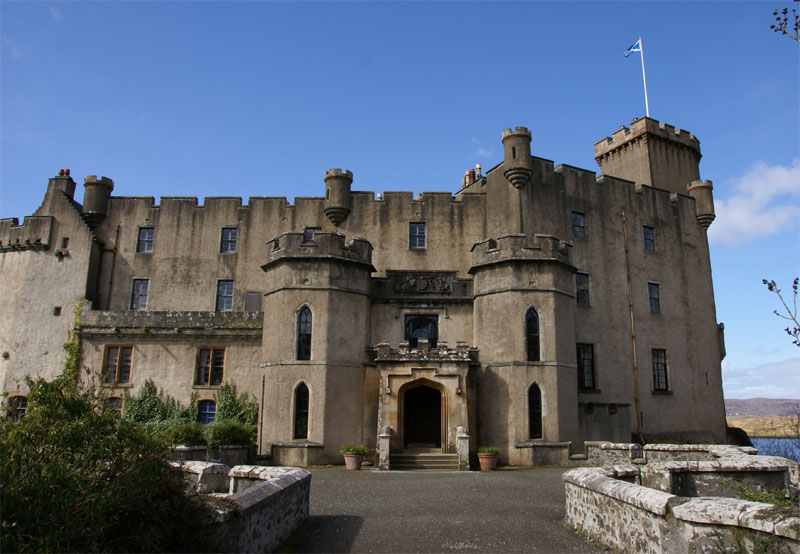
Lews Castle
Lews Castle is a striking example of a 19th-century country house located in the Outer Hebrides of Scotland. Constructed between 1847 and 1857, it was commissioned by Sir James Matheson, a wealthy merchant who acquired the entire Isle of Lewis through his fortune amassed in the Chinese Opium trade. The castle was designed by the notable Glasgow architect Charles Wilson, who employed a style that combines elements of Scottish baronial architecture with Victorian grandeur, reflecting the tastes and ambitions of its original owner.
The architectural design and construction
The castle's design features a robust and symmetrical layout typical of Victorian country houses, with strong influences from the Scottish baronial style. This style is characterized by turrets, battlements, and crow-stepped gables, which give the castle a fortified appearance despite its function as a residence rather than a defensive structure. The use of local stone and traditional building techniques helped anchor the castle visually and materially in its Hebridean setting.
The interior of Lews Castle was originally lavishly decorated to accommodate the needs of a wealthy family and their guests. Large reception rooms, dining halls, and private chambers were arranged to provide comfort and social prestige. The surrounding grounds were landscaped to complement the building, featuring gardens and parkland that enhanced the estate's appeal.
Historical ownership and uses
After Sir James Matheson's death, the castle and the Lewis estate changed hands in 1918 when it was purchased by Lord Leverhulme, an industrialist with ambitions to develop the Western Isles economically. Leverhulme's ownership marked a new chapter for the castle, as he later gifted it to the people of Stornoway parish in 1923. This transfer reflected a shift from private aristocratic residence to a community asset.
World War II military role
During the Second World War, Lews Castle was requisitioned by the military and served as accommodation for air and ground crew of the 700 Naval Air Squadron. This squadron operated a detachment of six Supermarine Walrus amphibious aircraft from a slipway at Cuddy Point within the castle grounds. The base was known as HMS Mentor. The castle's strategic location on the coast made it suitable for this role, linking it to the broader wartime efforts in the North Atlantic.
Post-war educational use
Following the war, the castle found a new purpose as accommodation for students attending Lews Castle College in the 1950s. This adaptation of the building for educational use illustrates the flexibility of the estate and its continued importance to the local community.
Preservation and current status
Today, Lews Castle remains a significant historic building in the Outer Hebrides. Its condition is generally considered well preserved, with ongoing efforts to maintain its architectural integrity and adapt it for modern uses. The castle and its grounds are accessible to visitors, offering insights into the region's history, architectural heritage, and the legacy of its notable owners.
Architectural and cultural significance
The castle is a prominent example of Victorian-era architecture in Scotland, embodying the wealth generated by global trade in the 19th century. Its design by Charles Wilson reflects the fusion of traditional Scottish motifs with contemporary Victorian styles. The castle's history, from private residence to military base and educational facility, highlights the evolving uses of such estates over time.
Moreover, Lews Castle's location in the Outer Hebrides connects it to the cultural and economic history of the region, including the impact of industrialists like Matheson and Leverhulme. The castle remains a landmark for visitors interested in Scottish history, architecture, and the unique heritage of the Hebridean islands.
Frequently asked questions (FAQ)
- What is the history behind Lews Castle?
- Lews Castle was built between 1847 and 1857 for Sir James Matheson, who bought the Isle of Lewis. It later became a military base during World War II and was used for student accommodation in the 1950s.
- Can I visit Lews Castle today?
- Yes, Lews Castle is open to visitors, offering tours of its historic interiors and grounds. It serves as a cultural landmark in the Outer Hebrides.
- What architectural style is Lews Castle built in?
- Lews Castle combines elements of Scottish baronial and Victorian architecture, designed by Charles Wilson in the mid-19th century.
- Why was Lews Castle used during World War II?
- During World War II, Lews Castle was requisitioned as accommodation for the 700 Naval Air Squadron, supporting amphibious aircraft operations from nearby Cuddy Point.
- Who owns Lews Castle now?
- The castle is currently owned by the Stornoway community, reflecting its transition from private estate to public heritage site.
Information
Sources & official resources
Verify the information above using these authoritative references.
Loading map...
Visitor reviews
No reviews yet. Been here? Write the first review and help other travelers!
Write the first reviewVisited this castle? Share your experience
Your review helps other travelers and adds first-hand knowledge to our encyclopedia.