Dunstaffnage Castle
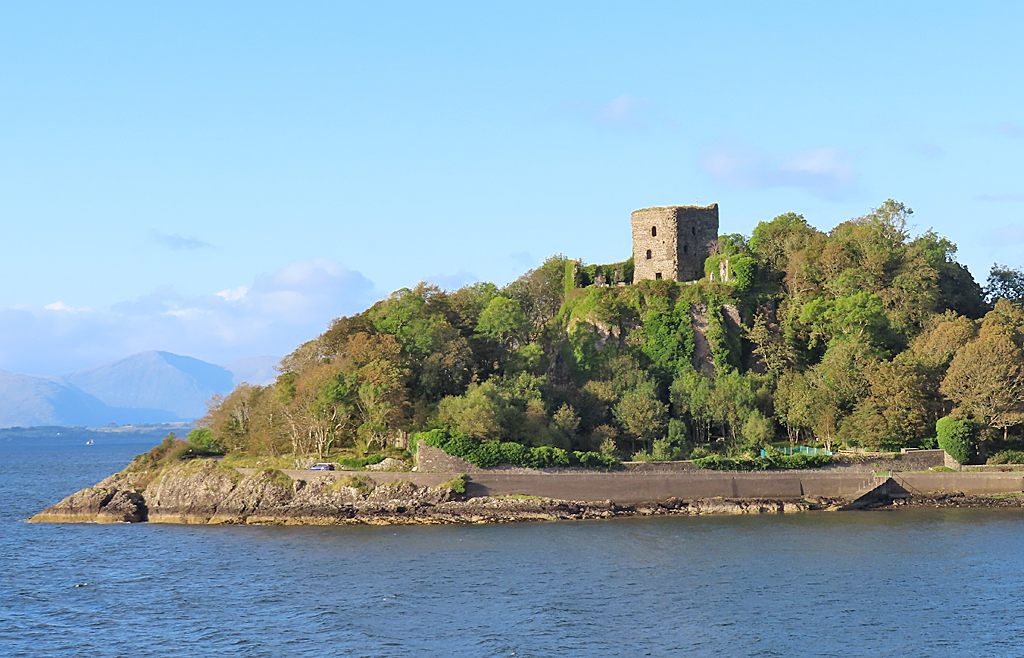
Dunstaffnage Castle stands as one of the oldest and most historically significant stone castles in Scotland. Constructed around 1220 by Duncan MacDougall, son of Earl Somerled, the castle played a pivotal role during the turbulent High Medieval period, particularly amid the fierce struggle between Scotland and Norway for control of the Hebrides. Its strategic location on a rocky promontory overlooking the southwestern entrance to Loch Etive and guarding the seaward approach from the Firth of Lorn to the Pass of Brander made it a formidable defensive fortress and a key stronghold in the region.
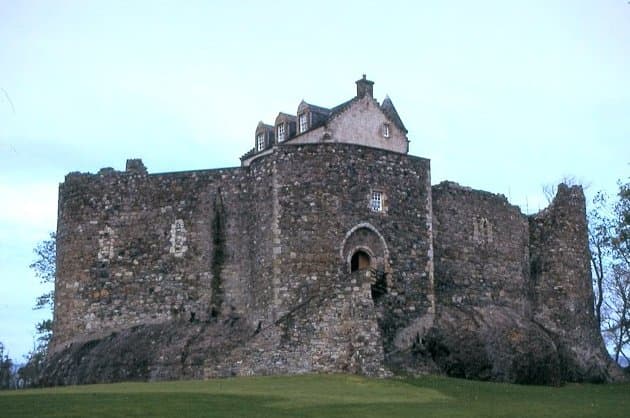
The castle's imposing stone curtain walls rise up to 18 meters in height and several meters thick, enclosing an irregular quadrangular courtyard approximately 35 by 30 meters in dimension. These walls, built from carefully coursed rubble stone with dressed sandstone detailing, feature narrow vertical arrow slits that were later adapted into gunloops to accommodate evolving military technology. The castle's defensive design was further enhanced by three projecting round towers, likely added by Duncan's son Ewen MacDougall, who also expanded the great hall within the courtyard. These towers include the large northern donjon or keep, which housed the lord's private chambers over multiple floors, a western tower with a basement prison, and an eastern tower transformed into a four-storey gatehouse in the late 15th century.
Architectural features and construction
The castle's original defensive features included a parapet walk along the top of the curtain walls, allowing defenders to patrol and repel attackers. Although only fragments of this walkway survive today, it testifies to the castle's military importance. The gatehouse's vaulted basement and entrance passage were guarded by half and guard rooms equipped with arrow slits facing the gateway. A stone staircase replaced the original wooden drawbridge, and the gatehouse was later converted into reception rooms and private apartments in the 18th century. Dormer windows on its roof bear the date 1725 and display the Campbell family coat of arms alongside the initials of Aeneas Campbell, the 11th hereditary Captain of Dunstaffnage, and his wife Dame Lilias.
Within the courtyard, the remains of the great hall and the "new house"—an 18th-century residential building—are visible. The great hall, once a grand space for feasting and gatherings, sat above vaulted storage cellars and featured richly decorated double lancet windows with pointed arches and carved patterns. The "new house" is historically significant as the place where Flora MacDonald was briefly imprisoned in 1746 for aiding Bonnie Prince Charlie's escape after the Battle of Culloden.
Historical significance and events
Dunstaffnage Castle was built during a period of intense conflict between the Scottish crown and Norse rulers over the Hebrides. Its founder, Duncan MacDougall, was the grandson of Somerled, the legendary "King of the Isles." The castle's strategic importance continued through the Wars of Scottish Independence (1296–1356), during which it was besieged by King Robert the Bruce in 1308 following his victory at the Battle of the Pass of Brander. After its capture, the castle became a royal stronghold and was governed by appointed keepers.
In the 15th century, the castle passed from the MacDougalls to the powerful Campbell family, Earls of Argyll, who maintained it as a key base for controlling the western Highlands. The Campbells' influence is evident in the castle's later architectural modifications and the hereditary role of the Captain of Dunstaffnage. The castle saw military action during the 17th-century Civil War, resisting an assault by the forces of James Graham, Marquis of Montrose, and suffered damage during the aftermath of Argyll's Rising in 1685.
During the Jacobite uprisings of 1715 and 1745, Dunstaffnage remained a government stronghold. Its most famous historical episode from this period was the brief imprisonment of Flora MacDonald, who was held there before being transferred to London for assisting Bonnie Prince Charlie's escape.
The chapel and surrounding structures
Approximately 150 meters southwest of the castle lie the ruins of the 13th-century Dunstaffnage Chapel, built by Duncan MacDougall as a private place of worship. The chapel measures about 20 by 6 meters and originally had a timber roof. It is renowned for its finely detailed Gothic architectural features, including lancet windows adorned with intricate dog-tooth carving and wide-splayed arches that allowed ample light into the interior. By the mid-18th century, the chapel had fallen into ruin, although a burial aisle was added to the east end to serve the Campbell family.
Historical and cultural legacy
The castle's long history reflects the complex dynamics of Scottish medieval and early modern politics, warfare, and clan rivalries. It symbolizes the transition from Norse-Gaelic lordship to Scottish royal authority and later to Campbell dominance in the west. The castle's preservation and partial restoration efforts, initiated in the early 20th century and now managed by Historic Environment Scotland, have helped maintain its status as a significant heritage site.
Dunstaffnage also carries a rich folkloric tradition, including tales of the "Ell-maid of Dunstaffnage," a ghostly figure whose appearances are said to foreshadow the fortunes of the castle's keepers. The hereditary Captain of Dunstaffnage retains a ceremonial role today, traditionally required to spend three nights annually at the castle.
Visitor experience and preservation
Today, visitors to Dunstaffnage Castle can explore its impressive curtain walls, towers, and courtyard ruins, gaining insight into medieval Scottish fortifications and clan history. The castle's setting on a rocky promontory surrounded on three sides by water offers stunning views of the surrounding landscape and the sea. The nearby ruins of the chapel provide a glimpse into the spiritual life of the castle's medieval inhabitants.
While some areas of the castle, such as the gatehouse, remain privately held, much of the site is accessible to the public under the care of Historic Environment Scotland. Restoration efforts have stabilized many structures, although the castle retains much of its rugged medieval character. Informative displays and guided tours help visitors appreciate the castle's architectural features and its role in Scottish history.
Dunstaffnage Castle remains an evocative symbol of Scotland's medieval past, blending architectural grandeur, historical drama, and cultural heritage in a striking coastal setting.
Frequently asked questions (FAQ)
- What are the opening hours for visiting Dunstaffnage Castle?
- Dunstaffnage Castle is generally open to visitors daily from 10:00 to 16:00 during the main tourist season. It is advisable to check the official Historic Environment Scotland website for seasonal variations and any special closures.
- How do I get to Dunstaffnage Castle from Oban?
- Dunstaffnage Castle is located just a few miles from Oban, Scotland. Visitors can reach the castle by car or local bus services heading towards Dunbeg. There is parking available near the site.
- What is the historical significance of Dunstaffnage Castle?
- Dunstaffnage Castle is one of Scotland's oldest stone castles, built around 1220 by the MacDougall family. It played a key role in the Wars of Scottish Independence, was besieged by Robert the Bruce, and later became a stronghold of the Campbell family.
- Can I explore the Dunstaffnage Chapel ruins during my visit?
- Yes, the ruins of the 13th-century Dunstaffnage Chapel are located about 150 meters southwest of the castle and are accessible to visitors. The chapel features notable Gothic architectural details and is an important part of the site.
- Is Dunstaffnage Castle suitable for visitors with limited mobility?
- Due to the castle's medieval construction and rugged terrain, some areas may be challenging for visitors with limited mobility. However, Historic Environment Scotland provides information on accessible routes and facilities to help plan your visit.
- Are there any guided tours available at Dunstaffnage Castle?
- Guided tours are occasionally offered at Dunstaffnage Castle, providing detailed insights into its history and architecture. Visitors should check in advance with Historic Environment Scotland for tour availability and schedules.
Photo gallery

Information
Featured in
Articles on the Castlopedia blog that feature Dunstaffnage Castle.
Sources & official resources
Verify the information above using these authoritative references.
Loading map...
Visitor reviews
No reviews yet. Been here? Write the first review and help other travelers!
Write the first reviewVisited this castle? Share your experience
Your review helps other travelers and adds first-hand knowledge to our encyclopedia.