Craigievar Castle
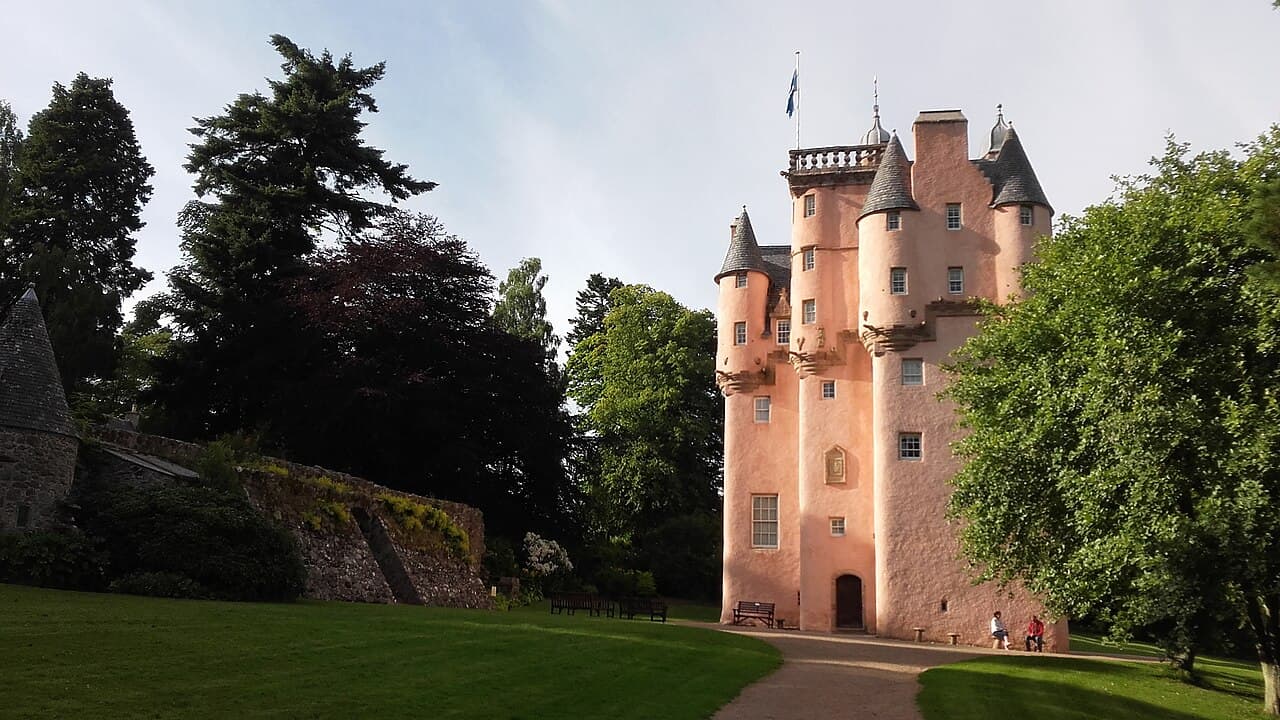
Craigievar Castle is a remarkable example of Scottish Baronial architecture, located south of Alford in Aberdeenshire, Scotland. Renowned for its distinctive pale pink harled exterior, the castle evokes the charm of a fairy-tale castle with its playful turrets, gargoyles, and high corbelling. This seven-storey structure, completed in 1626, stands as a testament to the architectural creativity and social history of early 17th-century Scotland.
The castle's unique coloration, achieved through a traditional lime-based harling renewed as recently as 2024, enhances its enchanting appearance. The pink hue contrasts beautifully with the granite mouldings and intricate stonework, making Craigievar a visual icon among Scottish castles. Its fairy-tale silhouette is often linked to inspirations behind Walt Disney's Cinderella castle, a tradition upheld by the current custodians.
Historical background and ownership
Originally the seat of Clan Sempill, Craigievar Castle was purchased in 1610 by William Forbes, a wealthy merchant known as "Danzig Willy" for his Baltic trade connections. Forbes acquired the partially completed structure from the financially struggling Mortimer family and completed the castle over the next fifteen years, finishing in 1626. The Forbes family maintained ownership for approximately 350 years, with the castle serving as the ancestral home of the Forbes baronets of Craigievar.
William Forbes's son was granted the baronetcy of Nova Scotia by King Charles I in 1630, a title still extant today. The Forbes family played notable roles in regional politics, including representation in the British House of Commons. Their lineage eventually intertwined with the Lords Sempill, combining two prominent Scottish noble families.
In the 19th century, the castle faced deterioration and the threat of demolition. However, in the 1820s, Sir John Forbes commissioned John Smith, an Aberdeen architect, to restore the castle rather than dismantle it. Restoration efforts included repairing the roof, raising the towers, and reinstating the original entrance, preserving its historic character.
During the Second World War, the family primarily resided at Fintray House, which was converted into a hospital for wounded Belgian soldiers. In 1963, the 19th Lord Sempill sold Craigievar Castle to the National Trust for Scotland, which has since managed the property and opened it to the public.
Architectural features and design
Structure and layout
Craigievar Castle is designed in a classic L-shaped plan, typical of Scottish Baronial castles. It rises seven storeys high, with a massive lower storey base supporting multiple turrets and corbelled battlements. The castle was originally surrounded by a walled courtyard with four round towers, although only one of these towers remains today. This surviving tower features an arched doorway displaying the carved initials of Sir Thomas Forbes, William Forbes's son.
Defensive elements
The castle retains several defensive features characteristic of early modern Scottish noble residences. A prominent example is the massive iron portcullis, locally known as a yett, which could be lowered to secure the main entrance. The thick walls and elevated towers also provided strategic advantages against potential attackers.
Interior decoration and plasterwork
One of Craigievar’s most celebrated features is its exceptionally crafted plasterwork ceilings. These ceilings are among the finest in Scotland, adorned with symbolic figures such as the Nine Worthies and heraldic emblems of the Forbes family. The Great Hall boasts the Stuart family arms prominently displayed above the fireplace and includes a musicians’ gallery for entertainment during gatherings. A hidden staircase connects the Great Hall to the high tower, serving both practical and defensive functions.
Notable rooms and collections
The castle’s interior includes the Queen’s Bedroom and servants’ quarters, which house a collection of Forbes family portraits and furnishings dating from the 17th and 18th centuries. Among the artworks are two original paintings by the renowned Scottish artist Henry Raeburn, preserved along with their payment receipts. The upper floors maintain authenticity by relying solely on natural daylight, with no artificial lighting installed.
Grounds and landscape
The Craigievar estate spans over 200 acres of farmland and woodland, situated approximately 218 meters above sea level. The surrounding landscape is characterized by rolling foothills of the Grampian Mountains to the south and flat plains to the north. The estate’s gardens and ornamental plantings largely date from the late 18th century onward, including a rock garden and decorative conifers added in the 1930s near the coach house.
Public access and preservation
Since its acquisition by the National Trust for Scotland in 1963, Craigievar Castle has been open to the public during the summer months, from Easter until the end of September. Visits are by guided tours only, ensuring preservation of the delicate interiors and plasterwork. Restoration projects have been ongoing, with major external limewash renovations completed between 2007-2009 and again in 2024 to maintain the castle’s distinctive appearance.
Craigievar Castle remains a treasured cultural landmark, celebrated for its fairy-tale appearance, rich history, and exemplary Scottish Baronial architecture. Its combination of defensive features, artistic interiors, and picturesque setting make it a unique destination for visitors interested in Scotland’s noble heritage and architectural legacy.
Frequently asked questions (FAQ)
- When was Craigievar Castle built and by whom?
- Craigievar Castle was completed in 1626 by William Forbes, a merchant from Aberdeen who purchased the unfinished castle in 1610 from the Mortimer family.
- What architectural style is Craigievar Castle known for?
- Craigievar Castle is a prime example of Scottish Baronial architecture, featuring an L-shaped plan, turrets, corbelling, and a distinctive pink harled exterior.
- Can visitors tour Craigievar Castle year-round?
- No, Craigievar Castle is open to the public from Easter until the end of September and visits are by guided tours only to protect the delicate interiors.
- What are some notable interior features of Craigievar Castle?
- The castle is famous for its exceptionally crafted plasterwork ceilings, including depictions of the Nine Worthies and family heraldry, as well as original Henry Raeburn paintings.
- Who currently owns Craigievar Castle?
- Craigievar Castle is owned and managed by the National Trust for Scotland, which acquired the property in 1963.
Photo gallery

Information
Opening hours
Easter to end of September, guided tours only
Architect
John Smith
Current owner
National Trust for Scotland
Website
Visit websiteFeatured in
Articles on the Castlopedia blog that feature Craigievar Castle.
Sources & official resources
Verify the information above using these authoritative references.
Loading map...
Visitor reviews
No reviews yet. Been here? Write the first review and help other travelers!
Write the first reviewVisited this castle? Share your experience
Your review helps other travelers and adds first-hand knowledge to our encyclopedia.