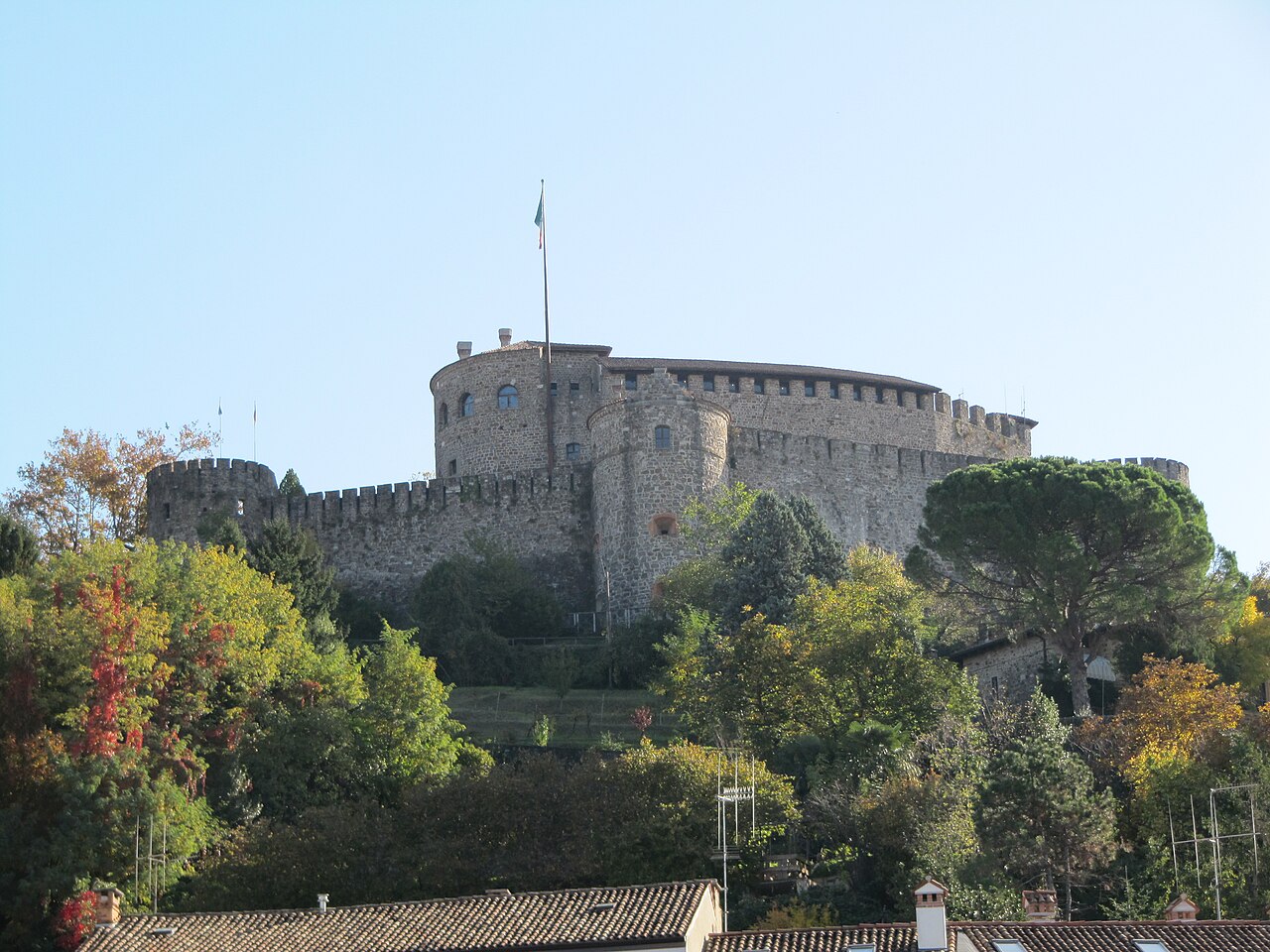
Miren Castle Church

Miren Castle Church in Miren, Slovenia
Miren, Slovenia
Modern (19th–20th c.)

Miren Castle Church stands on a hill in Miren, Slovenia, a site with a layered history marked by both medieval fortifications and religious significance. Originally, the hill was home to a castle, lending the site its name, but today it is dominated by a complex of ecclesiastical buildings that have evolved over centuries.

The legendary origins of Miren Castle hill

Local tradition tells of a noble ruler named King Miren, revered by the people for his generosity and kindness. According to legend, he founded the settlement of Miren to provide homes for impoverished peasants, establishing a community that would endure through the centuries. While the historical accuracy of this tale remains uncertain, it remains an important part of the cultural identity of Miren's inhabitants.

Medieval beginnings and early religious structures

The earliest documented structure on the hill was the Church of Our Lady, constructed in 1488. This church served as a spiritual center for the local community and underwent significant changes over time. It was rebuilt in 1753, reflecting architectural updates of the period, but was ultimately destroyed on 30 May 1914, a loss that marked the end of an era for the original building.

Hermit habitation and monastic presence

Between the early 18th century and mid-18th century, specifically from around 1700 to 1756, the castle hill was home to hermits who lived in seclusion. Their presence contributed to the site's spiritual atmosphere and laid the groundwork for the later monastic developments.

Construction and evolution of the current church

The current monastic church dedicated to Our Lady of Sorrows was built in 1886, replacing previous structures and reaffirming the hill's religious importance. This church is a focal point for pilgrims and visitors alike, embodying the continuity of faith on the site.

Destruction and restoration through the world wars

The church suffered complete destruction during both World War I and World War II, reflecting the turbulent history of the region. Each time, it was rebuilt, demonstrating the resilience of the community and their commitment to preserving this sacred place.

Artistic heritage and interior decoration

In 1958, the church's interior was adorned with frescoes by the Slovenian artist Tone Kralj. These frescoes add significant artistic value to the church, combining religious themes with a distinctive style that enhances the spiritual experience of visitors.

Architectural and cultural significance

The Miren Castle Church represents a blend of historical layers, from its origins as a fortified hill to its current status as a pilgrimage destination. The church's architecture reflects 19th-century ecclesiastical design with later artistic interventions, while the site itself is a symbol of local heritage and faith.

Current status and visitor experience

Today, the church remains an active place of worship and pilgrimage, attracting visitors interested in its history, architecture, and art. Its location on the hill offers panoramic views of the surrounding landscape, enhancing the spiritual ambiance. The site is well-maintained and accessible to the public, with ongoing efforts to preserve its cultural and historical significance.

Frequently asked questions (FAQ)

How do I get to Miren Castle Church?
Miren Castle Church is located in Miren, Slovenia, easily accessible by car or public transport. If you're traveling by car, you can find parking nearby. Public buses also connect Miren with major cities, making it convenient for visitors.
What is the historical significance of Miren Castle Church?
Miren Castle Church has a rich history dating back to the medieval period, showcasing the architectural styles of various eras. It served not only as a religious site but also as a strategic lookout point during historical conflicts. Today, it stands as a testament to Slovenia's cultural heritage.
When was Miren Castle Church built?
The origins of Miren Castle Church date back to the 12th century, with significant renovations occurring in the following centuries. Its architecture reflects both Romanesque and Gothic influences, making it an interesting study for enthusiasts of historical buildings. The church has been preserved to maintain its historical integrity.
Can I visit Miren Castle Church year-round?
Yes, Miren Castle Church is open for visitors throughout the year, though specific hours may vary by season. It's recommended to check the official website or local tourist information for the most accurate opening hours before your visit. This allows you to plan your trip effectively and enjoy the site at your convenience.
Why is Miren Castle Church popular among tourists?
Miren Castle Church attracts visitors due to its stunning architecture and picturesque views of the surrounding landscape. Its historical significance and serene atmosphere make it a perfect spot for both sightseeing and reflection. Additionally, the church often hosts cultural events that further enrich the visitor experience.
Is it possible to hold events at Miren Castle Church?
Yes, Miren Castle Church is available for special events, including weddings and cultural gatherings. The unique setting provides a charming backdrop for any occasion. Interested parties should contact the church administration for details on availability and requirements.
What are the best times to visit Miren Castle Church?
The best times to visit Miren Castle Church are during the spring and early autumn when the weather is pleasant and the surrounding nature is at its most vibrant. These seasons also see fewer tourists, allowing for a more intimate experience. However, the church's beauty makes it worth visiting any time of the year.
What are the ticket prices for visiting Miren Castle Church?
Admission to Miren Castle Church is generally free, allowing everyone to appreciate its beauty and history. However, donations are welcomed to support the maintenance and preservation of this historical site. Check for any special tours or events that may have associated costs.
What nearby attractions should I visit while in Miren?
While visiting Miren Castle Church, consider exploring nearby attractions such as the picturesque Soča River and the charming town of Nova Gorica. The area is also known for its wine regions, offering tastings and tours. These nearby sites enhance your overall experience in the region.

Loading map...

Visitor reviews

No reviews yet. Been here? Write the first review and help other travelers!

Write the first review

Visited this castle? Share your experience

Your review helps other travelers and adds first-hand knowledge to our encyclopedia.

Write a review

(5/5)

0/2000 characters

Your review will be visible after admin approval

Nearby castles

3.1 km

Castello di Rubbia

Savogna d’Isonzo, Italy

Castello di Rubbia stands as a remarkable historical monument near the confluence of the Vipava and Soča rivers, within the municipality of Savogna d’Isonzo in Italy. This castle's origins are deeply rooted in antiquity, with archaeological and architectural evidence suggesting a fortification existed on this strategic site since Roman times. The location was pivotal for controlling important routes through the Vipava Valley, serving as a military and administrative post overseeing passage between the Venetian Plain and the Danube Plain. Historical development and ownership The earliest known phase of the castle likely involved a Roman military outpost, whose foundations were later repurposed. The current structure primarily dates from the 15th and 16th centuries, embodying the Renaissance architectural style that replaced earlier medieval fortifications. This manor was constructed atop the remains of previous defensive works, reflecting the layered history of the site. The castle's documented ownership began with Count Egg, followed in the early 1500s by the noble Torre-Valsassina family. Later, the estate passed to Angelo Giacomo Edling before coming into the possession of the Coronini family, specifically Cipriano Coronini Kromberg, who retained it for several centuries. This lineage of ownership highlights the castle's importance as a noble residence and strategic stronghold. Military significance and conflicts The Gradisca Wars and artillery damage In the early 17th century, Castello di Rubbia gained renewed military relevance during the Gradisca Wars (1616-1617). Serving as a headquarters for military operations, the castle endured heavy artillery bombardment led by General Adem Trautmannsdorff. This assault inflicted severe structural damage, particularly to the castle's defensive walls and towers, underscoring its strategic importance in regional conflicts. World War I impact The castle's military role extended into the 20th century, where it again suffered significant destruction during World War I. The proximity to front lines meant the castle was exposed to artillery fire and combat operations, resulting in partial ruin before modern restoration efforts commenced. Religious refuge and cultural heritage A notable episode in the castle’s history occurred in 1563 when Primož Trubar, a prominent Protestant Slovene preacher, sought refuge within its walls. Fleeing the pressures of the Counter-Reformation, Trubar used the castle as a sanctuary to preach and conduct baptisms. This event marks the castle as a site of significant religious and cultural importance during a turbulent period in European history. Architectural features and restoration Structural composition and Roman elements The castle today mainly comprises a Renaissance manor built upon 15th-century foundations, which themselves incorporate remnants from earlier periods. The defensive walls, still visible, reveal the castle’s original military purpose alongside its residential function. A distinctive feature is the presence of Roman quarrying notches on one of the tower’s corner stones, indicating the reuse of Roman materials or the survival of Roman-built foundations beneath the medieval structure. Damage and restoration efforts Following the extensive damage from the Gradisca Wars and World War I, parts of the castle were left in a state of partial ruin. However, restoration work beginning in the early 21st century, guided by historical documentation, has revived the structure and preserved its historical integrity. These efforts have allowed the castle to function once again as a winery, continuing a tradition established in the late 19th century. Modern usage and visitor experience In 1872, the castle entered a new chapter when Leonardo Bianchi di Casalanza purchased and restored it, establishing vineyards and a winery on the estate. This agricultural heritage remains active, with the castle’s winery still operating under private ownership. The property occasionally opens to the public during special events, offering visitors a glimpse into its rich history and architectural splendor. A commemorative bust of Primož Trubar near the entrance honors his historical refuge at the castle, linking visitors directly to its religious and cultural legacy. The preservation of the defensive walls and the Roman-styled corner stones provides tangible connections to the castle’s multifaceted past, making Castello di Rubbia a unique destination for those interested in history, architecture, and viticulture.

Renaissance (15th–17th c.)
Details
7 km
Gorizia Castle — Italy castle

Gorizia Castle

Gorizia, Italy

Gorizia Castle, locally known as Castello di Gorizia, stands as a prominent medieval fortress overlooking the city of Gorizia in the Friuli-Venezia Giulia region of northeastern Italy. Perched on a strategic hill 155 meters above sea level, the castle has witnessed over a millennium of history, evolving from an early medieval stronghold to a Renaissance fortress, and now serves as a cultural monument housing the Museum of the Middle Ages of Gorizia. The origins of Gorizia Castle trace back to the 11th century, when initial wooden defensive structures typical of the era, such as a motte-and-bailey with a moat and palisade, were replaced by more permanent stone constructions. The earliest stone keep, dating from this period, remains partially visible today within the castle's central courtyard, offering a tangible connection to its medieval roots. The castle's significance grew in the 12th century when it became the seat of the Counts of Gorizia, with Henry IV of Spanheim recorded as the first known count in 1146. This noble lineage expanded their influence across northeastern Italy and parts of present-day Austria and Slovenia, gradually enlarging and fortifying the castle to reflect their growing power. Medieval foundations and expansions Throughout the 13th century, Gorizia Castle underwent substantial expansion. A lordly palace and a two-storey building were added within the castle walls, enhancing its residential and administrative functions. Outside the castle's defensive palisade, a fortified hamlet developed, where residents were required to build masonry homes and assist in the castle's defense, underscoring the fortress's role as a community stronghold. The castle's architectural form during this period is documented by a city seal from 1307, granted by Albert II, which depicts a stylized keep similar to the castle's known structure. By the mid-14th century, the castle's appearance was comparable to that of Bruck Castle near Lienz, reflecting regional architectural influences. Transition to habsburg and venetian control The death of Leonhard, the last Count of Gorizia, in 1500 marked the end of the House of Gorizia's rule. The castle and its county passed to Maximilian I, Holy Roman Emperor and head of the Habsburg dynasty. Despite efforts to reinforce the castle's defenses, it was captured in 1508 by the Republic of Venice, which claimed the territory based on its ties to the Patriarchate of Aquileia. During Venetian occupation, which lasted just over a year until 1509, the castle underwent significant modifications to adapt to Renaissance warfare, particularly the use of firearms. This included the demolition of the original 11th-century stone keep to make way for modern fortifications such as bastions and reinforced walls. The Venetian coat of arms and a 16th-century statue of the Lion of Saint Mark, the symbol of Venice, remain prominent features above the castle's main entrance, commemorating this brief but impactful period. Early modern transformations and military use Following the Venetian retreat, the castle reverted to Habsburg control and gradually lost its medieval character. By the 17th century, it functioned primarily as a prison and military barracks. The 18th century saw further enhancements including the construction of bastions, powder magazines, and thick defensive walls. Notably, some of these fortification works were supervised by the renowned mathematician and astronomer Edmond Halley, reflecting an innovative approach to military architecture. Damage and restoration in the 20th century Gorizia Castle suffered extensive damage during World War I due to aerial bombardments, reducing it to ruins after centuries of use. Between 1934 and 1937, a major restoration led by architect Ferdinando Forlati, assisted by military engineers and the Trieste Belle Arti authority, sought to restore the castle to its medieval appearance. This involved removing Renaissance-era white plaster and reconstructing stone façades, reviving the castle's original medieval aesthetic. During World War II, the castle was occupied by German troops, and its northeast garden was used for executions, adding a somber chapter to its long history. Museum and present-day significance Today, Gorizia Castle houses the Museum of the Middle Ages of Gorizia, featuring original medieval furniture, reproductions of weapons, and siege engines that illustrate the castle's military and domestic history. The central courtyard still reveals the remains of the original 11th-century tower, connecting visitors directly to its medieval origins. The castle is surrounded by a public park, offering scenic views of the city and a tranquil setting for visitors. Its well-preserved medieval stonework and layered architectural elements make it a significant cultural and historical landmark in the Friuli-Venezia Giulia region. Gorizia Castle's enduring presence reflects the complex history of northeastern Italy, shaped by medieval nobility, Renaissance warfare, Habsburg and Venetian influences, and modern restoration efforts. It stands as a testament to the region's strategic importance and rich heritage, inviting exploration and study of its architectural evolution and historical narratives.

High Medieval (11th–13th c.)
Details
9.5 km

Monfalcone Castle

Monfalcone, Italy

Monfalcone Castle, also known locally as Rocca di Monfalcone or Castello di Monfalcone, stands prominently on a hill north of the modern town of Monfalcone in the province of Gorizia, within the Friuli-Venezia Giulia region of Italy. This historic hill castle embodies a rich layering of defensive structures and cultural influences spanning from prehistoric times through the Renaissance and into the modern era. The site originally hosted a prehistoric fortified village, known as a castelliere, which served as an early defensive settlement. Its strategic position overlooking the surrounding landscape made it an ideal location for successive fortifications. During the Roman period, a watchtower was established here to guard the vital road connecting the ancient towns of Aquileia and Tergeste (modern Trieste). This early military function laid the groundwork for the site's enduring role in regional defense. The fortress as it is known today began to take shape under the Ostrogoths during the reign of Theoderic the Great around 490 AD, following his victory over Odoacer near the Isonzo River. This period marked the construction of a more permanent fortified keep, signifying the site's importance as a symbol of Ostrogothic authority in the area. Medieval and early modern history By the late 10th century, specifically in 967 AD, the castle and its surrounding lands were granted by Emperor Otto I to the Patriarchate of Aquileia, integrating the fortress into the religious and political framework of the time. The castle then became a key stronghold overseeing the County of Duino. Throughout the Middle Ages, Monfalcone Castle was a contested site, frequently caught between the ambitions of the Patriarch of Aquileia and the Counts of Gorizia. Despite this, the castle also held the status of a "free commune," granting it a seat in the regional Friulian Parliament, highlighting its political significance beyond mere military functions. In the late 14th and early 15th centuries, the fortress changed hands several times. In 1409, it fell under the control of the County of Gorizia, specifically under Count Heinrich of Ortenburg. However, the Republic of Venice seized the castle in 1420 after a surrender to the forces of Venetian Doge Tommaso Mocenigo. This marked a turning point, as the fortress was incorporated into Venice's defensive network to protect its mainland territories. Venetian renovations and military role Between 1431 and 1462, the Venetians undertook extensive renovations to strengthen the castle's defenses. These included repairing the existing walls and adding battlements—parapet walls with crenellations for archers and artillery. The castle's fortifications were adapted to meet the evolving demands of warfare, especially in response to threats from the Count of Gorizia, the Austrian Emperor, and incursions by the Turks. The fortress endured several assaults, including a brief occupation in 1514 by mercenaries from the League of Cambrai, who massacred the garrison. Venetian control was restored in 1525, commemorated by a carved stone plaque above the entrance of the central tower. During the early 16th century, under Venetian governor Giovanni Diedo, the castle was remodeled to accommodate the advent of firearms. A central, square-based tower was constructed specifically to safely store gunpowder, a significant adaptation reflecting the transition from medieval to early modern military architecture. By the late 16th century, the strategic importance of Monfalcone Castle diminished with the rise of the nearby Palmanova fortress. The castle's role shifted primarily to that of a lookout and signaling post on Venice's eastern frontier. Despite this reduced military function, the castle remained a target of conflict, such as the 1615 looting by Uskoks, irregular soldiers and pirates active in the Adriatic region. Transition to austrian and italian rule Following the fall of the Republic of Venice in 1797, the fortress came under Austrian rule. It retained limited military relevance but gradually fell into disuse. The castle suffered damage during World War I due to its location near the front lines. Between 1950 and 1955, restoration efforts were undertaken to preserve the remaining structures. Since 1968, the site has been managed by the local speleological group, the Gruppo Speleologico Monfalconese “Amici del Fante”, which established a museum focusing on the paleontology and speleology of the surrounding Karst region. Architectural features and remains The castle is characterized by a square keep at its core, surrounded by a circular defensive wall and a low earthen rampart. The central tower, rebuilt in the early 16th century, was designed with a square base specifically to store gunpowder safely, a reflection of the transition to gunpowder warfare. The tower is constructed entirely of stone from its foundations upwards and features the 1525 commemorative plaque above its entrance. Excavations have revealed parts of the earlier prehistoric castelliere fortifications beneath the medieval and Renaissance structures, highlighting the site's long history of military use. The outer walls were extensively repaired and fortified during the 15th century Venetian campaigns, with battlements added to improve defensive capabilities. Today, the castle remains a well-preserved example of layered military architecture, illustrating the evolution from prehistoric fortifications through Roman, Ostrogothic, medieval, and Renaissance phases. Its prominent hilltop location continues to offer commanding views of the surrounding landscape, underscoring its historical role as a sentinel over the region. Current use and visitor information The castle is currently home to a museum dedicated to the paleontology and speleology of the Karst region, managed by the local speleological society. However, it has experienced periods of closure, possibly for restoration or conservation efforts. Access to the castle is limited, as it cannot be reached directly by car, requiring visitors to approach on foot via hiking paths. Monfalcone Castle remains a significant cultural and historical landmark in Friuli-Venezia Giulia, reflecting centuries of military, political, and scientific heritage. Its layered history and architectural features make it an important site for understanding the region's complex past and evolving defense strategies.

Early Medieval (5th–10th c.)
Details