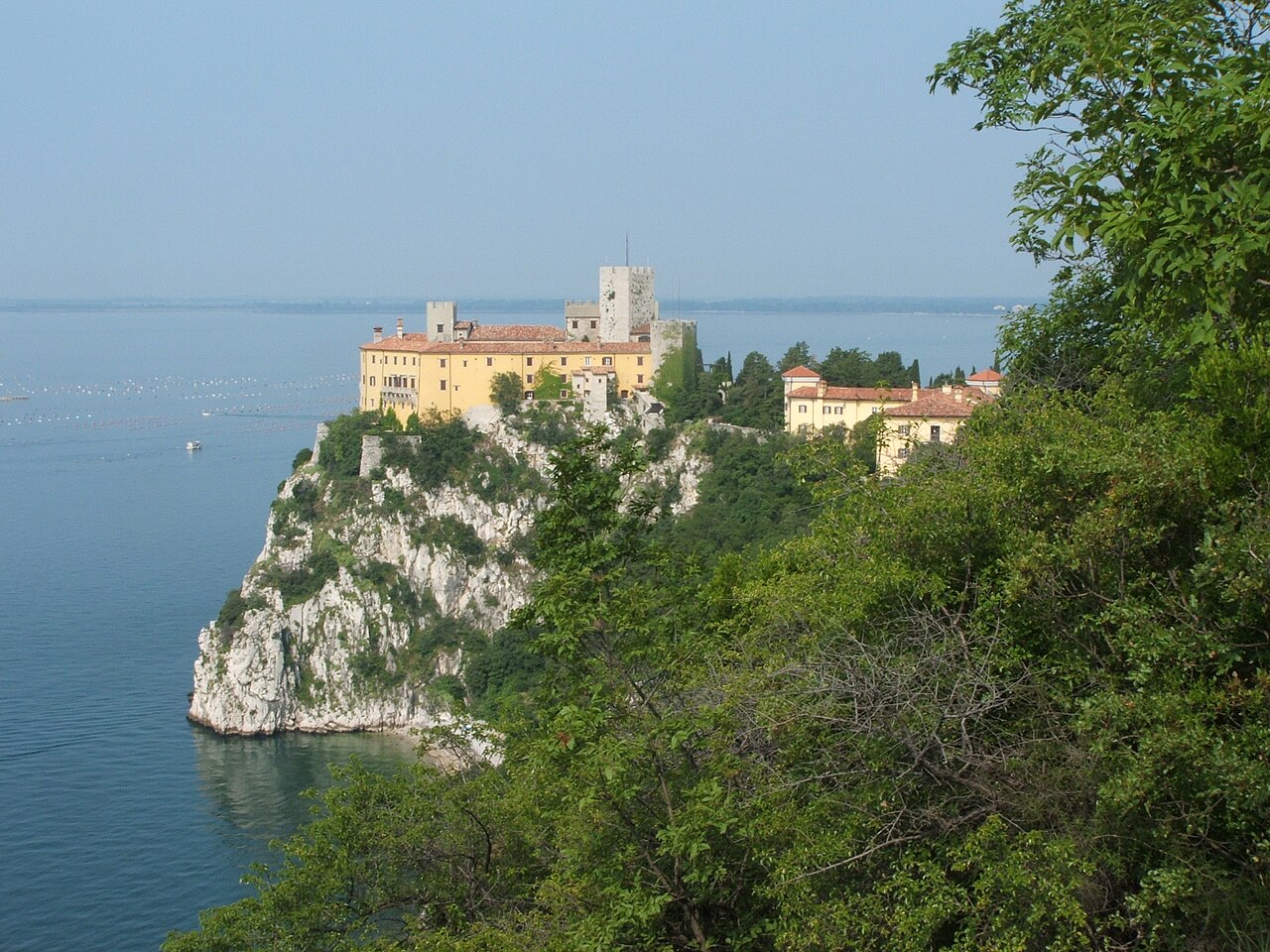
Monfalcone Castle
Monfalcone Castle, also known locally as Rocca di Monfalcone or Castello di Monfalcone, stands prominently on a hill north of the modern town of Monfalcone in the province of Gorizia, within the Friuli-Venezia Giulia region of Italy. This historic hill castle embodies a rich layering of defensive structures and cultural influences spanning from prehistoric times through the Renaissance and into the modern era.
The site originally hosted a prehistoric fortified village, known as a castelliere, which served as an early defensive settlement. Its strategic position overlooking the surrounding landscape made it an ideal location for successive fortifications. During the Roman period, a watchtower was established here to guard the vital road connecting the ancient towns of Aquileia and Tergeste (modern Trieste). This early military function laid the groundwork for the site's enduring role in regional defense.
The fortress as it is known today began to take shape under the Ostrogoths during the reign of Theoderic the Great around 490 AD, following his victory over Odoacer near the Isonzo River. This period marked the construction of a more permanent fortified keep, signifying the site's importance as a symbol of Ostrogothic authority in the area.
Medieval and early modern history
By the late 10th century, specifically in 967 AD, the castle and its surrounding lands were granted by Emperor Otto I to the Patriarchate of Aquileia, integrating the fortress into the religious and political framework of the time. The castle then became a key stronghold overseeing the County of Duino.
Throughout the Middle Ages, Monfalcone Castle was a contested site, frequently caught between the ambitions of the Patriarch of Aquileia and the Counts of Gorizia. Despite this, the castle also held the status of a "free commune," granting it a seat in the regional Friulian Parliament, highlighting its political significance beyond mere military functions.
In the late 14th and early 15th centuries, the fortress changed hands several times. In 1409, it fell under the control of the County of Gorizia, specifically under Count Heinrich of Ortenburg. However, the Republic of Venice seized the castle in 1420 after a surrender to the forces of Venetian Doge Tommaso Mocenigo. This marked a turning point, as the fortress was incorporated into Venice's defensive network to protect its mainland territories.
Venetian renovations and military role
Between 1431 and 1462, the Venetians undertook extensive renovations to strengthen the castle's defenses. These included repairing the existing walls and adding battlements—parapet walls with crenellations for archers and artillery. The castle's fortifications were adapted to meet the evolving demands of warfare, especially in response to threats from the Count of Gorizia, the Austrian Emperor, and incursions by the Turks.
The fortress endured several assaults, including a brief occupation in 1514 by mercenaries from the League of Cambrai, who massacred the garrison. Venetian control was restored in 1525, commemorated by a carved stone plaque above the entrance of the central tower.
During the early 16th century, under Venetian governor Giovanni Diedo, the castle was remodeled to accommodate the advent of firearms. A central, square-based tower was constructed specifically to safely store gunpowder, a significant adaptation reflecting the transition from medieval to early modern military architecture.
By the late 16th century, the strategic importance of Monfalcone Castle diminished with the rise of the nearby Palmanova fortress. The castle's role shifted primarily to that of a lookout and signaling post on Venice's eastern frontier. Despite this reduced military function, the castle remained a target of conflict, such as the 1615 looting by Uskoks, irregular soldiers and pirates active in the Adriatic region.
Transition to austrian and italian rule
Following the fall of the Republic of Venice in 1797, the fortress came under Austrian rule. It retained limited military relevance but gradually fell into disuse. The castle suffered damage during World War I due to its location near the front lines.
Between 1950 and 1955, restoration efforts were undertaken to preserve the remaining structures. Since 1968, the site has been managed by the local speleological group, the Gruppo Speleologico Monfalconese “Amici del Fante”, which established a museum focusing on the paleontology and speleology of the surrounding Karst region.
Architectural features and remains
The castle is characterized by a square keep at its core, surrounded by a circular defensive wall and a low earthen rampart. The central tower, rebuilt in the early 16th century, was designed with a square base specifically to store gunpowder safely, a reflection of the transition to gunpowder warfare. The tower is constructed entirely of stone from its foundations upwards and features the 1525 commemorative plaque above its entrance.
Excavations have revealed parts of the earlier prehistoric castelliere fortifications beneath the medieval and Renaissance structures, highlighting the site's long history of military use. The outer walls were extensively repaired and fortified during the 15th century Venetian campaigns, with battlements added to improve defensive capabilities.
Today, the castle remains a well-preserved example of layered military architecture, illustrating the evolution from prehistoric fortifications through Roman, Ostrogothic, medieval, and Renaissance phases. Its prominent hilltop location continues to offer commanding views of the surrounding landscape, underscoring its historical role as a sentinel over the region.
Current use and visitor information
The castle is currently home to a museum dedicated to the paleontology and speleology of the Karst region, managed by the local speleological society. However, it has experienced periods of closure, possibly for restoration or conservation efforts. Access to the castle is limited, as it cannot be reached directly by car, requiring visitors to approach on foot via hiking paths.
Monfalcone Castle remains a significant cultural and historical landmark in Friuli-Venezia Giulia, reflecting centuries of military, political, and scientific heritage. Its layered history and architectural features make it an important site for understanding the region's complex past and evolving defense strategies.
Frequently asked questions (FAQ)
- How do I get to Monfalcone Castle?
- Monfalcone Castle is easily accessible by car and public transportation. If you're traveling by train, the Monfalcone train station is just a short distance away, and local buses frequently connect the station to the castle.
- What is the historical significance of Monfalcone Castle?
- Monfalcone Castle, built in the 15th century, played a vital role in the defense of the region against invasions. Its strategic position allowed it to oversee the surrounding area, making it a key military stronghold throughout history.
- When was Monfalcone Castle constructed?
- Construction of Monfalcone Castle began in the late 15th century, with significant modifications made in subsequent centuries. The castle's architecture reflects various styles, showcasing its evolution over time.
- Can I take guided tours of Monfalcone Castle?
- Yes, guided tours are available for visitors who want to learn more about the castle's history and architecture. These tours typically include access to key areas of the castle and are conducted by knowledgeable guides.
- Why is the architecture of Monfalcone Castle unique?
- The architecture of Monfalcone Castle is unique due to its blend of Gothic and Renaissance styles, which is evident in its towers and fortifications. The castle's design was influenced by its function as a military fortress, featuring thick walls and strategic vantage points.
- Is it possible to visit Monfalcone Castle year-round?
- Yes, Monfalcone Castle is open to visitors year-round, although hours may vary by season. It’s advisable to check the official website for the most current opening times before planning your visit.
- What are the ticket prices for Monfalcone Castle?
- Ticket prices for Monfalcone Castle are generally affordable, with discounts available for students and seniors. Children under a certain age may enter for free, making it an accessible option for families.
- What is the best time to visit Monfalcone Castle?
- The best time to visit Monfalcone Castle is during the spring and early fall when the weather is mild and ideal for exploring. Additionally, visiting during these seasons allows you to enjoy fewer crowds and more comfortable conditions.
- Are there any nearby attractions to Monfalcone Castle?
- Yes, there are several nearby attractions, including the beautiful Gulf of Trieste and the historic town of Grado. These sites offer a delightful combination of natural beauty and cultural heritage, making them perfect for a day trip.
Information
Sources & official resources
Verify the information above using these authoritative references.
Loading map...
Visitor reviews
No reviews yet. Been here? Write the first review and help other travelers!
Write the first reviewVisited this castle? Share your experience
Your review helps other travelers and adds first-hand knowledge to our encyclopedia.