Dover Castle
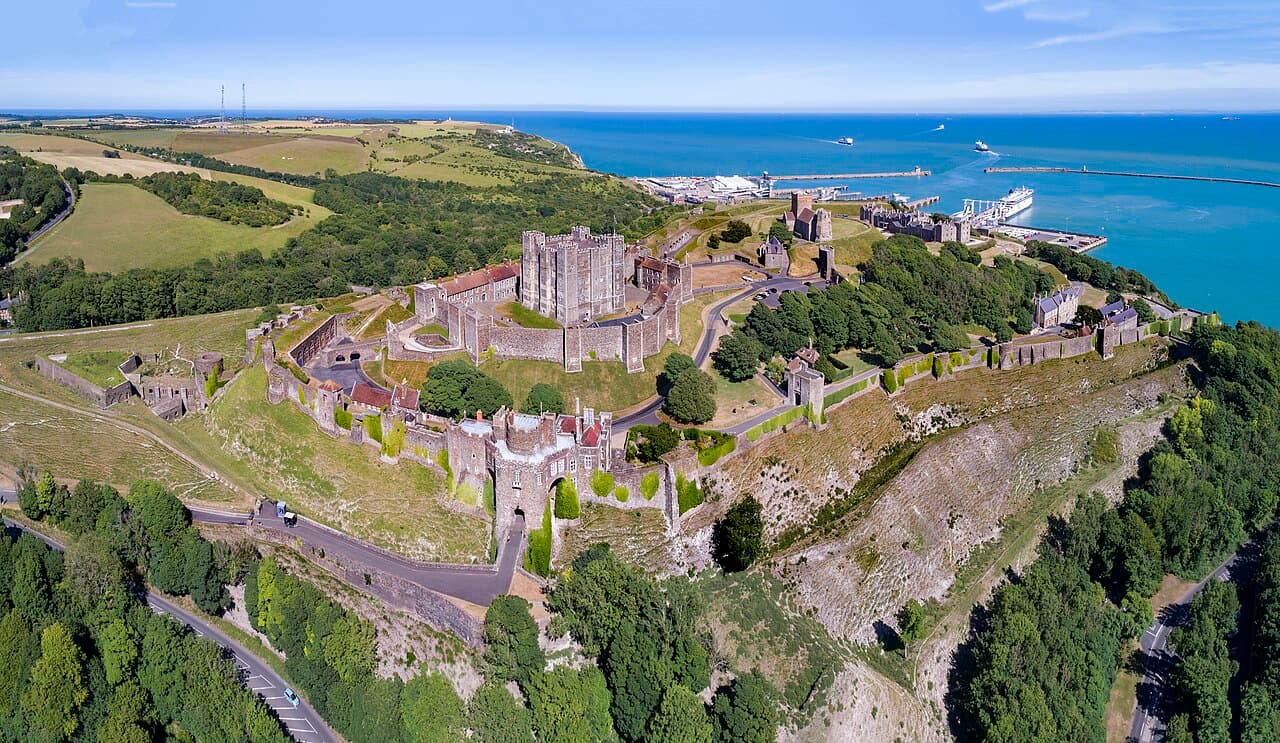
Dover Castle stands as one of England's most significant and largest fortresses, strategically positioned at the narrowest part of the English Channel in Kent. Its commanding location on Castle Hill has made it a vital military stronghold from the Iron Age through to the 20th century. The site reveals layers of history, including a remarkably preserved Roman lighthouse, an Anglo-Saxon church, and extensive medieval and modern fortifications.
The castle's origins trace back to the Norman Conquest of 1066, when William the Conqueror fortified an existing Anglo-Saxon earthwork to secure England's southeastern coast. This early fortification was initially a motte-and-bailey structure, evolving significantly under King Henry II in the late 12th century. Henry II commissioned the construction of the imposing rectangular keep designed by the notable engineer Maurice the Engineer, along with concentric inner and outer baileys fortified by robust curtain walls and towers.
Ancient and early medieval foundations
The site of Dover Castle exhibits evidence of human activity from the Iron Age, with earthworks suggesting early defensive use. During the Roman period, Dover was a crucial port, and the castle grounds include one of the two Roman lighthouses built in the early 2nd century. This five-level octagonal tower, constructed from tufa, Kentish ragstone, and red brick, remains the tallest and most complete Roman structure in England. It was later adapted in the Saxon era around 1000 AD into a belfry for the nearby church of St Mary in Castro, illustrating the site's continuous religious and strategic significance.
Norman conquest and medieval expansion
Following the conquest, the Normans established a motte-and-bailey castle on the hill, which was initially built with clay and timber. This early fortification was replaced by stone structures after the collapse of the clay defenses. By 1088, the castle was garrisoned by knights, reflecting its growing military importance. The most transformative period was under Henry II (1154–1189), who rebuilt the castle in stone, creating the formidable keep and concentric defensive walls that define its medieval appearance today.
The great keep and concentric defenses
The great keep is one of the last rectangular keeps constructed in England and was designed for both defense and residence. It features thick walls, narrow arrow slits, and a grand hall. Surrounding the keep are two rings of curtain walls, reinforced by towers such as the Avranches Tower, which controlled the eastern defenses. This concentric design allowed defenders to fall back to inner fortifications if outer walls were breached.
Siege of 1216-1217
Dover Castle's strategic importance was highlighted during the First Barons' War when rebel barons invited Prince Louis of France to claim the English throne. In 1216, Louis landed in Thanet and besieged the castle, breaching the walls after mining tunnels beneath the northern defenses. Despite this, the defenders held firm, repelling the French assault. The siege ended with an armistice, but hostilities resumed in 1217 when Louis attacked again. The French defeat at the Battle of Lincoln shortly after forced their withdrawal, securing the castle for the young King Henry III.
Following the siege, Henry III undertook significant strengthening of the castle's northern walls and gates, including the development of an underground forward-defense system incorporating St John's Tower. Additional gates such as Fitzwilliam's Gate and Constable's Gate enhanced access control and defense.
Tudor upgrades and civil war
In the 16th century, Henry VIII inspected and upgraded Dover Castle's defenses amid fears of invasion following his excommunication and the alliance of France and Spain. He commissioned the construction of the Moat Bulwark and other artillery fortifications to guard the coast. The castle also features an exhibition recreating Henry VIII's accommodations, reflecting its dual military and residential roles.
During the English Civil War in 1642, the castle was initially held by Royalists. However, it was captured by Parliamentarian forces with minimal resistance, illustrating a shift in military tactics and the castle's reduced strategic role in the face of evolving warfare.
18th and 19th century developments
Between 1784 and 1790, Dover Castle played a pivotal role in the Anglo-French Survey, a scientific endeavor to measure the precise distance between the Greenwich and Paris observatories. This project was overseen by General William Roy, marking the castle's contribution to early geodesy and cartography.
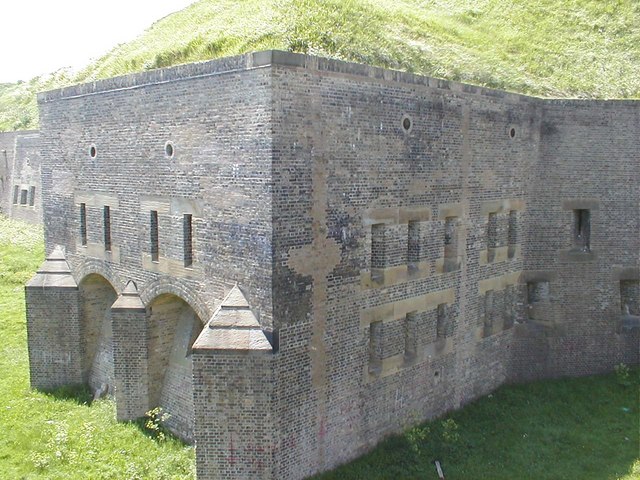
During the Napoleonic Wars, the castle underwent extensive remodeling under the direction of engineer William Twiss. Twiss redesigned the outer defenses, adding large bastions such as the Horseshoe, Hudson's, East Arrow, and East Demi-Bastions on the eastern side, and the Constable's Bastion on the west. He replaced the keep's roof with massive brick vaults to support heavy artillery and constructed Canon's Gateway to link the castle with the town's defenses.
One of the castle's most remarkable features is its extensive underground barracks tunnels, built approximately 15 meters below the cliff top. First occupied in 1803, these tunnels housed over 2,000 troops during the Napoleonic Wars and represent the only known underground barracks in Britain, showcasing innovative military engineering.
Role in world wars and modern era
Dover Castle continued to serve as a critical military installation during both World Wars. It was equipped with anti-aircraft guns and radar systems to defend against aerial attacks. The underground tunnels were adapted as air-raid shelters, a military command center, and a hospital during World War II.
In May 1940, Admiral Sir Bertram Ramsay directed the evacuation of over 338,000 Allied soldiers from Dunkirk (Operation Dynamo) from the castle's tunnels. The subterranean complex was expanded with new tunnels and facilities, including operating theatres and dormitories, to support this massive military operation.
After the war, the military presence at Dover Castle continued until 1958. Today, the castle is managed by English Heritage and is a Scheduled Monument and Grade I listed building. It houses the Queen’s & Princess of Wales’s Royal Regiment Regimental Museum and remains a symbol of England's enduring military heritage.
Architectural highlights and visitor experience
The castle complex includes a large inner and outer bailey, the imposing great keep, multiple defensive towers, and the Roman lighthouse, which visitors can explore. The lighthouse's distinctive octagonal shape and ancient construction materials make it a unique architectural relic.
Visitors can also see the Royal Chapel inside the keep, dedicated to St Thomas Becket, and the nearby St Mary in Castro church, a Saxon structure rebuilt in the Victorian era. The castle offers guided tours, including monthly visits to the historic Avranches Tower and multimedia exhibitions detailing the castle's famous sieges and military history.
Dover Castle's preservation and ongoing archaeological work ensure that its rich history is accessible to the public, making it a premier destination for those interested in medieval architecture, military history, and England's coastal defenses.
Frequently asked questions (FAQ)
- What is Dover Castle known for?
- Dover Castle, often referred to as the "Key to England," is renowned for its strategic significance throughout history, particularly during the medieval period. Its impressive architecture, including the Great Tower and extensive fortifications, showcases Norman military design and has played a crucial role in defending England against invasions.
- When was Dover Castle built?
- Construction of Dover Castle began in the 11th century, shortly after the Norman Conquest of England in 1066. Over the centuries, it has undergone significant expansions and renovations, reflecting various architectural styles and military advancements.
- Can I visit Dover Castle year-round?
- Yes, Dover Castle is open to visitors throughout the year, although hours may vary seasonally. It's advisable to check the official website for the latest information on opening times before planning your visit.
- What are the ticket prices for Dover Castle?
- Ticket prices for Dover Castle vary depending on age and type of visit. Discounts are often available for families, students, and seniors, so be sure to check the official website for the most current pricing and any special promotions.
- Is it possible to access Dover Castle with a wheelchair?
- Yes, Dover Castle is committed to accessibility and provides facilities for visitors with mobility issues. Certain areas are equipped with ramps, and staff are available to assist guests as needed, ensuring everyone can enjoy the castle's rich history.
- What is the best time to visit Dover Castle?
- The best time to visit Dover Castle is during the spring and summer months, from April to September, when the weather is generally mild and pleasant. Additionally, this period often features special events and activities that enhance the visitor experience.
- Are there any nearby attractions to visit?
- Yes, Dover Castle is located near several other attractions, including the White Cliffs of Dover and the Dover Museum. Both sites offer additional insights into the region's history and natural beauty, making for a comprehensive day trip.
- What are the opening hours for Dover Castle?
- Dover Castle typically opens at 10:00 AM and closes at 5:00 PM during peak season, but hours may vary in the off-peak months. Always check the official website for the latest updates on operating hours before your visit.
Photo gallery

Information
Featured in
Articles on the Castlopedia blog that feature Dover Castle.
Sources & official resources
Verify the information above using these authoritative references.
Loading map...
Visitor reviews
No reviews yet. Been here? Write the first review and help other travelers!
Write the first reviewVisited this castle? Share your experience
Your review helps other travelers and adds first-hand knowledge to our encyclopedia.