St Briavels Castle
St Briavels Castle stands prominently in the heart of the Forest of Dean in Gloucestershire, England, embodying centuries of history and architectural evolution. This Norman hill castle was originally constructed in the late 11th to early 12th century as a royal administrative center rather than a traditional border fortress. Its strategic location on a spur overlooking the River Wye allowed it to control access to the forest and enforce forest law, a critical function in medieval England.
The castle's foundation is closely tied to the early Norman consolidation of power after 1066. Built primarily from locally quarried Old Red Sandstone and limestone, the castle's robust and imposing walls reflect the natural materials of the region. The village of St Briavels itself grew around the castle, benefiting from the area's rich natural resources, including quarrying and forestry.
Unlike many castles built primarily for military defense, St Briavels served a dual role as a royal administrative center and a forest law enforcement hub. Its earliest keep, constructed on a raised motte of clay and stone, was a massive stone tower similar in design to those at Goodrich and White Castles. Although the keep was demolished in the 18th century and no longer stands, its historical significance remains central to understanding the castle's original purpose.
Medieval origins and royal connections
The castle's earliest known custodians include Walter de Gloucester and his son Miles de Gloucester, the first Earl of Hereford, who played pivotal roles in the castle's early history. Constructed between 1075 and 1129, St Briavels was established by royal decree to administer the Forest of Dean and oversee forest law, rather than primarily to defend the Welsh border as sometimes assumed.
During the reign of King John in the early 13th century, the castle gained additional prominence as a royal hunting lodge. King John visited the castle regularly in November to hunt in the forest, and he is credited with expanding and renovating the castle's fortifications. Some of the surviving curtain walls and rooms date from this period and showcase the early 13th-century royal architectural style.
Under King John's reign, St Briavels also became England's main production site for quarrels, the bolts used in crossbows. This military-industrial function supported both royal forces and the Marcher Lords, who governed the volatile borderlands between England and Wales. Consequently, the castle's defenses were strengthened with a formidable gatehouse and curtain walls.
Architectural features and fortifications
The gatehouse
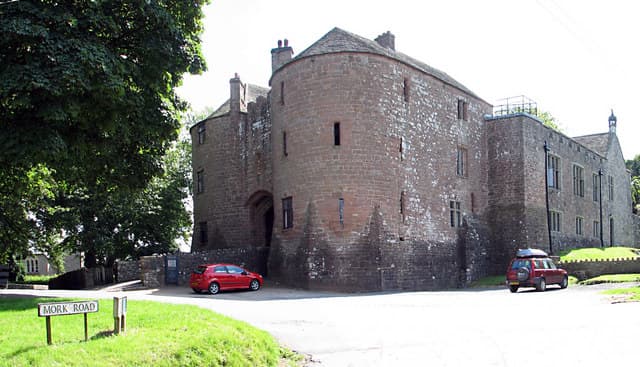
The castle's Edwardian gatehouse, built in the early 14th century, is one of its most remarkable features. This imposing structure consists of two large D-shaped towers flanking a nearly 15-meter-long gate passage. Above the entrance lies a spacious chamber connecting the towers, demonstrating the advanced masonry skills of the period.
St Briavels is unique for having three functioning portcullises, including smaller ones securing the porters' lodges. Originally, the gatehouse was taller and included a drawbridge, which was removed during 20th-century restorations. The gatehouse's base is reinforced with large octagonal spurs designed to prevent undermining by attackers, a defensive feature characteristic of castles in the Welsh Marches.
The southeast face of the gatehouse is a modern reconstruction following a partial collapse, but the overall structure remains a dominant defensive and architectural element of the castle.
Curtain walls and bailey
The castle is enclosed by an irregular polygonal stone curtain wall built atop earlier earthworks. A small round tower survives at the southeast corner, while the southern wall once contained the main gate near the keep, though this gateway no longer exists. The curtain walls provided formidable defense and enclosed the castle's bailey, or courtyard.
Within the bailey, several medieval domestic buildings have been restored, including a two-story hall and solar measuring approximately 23 by 10 meters. The hall features a notable chimney called the "Forester's Horn", symbolizing the castle's role in forest law enforcement. Nearby stands a 14th-century chapel that was later modified in the 17th century, reflecting the castle's continuous use and adaptation through the centuries.
A sunken pit prison within the courtyard bears 17th-century graffiti, offering a glimpse into the castle's later use as a place of detention.
Historical significance and later uses
Throughout the 14th and 15th centuries, St Briavels Castle changed hands among prominent nobles and royal favorites amid political upheavals such as the Anarchy, the Despenser War, and the Wars of the Roses. Despite these turbulent times, the castle itself did not experience major sieges or battles, maintaining its role primarily as an administrative center and residence.
By the 18th and 19th centuries, the castle's military importance had diminished, and it was repurposed as a court and a debtors' prison. In 1775, prison reformer John Howard documented harsh conditions within the prison. Following local unrest and parliamentary investigations in the 1830s, reforms improved conditions, and the prison ceased operation by 1842.
In the 20th century, extensive restoration prepared St Briavels Castle for new uses. Since 1948, it has functioned as a youth hostel, welcoming visitors while preserving its historical and architectural legacy. Today, the castle is managed by English Heritage and is protected as a Grade I listed building and a Scheduled Monument.
Castle remains and landscape
Strategically perched on a spur overlooking the River Wye, the castle's original moat was fed by a natural spring, though much of it has been filled in or transformed into garden space in the 20th century. The original Norman keep, once towering at approximately 20 meters, was demolished in the 18th century, leaving no visible remains today.
The surviving curtain walls, gatehouse, and restored domestic buildings provide valuable insight into the castle's medieval architecture and functions. The castle's setting within the Forest of Dean enhances its historical ambiance, linking it closely to the forest law enforcement and royal hunting traditions that defined much of its history.
Although some ancillary structures like the forge have been lost, the castle's core defensive and residential elements remain well preserved, offering visitors a comprehensive view of a Norman administrative and defensive complex adapted through centuries of English history.
Frequently asked questions (FAQ)
- How do I get to St Briavels Castle?
- St Briavels Castle is located in the village of St Briavels, in the Forest of Dean, United Kingdom. You can reach the castle by car, with parking available nearby, or by public transport, with local bus services connecting to the area. The nearest train station is in Lydney, which is about 6 miles away.
- What is the historical significance of St Briavels Castle?
- St Briavels Castle dates back to the 12th century and was originally built as a royal castle for King Henry II. It has served various purposes over the centuries, including a fortress, a prison, and a residence. Its rich history reflects the architectural and military evolution of medieval England.
- When was St Briavels Castle built?
- St Briavels Castle was constructed around 1155 during the reign of King Henry II. Its strategic location made it an important site for controlling the borders of England and Wales. The castle has undergone many renovations and restorations over the years, preserving its historical integrity.
- Can I visit St Briavels Castle?
- Yes, St Briavels Castle is open to visitors, and you can explore its historical grounds and architecture. Guided tours are available, offering insights into the castle's history and significance. Be sure to check the official website for specific visiting hours and any seasonal events.
- Why is St Briavels Castle known for its architecture?
- St Briavels Castle features a mix of Norman and medieval architectural styles, showcasing impressive stonework and defensive structures. The well-preserved gatehouse and inner courtyard illustrate the castle's historical importance and its adaptation over the centuries. Visitors can appreciate the unique architectural features that tell the story of its past.
- Is it possible to stay overnight at St Briavels Castle?
- Yes, St Briavels Castle offers unique accommodation options for visitors who wish to experience a night in a historic setting. The castle provides a range of lodging facilities, allowing guests to immerse themselves in the medieval atmosphere. Reservations are recommended, especially during peak tourist seasons.
- What are the opening hours for St Briavels Castle?
- St Briavels Castle is typically open to visitors from March to October, with hours varying depending on the season. It is advisable to check the official website for the most current information on opening times and any special events that may affect access. Planning your visit during weekdays can help avoid larger crowds.
- What are the ticket prices for St Briavels Castle?
- Ticket prices for St Briavels Castle vary depending on the age of the visitor and whether additional guided tours are included. Discounts may be available for children, seniors, and families, so it's a good idea to check the official website for the latest pricing information. Purchasing tickets in advance can also help ensure your spot, especially during busy periods.
- What are some nearby attractions to visit after St Briavels Castle?
- After visiting St Briavels Castle, you can explore the beautiful Forest of Dean, known for its stunning landscapes and outdoor activities. Nearby attractions include the Wye Valley, Tintern Abbey, and the historic town of Lydney. These sites offer a great way to continue your exploration of the area's rich history and natural beauty.
Photo gallery

Information
Website
Visit websiteSources & official resources
Verify the information above using these authoritative references.
Loading map...
Visitor reviews
No reviews yet. Been here? Write the first review and help other travelers!
Write the first reviewVisited this castle? Share your experience
Your review helps other travelers and adds first-hand knowledge to our encyclopedia.