Castle of Cardona
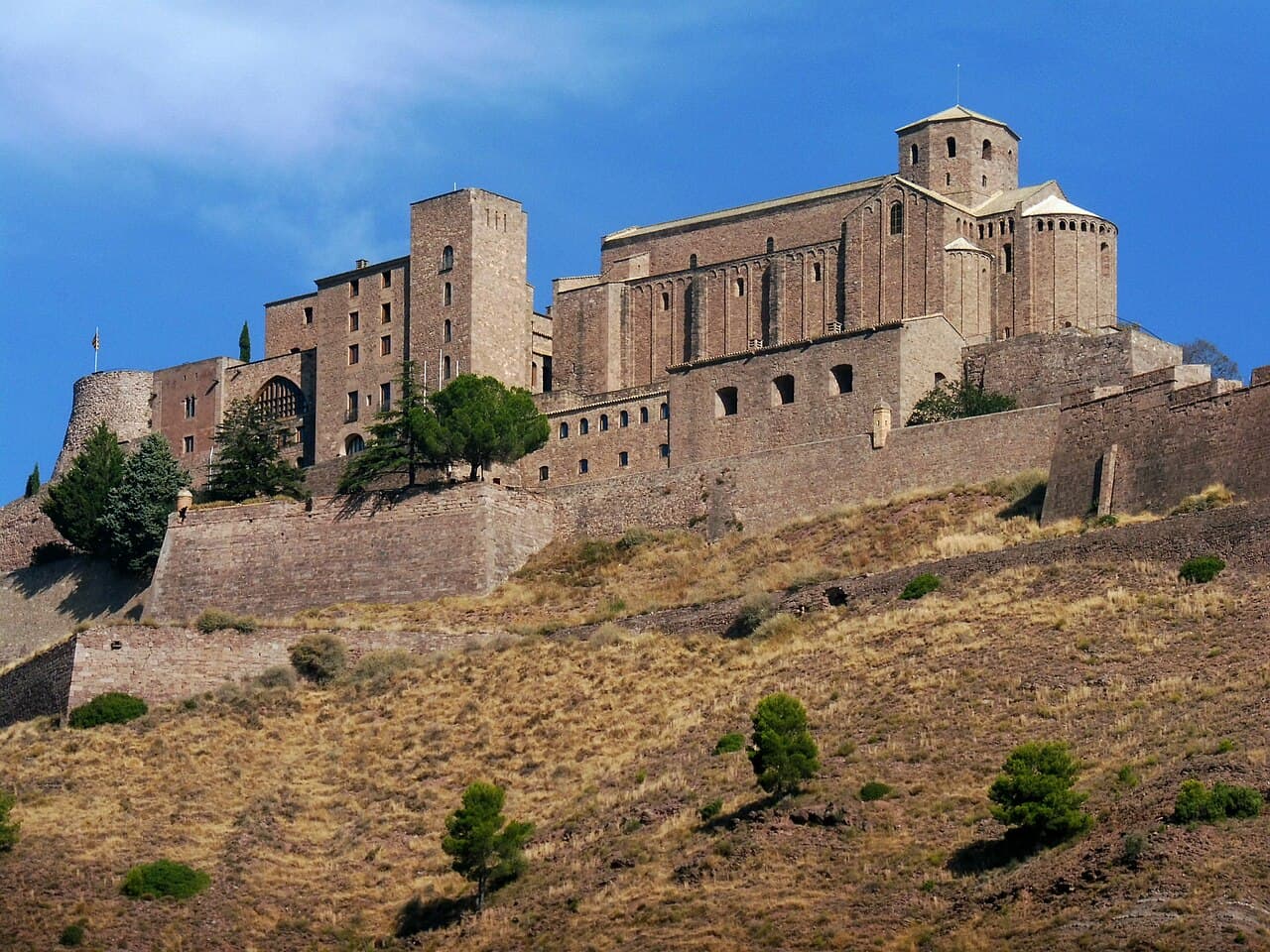
The Castle of Cardona stands as one of the most significant and well-preserved medieval fortresses in the Principality of Catalonia. Perched atop a strategic hill overlooking the Cardener river valley and the historic town of Cardona, this fortress has played a pivotal role in the region's military, political, and cultural history for over a millennium.
Its origins trace back to the early medieval period, specifically the 9th century, during the Carolingian era. The castle was initially constructed to defend the area against Saracen raids and to secure the frontier of the Frankish Empire. After being destroyed in these conflicts, it was restored in 798 by Louis the Pious to fortify the region in preparation for the reconquest of Barcelona. The fortress was definitively reestablished between 872 and 886 under the leadership of Wilfred the Hairy (Guifré el Pilós), who granted one of the earliest known settlement charters to the inhabitants, marking the castle as a center of local governance and community.
Historical significance and noble lineage
From the late 10th century onward, the viscounts of Osona made the castle their residence. Around 1040, Folc I adopted the Cardona name and founded the Barony of Cardona, establishing the castle as the seat of this influential noble family. The Cardona lineage played a crucial role in the politics of Catalonia and Aragon throughout the Middle Ages, participating in military campaigns and noble revolts. Their prominence culminated in their elevation to dukes in 1491, and the castle served as both a noble residence and a political stronghold.
Architectural features and fortifications
The torre de la minyona
The castle's most iconic architectural feature is the torre de la minyona, a truncated tower dating from the 11th century. Originally nearly 20 meters tall with a base diameter exceeding 10 meters, this tower was reduced to 13 meters in height during the Peninsular War in 1812. The tower has served multiple functions, including as a watchtower, powder magazine, and prison. Its robust construction and prominent location made it a key element of the castle’s defenses.
The church of sant vicenç
Adjacent to the fortress is the Romanesque Church of Sant Vicenç de Cardona, constructed between 1029 and 1040 under Viscount Bermon I. The church is well preserved and once featured murals on its portico, which have since been relocated to the National Art Museum of Catalonia for preservation. The church also contains one of the fortress’s three surviving powder magazines, highlighting its dual religious and military functions.
Fortifications and military adaptations
The castle's fortifications evolved significantly from the late 17th century onward. In 1682, the engineer Ambrosio Borsano designed the first ring of bastions around the ducal castle. During the War of Spanish Succession (1701–1714), additional bastions and artillery batteries were constructed, including the reconstruction of the Sant Llorenç bastion and the establishment of the main powder magazine near the church. These enhancements reflect the fortress's adaptation to the evolving military technology of the era.
A prominent defensive structure is the casamata, a heavily fortified artillery emplacement built during the Peninsular War in 1812. This two-level structure includes a covered bunker with five cannon openings and an upper exterior level with four loopholes for firing. The casamata served as an arms and ammunition depot supplying surrounding batteries and is considered one of the strongest defensive points within the complex.
Within the fortress, three powder magazines survive: those located in the casamata, the church of Sant Vicenç, and the Sant Carles bastion. These magazines stored gunpowder and munitions essential for the castle’s defense during sieges and military operations.
Historical events and military role
The Castle of Cardona played a crucial role during the War of Spanish Succession. In 1711, it withstood a prolonged siege by Bourbon forces, holding out until September 1714. It was the last fortress in Catalonia to surrender, symbolizing the region’s resistance during this turbulent period. This siege marked the castle’s final major military engagement.
In the 19th century, the castle was repurposed as a military barracks. The church within the complex was adapted to house soldiers, reflecting the castle’s continued military use until the early 20th century. After the military command was dissolved, the castle was abandoned for a time.
Modern preservation and cultural significance
Declared a national monument in 1949, the Castle of Cardona has undergone extensive restoration efforts since 1976. It was transformed into a parador, a state-run luxury hotel, offering 106 rooms within its historic walls. Since 2010, it has functioned as Catalonia’s first parador-museum under the auspices of the Historical Museum of Catalonia. Further rehabilitation in 2014 included musealization and structural improvements, ensuring the preservation of its historical fabric while adapting it for cultural and educational purposes.
The castle is also known for its cultural presence, having served as a filming location for Orson Welles's movie Chimes at Midnight. Visitors praise the parador for its excellent food, attentive service, and breathtaking views from the castle's patio, especially under moonlight. The original path leading down to the town offers a scenic and historic stroll, connecting the fortress to the community it once protected.
Architectural layout and surroundings
The fortress complex is situated at an elevation between 585 and 600 meters, strategically positioned on a hill overlooking a river meander and the nearby salt mines that historically contributed to the town's wealth and importance. The castle's layout reflects continuous adaptations from the medieval period through the 19th century, incorporating bastions, artillery batteries, and casemates that demonstrate evolving defensive strategies.
The Chapel of Sant Ramon Nonat, founded in 1681 on the site where the saint died in 1240, is part of the castle complex. It houses a silver lamp and a retable crafted by sculptor Pau Sunyer and gilded by silversmith Magí Torrabruna. The retable was restored in 2021, preserving its artistic and religious significance within the fortress.
Overall, the Castle of Cardona stands as a testament to the rich medieval heritage of Catalonia. Its well-preserved structures, historical significance, and continued use as a cultural site make it a valuable destination for those interested in medieval architecture, Spanish history, and heritage tourism.
Frequently asked questions (FAQ)
- How do I get to the Castle of Cardona?
- The Castle of Cardona is easily accessible by car or public transportation. If you are driving, you can find parking nearby. For those using public transport, local buses connect Cardona with major cities in Catalonia.
- What is the historical significance of the Castle of Cardona?
- The Castle of Cardona, dating back to the 9th century, played a crucial role in the defense of the region during the Middle Ages. It was the residence of the powerful Cardona family and served as a military stronghold. Today, it stands as a testament to the rich history of the area and offers insights into medieval life.
- When was the Castle of Cardona built?
- Construction of the Castle of Cardona began in the 9th century and continued over several centuries. Significant expansions and renovations occurred throughout the medieval period, particularly in the 11th and 12th centuries. The castle has preserved its impressive structure and historical elements over the years.
- Can I enter the Castle of Cardona?
- Yes, visitors are welcome to explore the Castle of Cardona. Guided tours are available, providing insights into its history and architecture. It's advisable to check the official website for any specific visitor guidelines or restrictions.
- Why is the architecture of the Castle of Cardona unique?
- The architecture of the Castle of Cardona showcases a blend of Romanesque and Gothic styles, reflecting its long history and the various renovations it has undergone. The castle features impressive defensive walls, towers, and a well-preserved keep. Its unique design makes it a fascinating site for architecture enthusiasts.
- Is it possible to visit the Castle of Cardona with children?
- Absolutely! The Castle of Cardona is a family-friendly destination, with engaging tours that can captivate visitors of all ages. Children can enjoy exploring the castle's grounds and learning about its history in an interactive way.
- What are the opening hours for the Castle of Cardona?
- The Castle of Cardona typically opens to visitors from 10 AM to 7 PM during the summer months and from 10 AM to 5 PM in the winter. It's recommended to check the official website for any changes in hours or special holiday schedules before planning your visit.
- What are the ticket prices for the Castle of Cardona?
- Ticket prices for the Castle of Cardona are generally affordable, with discounts available for students and seniors. Children under a certain age may enjoy free admission. Always check the official site for the most current pricing and any special offers.
- What nearby attractions can I visit while in Cardona?
- While visiting the Castle of Cardona, you can also explore the beautiful town of Cardona itself, known for its salt mountain and the historic church of Sant Miquel. Other nearby attractions include the Montserrat Monastery and the scenic landscapes of the Catalan countryside, perfect for a day of exploration.
Photo gallery

Information
Website
Visit websiteFeatured in
Articles on the Castlopedia blog that feature Castle of Cardona.
Sources & official resources
Verify the information above using these authoritative references.
Loading map...
Visitor reviews
No reviews yet. Been here? Write the first review and help other travelers!
Write the first reviewVisited this castle? Share your experience
Your review helps other travelers and adds first-hand knowledge to our encyclopedia.