Bodiam Castle
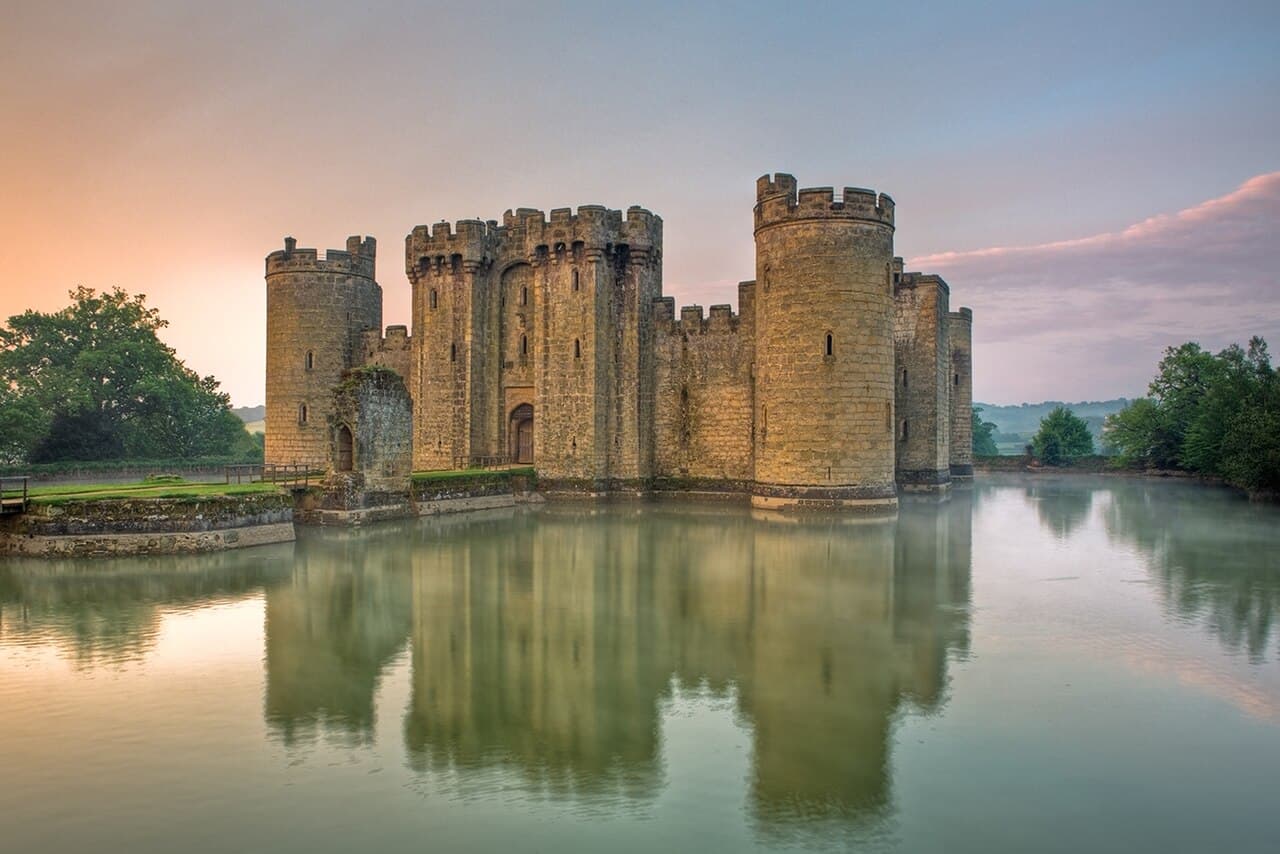
Bodiam Castle is one of the most iconic and picturesque medieval castles in England, located near the village of Bodiam in East Sussex. Built in 1385 by Sir Edward Dalyngrigge, a former knight of Edward III, the castle was constructed with the permission of King Richard II during the Hundred Years' War to defend the region against potential French invasions. This late medieval castle is renowned for its striking quadrangular plan, surrounded by a wide water-filled moat, and is often celebrated as an archetype of the ideal English castle.
Unlike many contemporary castles, Bodiam Castle was built without a central keep. Instead, its defensive and residential functions were integrated into the curtain walls and towers that surround a central courtyard. The castle features four large circular drum towers at each corner and square towers along the curtain walls. The main entrance is a formidable twin-towered gatehouse on the north side, originally accessed by two wooden bridges crossing the moat and an island known as the Octagon. The gatehouse is notable for its surviving original wooden portcullis, a rare example of medieval defensive architecture.
Historical background and construction
Sir Edward Dalyngrigge, deprived of his family estates as a younger son, amassed wealth as a mercenary in France during the early phases of the Hundred Years' War. Returning to England in 1377, he married into the local Bodeham family, acquiring the manor of Bodiam. In 1385, amid renewed hostilities with France and fears of coastal raids, Dalyngrigge was granted a licence to crenellate by King Richard II, allowing him to fortify his manor house. Instead of refurbishing the existing manor, Dalyngrigge chose a fresh site on his land to construct a new castle designed both for defense and to display his status.
The castle was built swiftly in a single phase, probably completed by 1392, although Sir Edward died shortly after in 1395. The location was carefully landscaped to enhance the castle's grandeur, with the moat not only serving as a defensive barrier but also as an ornamental feature that made the castle appear larger and more impressive. The moat, fed by natural springs, was difficult to drain and surrounded the castle on all sides, creating the illusion of a floating fortress.
Architectural features and layout
Defensive structures
Bodiam Castle's design exemplifies the quadrangular castle style popular in the 14th century, with a square plan enclosing a central courtyard. The castle lacks a traditional keep, instead relying on its curtain walls and towers for defense. The four corner towers are circular, providing wide fields of fire, while square towers are positioned along the walls for additional protection.
The main northern gatehouse is a three-story structure with twin towers, machicolations, and arrow slits. Its entrance passage is vaulted and equipped with murder holes and three wooden portcullises, one of which still survives. The gatehouse was originally connected to a two-story barbican by a drawbridge, enhancing the castle's layered defenses. The barbican, though largely dismantled, included living quarters for guards and a portcullis slot.
The castle also has a secondary entrance on the south side through a postern gate accessed by a drawbridge. The moat, averaging 1.5 meters deep, was fed by springs and surrounded the entire structure. While the moat provided a defensive barrier, its embankments were not substantial, leading some historians to argue its role was as much ornamental as militaristic.
Residential and domestic buildings
The buildings lining the curtain walls housed the lord, his family, guests, guards, and servants. The south range contained the great hall, measuring approximately 7.3 by 12 meters, serving as the social heart of the castle. Adjacent were the pantry, buttery, and a large kitchen designed with high walls to dissipate cooking heat. The southwest tower housed a well supplying water.
Along the east wall were a chapel, hall, and antechamber, with the curtain wall extended to accommodate the chapel's height. The lord's main living quarters were two stories high with a basement, though their exact layout remains uncertain. The west curtain wall contained additional halls and kitchens likely intended for servants. The servants' hall was notably darker and lacked a fireplace, unlike the great hall.
Additional structures included a two-story building with a basement east of the main gatehouse, probably used for storage and living quarters. The northwest tower featured fireplaces on each floor and a basement with a well. The castle's 28 toilets drained directly into the moat, which would have functioned as an open sewer, reflecting medieval sanitation practices.
Ownership history and later use
The castle remained with the Dalyngrigge family until 1470, when it passed by marriage to the Lewknor family. During the Wars of the Roses, Sir Thomas Lewknor supported the Lancastrian cause. When Richard III ascended the throne in 1483, Bodiam Castle was besieged and surrendered with little resistance. The castle was confiscated but restored to the Lewknors by Henry VII in 1485. The Lewknor descendants held the castle through the 16th century, though its specific use during this period is poorly documented.
In the 17th century, John Tufton, 2nd Earl of Thanet, reunited the castle with the manor. A Royalist during the English Civil War, Tufton was fined heavily by Parliament and sold Bodiam to Nathaniel Powell, a Parliamentarian. Following the sale, the castle was dismantled—its barbican, bridges, and internal buildings were destroyed to prevent military reuse, leaving the structure a romantic ruin.
In the 18th and 19th centuries, Bodiam Castle became an early tourist attraction, admired as a picturesque ivy-covered ruin. It was purchased in 1829 by John 'Mad Jack' Fuller, who partially restored it to prevent its demolition. Later owners, including George Cubitt, 1st Baron Ashcombe, and Lord Curzon, undertook further restoration while preserving its romantic appearance.
Lord Curzon acquired the castle in 1916 and donated it to the National Trust in 1925. Since then, the castle has been preserved, studied through archaeological excavations, and opened to the public. It is a Grade I listed building and a scheduled monument, recognized for its national and international importance.
Legacy and cultural significance
Bodiam Castle is widely regarded as the quintessential English medieval castle, embodying both the defensive and aesthetic ideals of the period. Its moat, towers, and gatehouse have become iconic images, frequently reproduced in books, art, and media worldwide. The castle’s romantic ruinous state has inspired generations of visitors and historians alike.
The castle's design has sparked scholarly debate over its primary function: whether it was built mainly as a formidable fortress or as a grandiose country residence symbolizing status and power. Elements such as large windows on the lower floors, which would have been weak defensively, and the ornamental moat support the latter interpretation. Nevertheless, its defensive features, including multiple portcullises, murder holes, and machicolations, demonstrate its military readiness.
Today, Bodiam Castle remains a popular tourist destination, attracting nearly 200,000 visitors annually. Its well-preserved exterior, dramatic setting, and evocative ruins offer a vivid glimpse into England’s medieval past. The castle is accessible from London and nearby towns, with visitor facilities including a museum and guided tours that enrich the experience.
Visiting Bodiam Castle
The castle is open to the public from February through October, with typical visiting hours from 10:30 am to 5 pm. Visitors can explore the castle grounds, climb the towers for panoramic views of the surrounding Sussex countryside, and learn about its history through exhibitions and audio-visual presentations. The site is managed by the National Trust, which maintains the castle and offers educational programs.
Nearby attractions include the heritage steam railway connecting Bodiam to the picturesque town of Tenterden, enhancing the visitor experience with a journey through the English countryside. Bodiam Castle's enduring charm and historical significance make it a must-visit for enthusiasts of medieval architecture and English history.
Frequently asked questions (FAQ)
- What is the historical significance of Bodiam Castle?
- Bodiam Castle, built in 1385, was constructed to defend the area against potential French invasion during the Hundred Years' War. Its picturesque design and strategic location have made it a symbol of medieval architecture in England, attracting visitors interested in history and heritage.
- When is the best time to visit Bodiam Castle?
- The best time to visit Bodiam Castle is during the spring and summer months, from April to September, when the gardens are in full bloom and the weather is generally mild. Visiting during these months also allows you to enjoy various events and activities that are often held at the castle.
- Can I bring my dog to Bodiam Castle?
- Yes, dogs are welcome at Bodiam Castle, but they must be kept on a lead at all times. This makes it a great destination for pet owners who want to enjoy a day out in a beautiful historical setting.
- What are the opening hours for Bodiam Castle?
- Bodiam Castle typically opens from 10 AM to 6 PM during the peak season, but hours may vary in the off-season. It's always a good idea to check the official website for the most current opening hours before your visit.
- Is Bodiam Castle accessible for visitors with disabilities?
- Yes, Bodiam Castle has made efforts to ensure accessibility for all visitors. While the castle itself has some uneven surfaces, there are accessible pathways and facilities to accommodate guests with mobility challenges.
- What are the ticket prices for Bodiam Castle?
- Ticket prices for Bodiam Castle vary depending on age and group size, with discounts available for children and families. It's recommended to purchase tickets online in advance to secure the best rates and avoid queues on busy days.
- What nearby attractions can I visit after Bodiam Castle?
- After visiting Bodiam Castle, you can explore the beautiful grounds of the Kent and East Sussex Railway, which offers scenic train rides through the countryside. Additionally, the charming village of Robertsbridge and the historic town of Rye are both within a short drive, providing further opportunities for exploration.
- How do I get to Bodiam Castle?
- Bodiam Castle is conveniently located off the A265 main road, making it accessible by car. If you prefer public transport, there are local bus services that connect nearby towns, although a car may provide more flexibility for exploring the area.
Photo gallery

Information
Website
Visit websiteFeatured in
Articles on the Castlopedia blog that feature Bodiam Castle.
Sources & official resources
Verify the information above using these authoritative references.
Loading map...
Visitor reviews
No reviews yet. Been here? Write the first review and help other travelers!
Write the first reviewVisited this castle? Share your experience
Your review helps other travelers and adds first-hand knowledge to our encyclopedia.