Beaumaris Castle
Beaumaris Castle stands as one of the most iconic medieval fortresses in Wales, renowned for its architectural precision and historical significance. Constructed in the late 13th century as part of King Edward I's campaign to conquer and control North Wales, this castle embodies the pinnacle of concentric castle design and military engineering of its time. Located on the Isle of Anglesey, the castle was strategically positioned to dominate the surrounding landscape and secure English authority in the region.
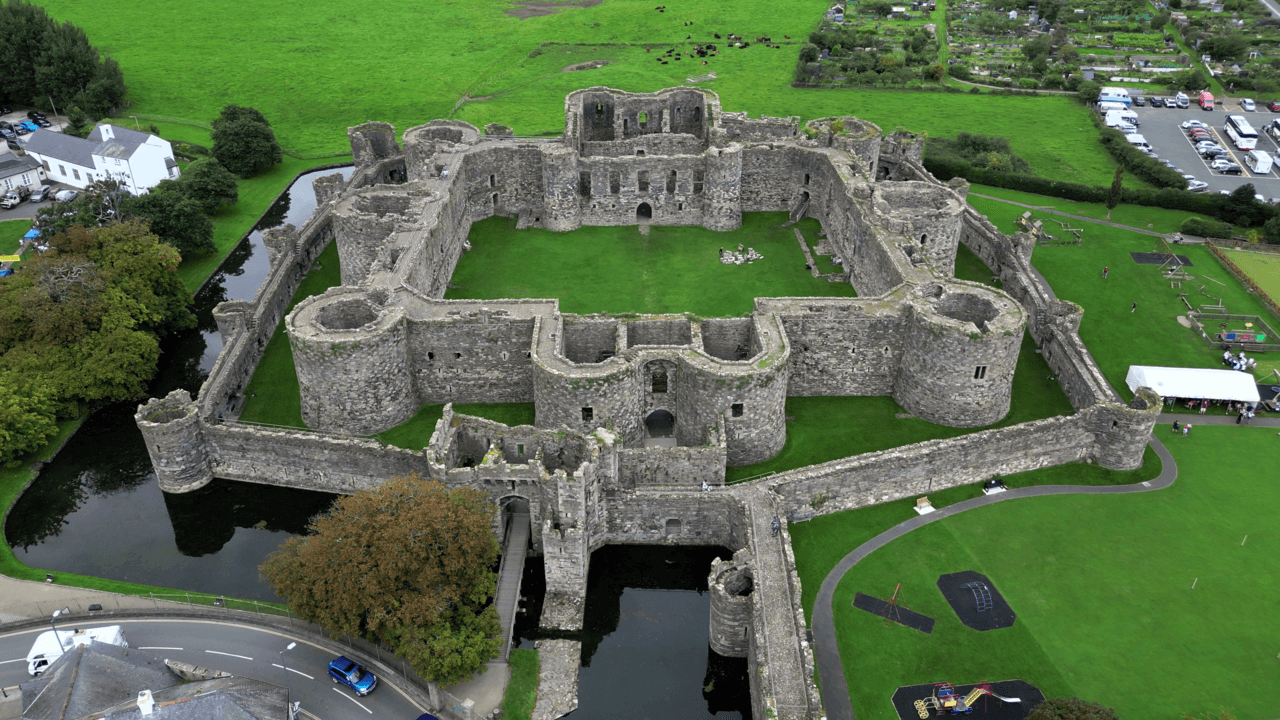
Initiated in 1295 under the supervision of the master architect James of St George, Beaumaris Castle was intended to be the most formidable and technically perfect fortress in Britain. Although construction was never fully completed due to shifting political and financial priorities, the castle remains an outstanding example of late 13th-century military architecture. Its design features a symmetrical layout with two concentric lines of defensive walls, a wide moat, and a complex system of towers and gatehouses that create multiple layers of defense.
Architectural design and features
Concentric layout and fortifications
The castle is celebrated as Britain's "most perfect example of symmetrical concentric planning," a design that incorporates four successive lines of fortifications. The outer ward is surrounded by an eight-sided curtain wall approximately 18 meters across, protected by twelve towers and two main gatehouses: the Gate next the Sea to the south and the Llanfaes Gate to the north. This outer wall is encircled by a moat roughly 5.5 meters wide, which was originally water-filled and partially tidal, allowing for direct sea access.
The inner ward, enclosed by much thicker and taller walls rising to 11 meters high and 4.7 meters thick, contains six massive towers and two large D-shaped gatehouses. These walls were designed to house domestic ranges capable of supporting two major royal households. The inner ward's north gatehouse was planned to have two floors with large windows but was only partially finished.
Defensive elements and innovations
Beaumaris Castle incorporates numerous defensive features typical of Edwardian castles, including hundreds of arrow slits arranged at various heights for comprehensive coverage. During the 15th century, some ground-level slits were blocked to prevent enemy exploitation. The southern Gate next the Sea was fortified with a barbican, a drawbridge, and multiple murder holes through which defenders could attack invaders from above. Nearby, the Gunners Walk platform likely hosted a trebuchet, a powerful siege engine.
The castle also features a network of passageways within the inner ward walls, linking towers, guardrooms, living chambers, and latrines. The latrines were ingeniously designed to drain waste directly into the moat, although this system was not entirely effective.
Historical context and construction timeline
Initial construction and interruptions
Plans for Beaumaris Castle were first drawn up around 1284, but actual building work was delayed due to funding shortages. Construction began in earnest in 1295 following the suppression of the Madog ap Llywelyn uprising. James of St George led a substantial workforce during the initial years, employing advanced techniques and materials sourced locally within a 16-kilometer radius, including limestone from Penmon and sandstone.
However, Edward I's military campaigns in Scotland diverted funds, causing work to halt around 1300. Construction resumed briefly in 1306 amid fears of a Scottish invasion but ceased permanently around 1330. Despite spending approximately £15,000, a significant sum at the time, the castle remained incomplete, with some planned features never realized.
Later history and military significance
In 1403, during the Owain Glyndŵr rebellion, Welsh forces captured Beaumaris Castle, but it was retaken by English royal troops in 1405. By the 16th century, the castle had fallen into disrepair, suffering from water damage and neglect. Records from 1609 describe the fortress as decayed and largely unusable.
During the English Civil War (1642–1646), the castle was held by Royalist forces loyal to King Charles I and reinforced by Thomas Bulkeley. Despite these efforts, Parliamentary troops captured it in 1646. The castle briefly reverted to Royalist control during a local uprising in 1648 but was soon retaken by Parliament. Notably, Beaumaris was spared deliberate destruction (slighting) that befell many other castles.
Post-medieval use and preservation efforts
Decline and romantic appreciation
After the Restoration of the monarchy in 1660, the castle's condition worsened as valuable materials, including lead roofing, were stripped away. In the early 19th century, Thomas Bulkeley, 7th Viscount Bulkeley, acquired the site and incorporated the ruins into the grounds of his estate, Baron Hill. The castle became admired as a picturesque ruin, attracting visitors such as the future Queen Victoria in 1832 and the artist J. M. W. Turner in 1835. Some stone was repurposed in 1829 to build Beaumaris Gaol nearby.
Modern conservation and heritage status
In 1925, Richard Williams-Bulkeley entrusted Beaumaris Castle to the Commissioners of Works, initiating conservation efforts including clearing vegetation, excavating the moat, and repairing masonry. The castle was designated a Grade I listed building in 1950, recognizing its exceptional historic and architectural value.
In 1986, Beaumaris Castle became part of the UNESCO World Heritage Site "Castles and Town Walls of King Edward in Gwynedd," celebrated as one of the finest examples of late 13th and early 14th-century military architecture in Europe. Today, the site is managed by the Welsh Government's Cadw agency, which oversees ongoing preservation and public access.
Materials and construction techniques
The castle was constructed using locally sourced materials, including limestone from Penmon, sandstone, and green schist, a metamorphic rock used only in the lower courses before 1298. Built on low-lying coastal sediments near sea level, the foundations rest on deposits known as till, which required careful engineering to ensure stability.
The masonry work is noted for its high quality and precision, contributing to the castle's reputation as the most technically perfect fortress in Britain. The use of symmetrical concentric walls and multiple defensive layers reflects the advanced military architectural knowledge of the late 13th century.
Architectural layout and daily life
Within the inner ward, the castle contained ranges of domestic buildings along the east and west walls, designed to accommodate two major royal households. Surviving fireplaces indicate these were residential quarters. One tower housed a private chapel richly decorated for the king and his family, separate from the soldiers' quarters.
The castle's design included sophisticated amenities such as latrines draining into the moat and interconnected passageways for efficient movement of defenders and residents within the fortification.
Visitor experience and significance today
Beaumaris Castle remains a major tourist attraction, admired for its impressive scale, architectural harmony, and scenic location overlooking the sea and nearby mountains. Visitors can explore the extensive defensive walls, towers, gatehouses, and moat, gaining insight into medieval military strategy and royal life.
The castle's status as a UNESCO World Heritage Site and Grade I listed building underscores its cultural importance and ensures continued conservation efforts. Its enduring legacy as Edward I's last and most ambitious castle project offers a unique window into the history of medieval Wales and English conquest.
Frequently asked questions (FAQ)
- What is the historical significance of Beaumaris Castle?
- Beaumaris Castle is a UNESCO World Heritage Site and is considered one of the finest examples of late 13th-century military architecture in Britain. Built by Edward I during his conquest of Wales, it showcases innovative design features, including a concentric layout that was ahead of its time.
- When was Beaumaris Castle constructed?
- Construction of Beaumaris Castle began in 1295 and continued for several decades, although it was never fully completed. The castle was part of Edward I's campaign to establish English dominance in Wales and reflects the military and political ambitions of the era.
- Is it possible to visit Beaumaris Castle year-round?
- Yes, Beaumaris Castle is open to visitors year-round, although opening hours may vary by season. It is advisable to check the official website for the most current information on visiting hours and any seasonal events.
- Can I find nearby attractions to visit along with Beaumaris Castle?
- Absolutely! Beaumaris Castle is located near several attractions, including the picturesque Beaumaris town, the Victorian pier, and the beautiful coast of Anglesey. Visitors can also explore the nearby Beaumaris Gaol and the stunning Menai Suspension Bridge.
- What are the ticket prices for Beaumaris Castle?
- Ticket prices for Beaumaris Castle vary depending on age and whether you are a child, adult, or senior. It's best to visit the official website for the latest pricing information and any available discounts or family tickets.
- How do I access Beaumaris Castle?
- Beaumaris Castle is easily accessible by car, with parking available nearby. There are also public transport options, including buses that connect to the town, making it convenient for visitors traveling from other parts of Wales.
- What is the best time to visit Beaumaris Castle?
- The best time to visit Beaumaris Castle is during the spring and summer months when the weather is milder and the gardens surrounding the castle are in full bloom. Additionally, these months often feature special events and guided tours that enhance the visitor experience.
- Are there any accessibility options at Beaumaris Castle?
- Yes, Beaumaris Castle strives to be accessible to all visitors. There are pathways and facilities designed to accommodate those with mobility challenges, though some areas of the castle may have limited access due to its historical structure.
- What are the opening hours of Beaumaris Castle?
- Beaumaris Castle typically opens at 9:30 AM and closes at 5 PM, but hours may vary seasonally. It is recommended to check the official website or contact the visitor center for the most accurate and up-to-date information on opening hours.
Photo gallery

Information
Website
Visit websiteFeatured in
Articles on the Castlopedia blog that feature Beaumaris Castle.
Sources & official resources
Verify the information above using these authoritative references.
Loading map...
Visitor reviews
No reviews yet. Been here? Write the first review and help other travelers!
Write the first reviewVisited this castle? Share your experience
Your review helps other travelers and adds first-hand knowledge to our encyclopedia.