Castell Bryn Gwyn
Castell Bryn Gwyn is a significant prehistoric monument located near Llanfairpwllgwyngyll in Wales, within the United Kingdom. This site, whose name translates as "White Hill Castle," is not a medieval fortress but an ancient earthwork enclosure that reflects multiple phases of prehistoric and early historic occupation. It stands as a remarkable example of a Neolithic to Iron Age ceremonial and defensive site, showcasing the evolving architectural practices of early communities in this region.
Early neolithic origins and earthwork construction
The earliest construction at Castell Bryn Gwyn dates back to the late Neolithic period, approximately between 2500 and 2000 BC. During this time, the site was established as a circular earthwork enclosure, characterized by a raised bank and ditch system. The earth bank, composed of clay and gravel, rises to about 1.5 metres in height and is covered by a grassy layer, blending naturally into the surrounding landscape.
This circular layout encloses an interior area roughly 54 metres in diameter, creating a level platform that may have served as a venue for communal gatherings, religious ceremonies, or other ritual activities. Archaeological evidence, including fragments of typical Neolithic pottery, supports the interpretation of Castell Bryn Gwyn as a henge-like sanctuary, a type of monument often associated with ceremonial use rather than military defense.
Iron age modifications and stone revetments
Beginning around 800 BC in the Iron Age, the site underwent significant architectural changes. The original earthen bank was enhanced with the addition of stone revetments along its outer edge. These stone walls served to stabilize the earthworks and may have also defined the enclosure more prominently within the landscape.
The use of local stone to reinforce the bank indicates a shift in construction techniques and possibly in the site's function, reflecting the evolving social and defensive needs of the communities inhabiting the area. This phase marks the transition from purely earthen structures to more durable stone-faced fortifications.
Roman period repairs and continued use
During the Roman occupation of Britain, starting in the 1st century AD, Castell Bryn Gwyn was maintained and repaired, particularly the stone walls. This suggests that the site retained some importance, whether strategic, symbolic, or practical, during Roman times and possibly beyond.
While no direct evidence indicates military use by the Romans, the upkeep of the stone revetments indicates ongoing recognition of the site's value. The continuity of maintenance over centuries highlights the site's enduring presence in the cultural landscape of the region.
Site layout and physical characteristics
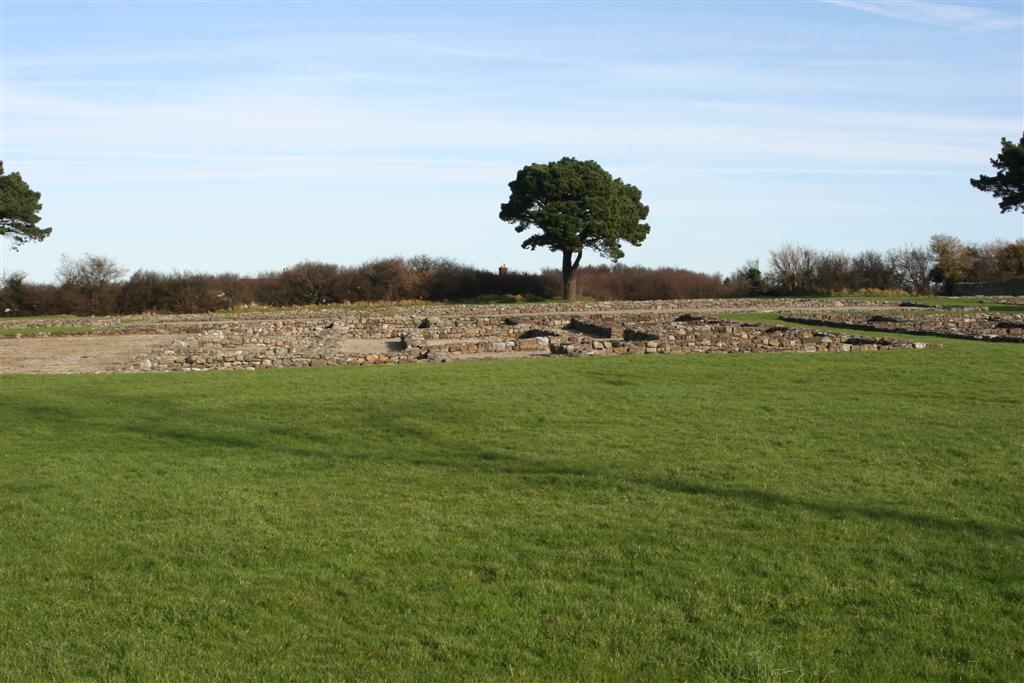
The monument is situated on a gently rising hill approximately 13 metres above sea level, set within relatively flat countryside with hills to the southeast. The circular enclosure is defined by the grassy earthen bank with its stone revetments, forming a distinct boundary around the interior platform.
Access to Castell Bryn Gwyn is primarily via footpaths connecting to nearby roads, with limited parking facilities available. The site remains largely intact, with no known inscriptions, decorative carvings, or significant artifact assemblages beyond the Neolithic pottery fragments.
Cultural significance and preservation
Castell Bryn Gwyn holds considerable archaeological and cultural importance as a multi-period prehistoric site demonstrating the transition from Neolithic ritual landscapes to Iron Age fortified enclosures. Its preservation offers valuable insights into early construction methods and community organization in prehistoric Wales.
The site is protected as a scheduled monument, ensuring its conservation for future generations. Visitors can experience the enduring form of this ancient enclosure within its natural setting, appreciating the continuity of human activity spanning several millennia.
Frequently asked questions (FAQ)
- What is the historical significance of Castell Bryn Gwyn?
- Castell Bryn Gwyn is a prehistoric site dating from the late Neolithic to the Roman period, illustrating early ceremonial and defensive architecture in Wales.
- How do I access Castell Bryn Gwyn?
- The site is accessible via footpaths connecting to nearby roads near Llanfairpwllgwyngyll, with limited parking available nearby.
- Is Castell Bryn Gwyn a medieval castle?
- No, despite its name meaning "White Hill Castle," it is a prehistoric earthwork enclosure, not a medieval fortress.
- When was Castell Bryn Gwyn constructed?
- The initial construction dates to the late Neolithic period, around 2500 to 2000 BC, with modifications during the Iron Age and Roman times.
- What remains can be seen at Castell Bryn Gwyn?
- Visitors can see a circular earthen bank about 1.5 metres high, stabilized by stone walls from the Iron Age and Roman periods.
Information
Website
Visit websiteSources & official resources
Verify the information above using these authoritative references.
Loading map...
Visitor reviews
No reviews yet. Been here? Write the first review and help other travelers!
Write the first reviewVisited this castle? Share your experience
Your review helps other travelers and adds first-hand knowledge to our encyclopedia.