Bash Tapia Castle
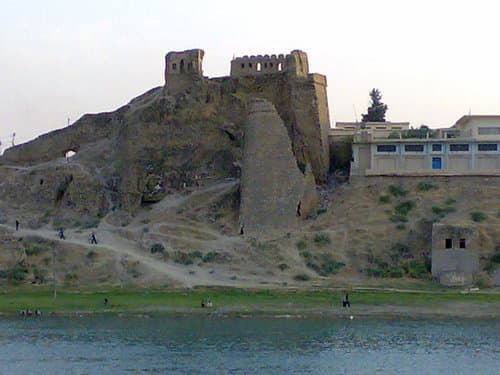
Bash Tapia Castle stands as a monumental testament to the rich and turbulent history of Mosul, Iraq. This hill castle, perched strategically about 75 feet above the surrounding terrain and roughly 150 feet above the Tigris River, was a crucial component of the city's western defensive fortifications. Its elevated position provided commanding views for surveillance and defense, making it a formidable stronghold from the medieval period through the Ottoman era and beyond.
The origins of Bash Tapia Castle trace back to the late 8th century, with initial fortifications attributed to the Umayyad ruler Marwan ibn Muhammad. However, the castle as it is historically recognized today was largely constructed during the 12th century under the Atabeg dynasty. It formed part of a series of seven fortresses along the western bank of the Tigris, designed to protect Mosul from invasions and control access to the city.
Historical significance and military role
Throughout its extensive history, Bash Tapia Castle witnessed numerous cycles of destruction and rebuilding, reflecting the shifting political and military landscape of northern Iraq. In 1058 CE, the fortress was destroyed during the rule of the Banu Basasiri, an event indicative of the region's volatility. The castle suffered further damage in 1261 CE during the Mongol invasions led by Hulagu Khan, whose campaigns left a profound mark on Mesopotamian architecture and urban centers.
The 14th century brought additional challenges when the castle was damaged in 1393 amid the invasions of Timur (Tamerlane). Despite these setbacks, the fortress was revitalized under Ottoman rule, which saw significant renovations and fortification enhancements. Notably, in the 17th and 18th centuries, governors such as Bakr Pasha Ismail al-Mosuli and Haji Hussein al-Jalili undertook extensive repairs, including the addition of a prominent high tower that became a defining feature of the castle.
Bash Tapia Castle played a pivotal role during the Ottoman-Persian War (1743–1746). In the 1743 siege of Mosul, the fortress served as the command center for Hussein Pasha al-Jalili, who successfully orchestrated the defense that lifted the siege by Persian ruler Nader Shah on 23 October 1743. This event underscores the castle's strategic military importance well into the early modern period.
Architectural features and design
The castle's architecture reflects its military function and the various cultural influences over centuries. As a hill castle, it utilized its natural elevation to enhance defensive capabilities. The fortress was integrated into Mosul’s city walls, forming a critical segment of the western fortifications.
A standout architectural element is the high tower added during the Ottoman restoration, which served both as a lookout and a symbol of authority. The castle complex included a citadel, a heavily fortified inner section that housed command posts and key defensive positions.
Defensive features such as machicolations—overhanging parapets with openings for dropping projectiles or boiling substances on attackers—were incorporated into the design, demonstrating advanced medieval military engineering. The presence of underground tunnels connecting the castle to the old city and secret exits beyond the city walls highlights the strategic planning for siege scenarios, enabling discreet movement of troops and supplies.
Within the castle, multiple rooms served diverse purposes including quarters for soldiers, storage for weapons and ammunition, and administrative functions. The fortress was constructed primarily of stone and mortar, materials chosen for durability and resistance to siege warfare.
Modern history and preservation challenges
In the 21st century, Bash Tapia Castle faced significant threats due to neglect, urban development, and conflict. Following the 2003 invasion of Iraq, the fortress fell into disrepair as maintenance ceased and parts of the site were repurposed without regard for its heritage value.
The situation worsened dramatically when ISIS captured Mosul in June 2014. During the ensuing conflict, the castle sustained heavy damage. In April 2015, ISIS reportedly destroyed significant portions of the fortress, inflicting a devastating blow to one of Mosul’s oldest and most important historical landmarks.
Despite this destruction, photographs from 2016 showed that some sections of the castle remained standing, testament to its robust construction. The site was recaptured by Iraqi forces in June 2017, but the castle remains largely in ruins. It now serves as a poignant archaeological site that embodies Mosul’s layered history and resilience.
Cultural significance and future prospects
Bash Tapia Castle is more than a military relic; it is a symbol of Mosul’s enduring cultural heritage. Its long history of construction, destruction, and restoration mirrors the city’s own story of survival through centuries of conquest and change.
Efforts to preserve and restore the castle are crucial for maintaining the historical identity of Mosul. The fortress offers valuable insights into medieval Islamic military architecture and urban defense systems. It also provides a tangible connection to the city’s past rulers, from the Umayyads and Atabegs to the Ottomans.
As a well-known archaeological site, Bash Tapia Castle has the potential to become a focal point for cultural tourism and education in northern Iraq. Preservation initiatives could help safeguard the remnants and promote awareness of Mosul’s rich historical landscape.
Frequently asked questions (FAQ)
- When was Bash Tapia Castle originally built?
- Bash Tapia Castle was originally constructed in the 12th century by the Atabeg dynasty, with earlier fortifications dating back to the late 8th century under Umayyad rule.
- What role did Bash Tapia Castle play in the 1743 siege of Mosul?
- During the 1743 siege of Mosul, Bash Tapia Castle served as the command center for Hussein Pasha al-Jalili, playing a crucial role in the successful defense against Persian forces led by Nader Shah.
- Is Bash Tapia Castle accessible to visitors today?
- Currently, Bash Tapia Castle is in ruins due to damage from recent conflicts. Access may be limited and subject to safety concerns, so visitors should check local conditions before planning a visit.
- What are the notable architectural features of Bash Tapia Castle?
- The castle features a high Ottoman-era tower, machicolations for defense, a citadel, and underground tunnels connecting it to the old city and secret exits.
- How did modern conflicts affect Bash Tapia Castle?
- Bash Tapia Castle suffered significant damage during the ISIS occupation of Mosul from 2014 to 2017, including partial destruction in 2015, leaving it largely in ruins today.
Photo gallery

Information
Loading map...
Visitor reviews
No reviews yet. Been here? Write the first review and help other travelers!
Write the first reviewVisited this castle? Share your experience
Your review helps other travelers and adds first-hand knowledge to our encyclopedia.