Here's a confession that might ruffle a few feathers: most of the "castles" plastered across your Pinterest travel board aren't castles at all. They're palaces. Gorgeous, opulent, dripping in gold leaf – but structurally about as defensible as a greenhouse. And honestly? Most people couldn't care less about the distinction until someone points it out, and then suddenly they can't unsee it.
So let's settle this once and for all. What actually separates a true fortress from a glorified mansion with battlements bolted on for effect? It's not about size, and it's definitely not about how many turrets a building has (looking at you, Neuschwanstein). It comes down to one word that architects obsess over and tourists tend to ignore: function. A castle was built to survive an attack. A palace was built to survive a dinner party – the kind where you need to out-decorate a rival duke. Grab a coffee, because we're about to walk the walls (literally, in some cases) and figure out exactly how to spot the difference in under five minutes, next time you're standing in front of one.
What actually makes a castle a castle?
Let's start with the basics, because a lot of people get this wrong from the jump. A castle, in the strict architectural and historical sense, is a fortified residence – a building designed first and foremost to withstand a siege, and only secondarily to be comfortable to live in. That ordering matters enormously. Comfort was never the priority; survival was. If a castle's owner had to choose between a warmer hall and a taller, thicker wall, the wall won every single time.
"You can dress a palace up as a castle with a turret here and a fake battlement there," one restoration architect once told a group of visitors touring a 19th-century "castle" in Central Europe, "but the building will always tell you the truth, if you know where to look."
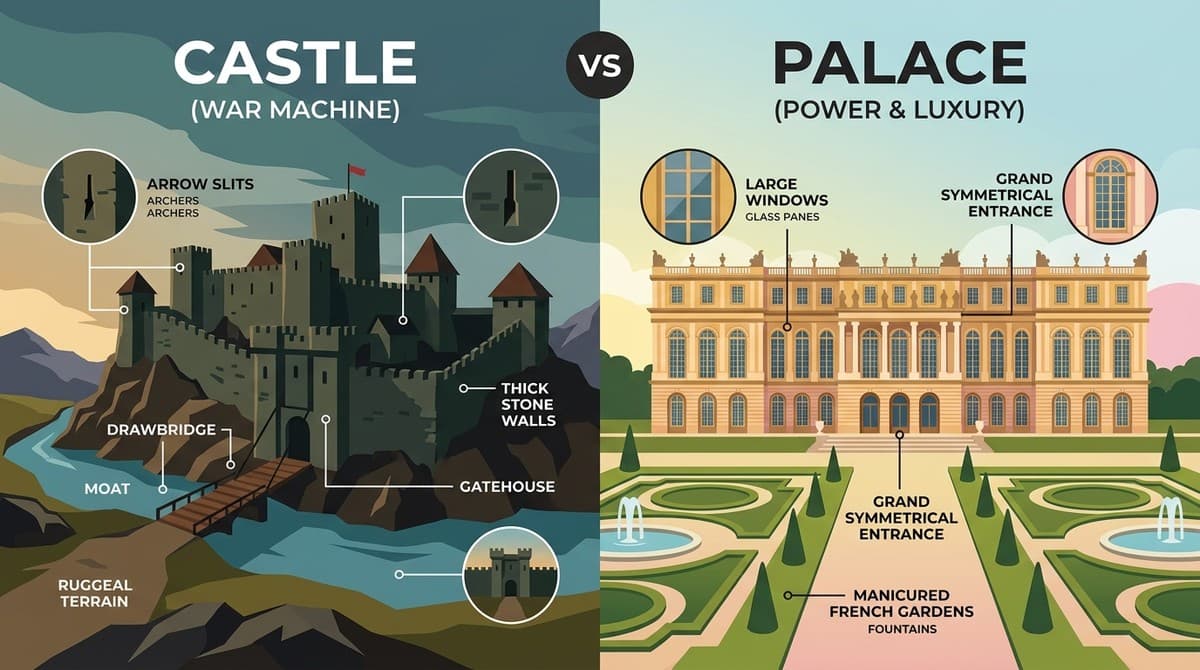
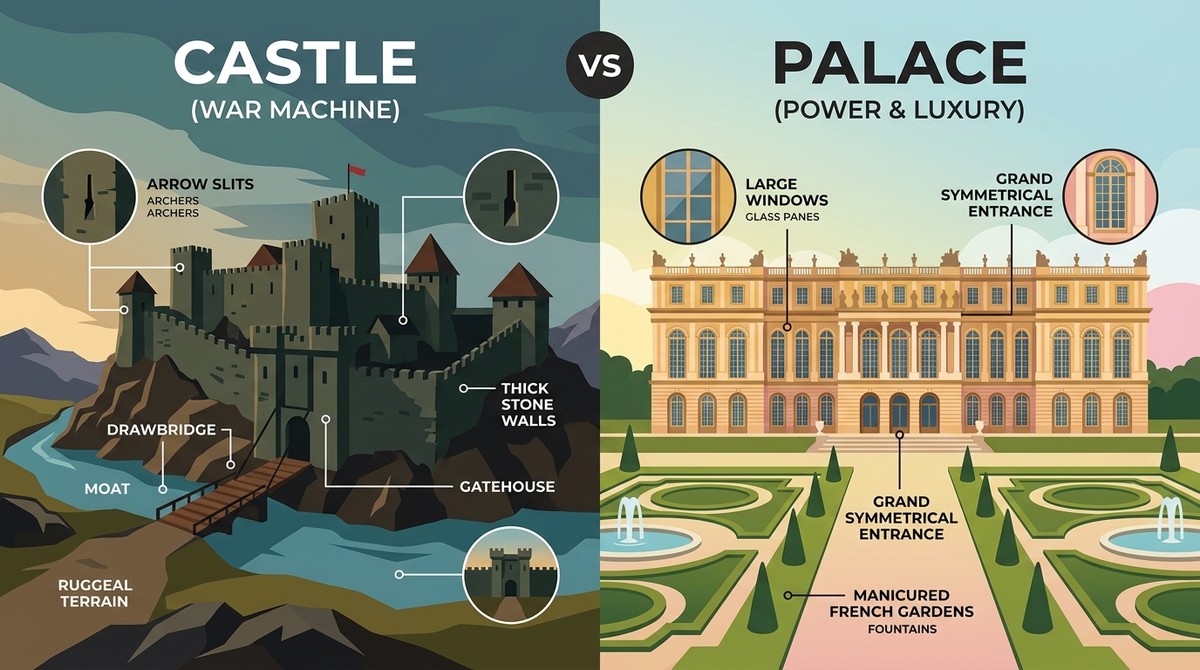
Think about what that actually meant in practice. Thick curtain walls, often several meters deep, built from rubble-core masonry that could absorb the impact of a battering ram or, later, early cannon fire. Narrow arrow slits instead of windows, because a wide window is just an invitation for an enemy archer. A moat or dry ditch to slow down siege engines and undermining attempts. A gatehouse stacked with murder holes, portcullises, and sometimes a second inner gate – because if attackers broke through the first line, you wanted them trapped in a killing zone before they reached the courtyard. And right at the heart of it all, the keep (or donjon, if you're feeling fancy about your French), the last-stand tower where the lord's family and garrison could hole up if everything else fell.
Here's the thing that surprises most visitors: castles were often deliberately uncomfortable. Cold, drafty, dim – because every design choice served defense, not luxury. You didn't put a huge glass window in a castle wall in the 12th century for the view; you'd have been laughed out of your own garrison. As one castle historian likes to put it, "a castle is a machine for war that happens to have a bedroom in it". That single line honestly sums up the whole philosophy better than any textbook could.
And it wasn't just about walls, either. Castles were built with an intense awareness of terrain. A hilltop, a river bend, a narrow mountain pass – the location was as much a weapon as the stonework. Builders would spend as much time studying the landscape as they did the blueprints, because a castle in the wrong spot was basically a fancy tomb waiting to happen.
Palaces: all the glamour, none of the grit
Now flip the coin. A palace is a residence built primarily to impress and to comfortably house royalty, nobility, or high-ranking officials – with defense as, at best, a decorative afterthought. Palaces exist to say "look how powerful and wealthy I am," not "good luck getting through my front door."
Walk into a genuine palace and you'll notice the differences immediately, even if you've never read an architecture textbook in your life. Enormous windows flood the rooms with light, because who wants to live in a dim stone box when you're the one paying for the whole building? Ornamental gardens sprawl outward instead of defensive earthworks – parterres, fountains, hedge mazes designed purely for pleasure and status, not sightlines for archers. Grand staircases sweep upward in ways that would be an absolute liability during a siege (imagine trying to defend the Palace of Versailles's Hall of Mirrors – you'd be dead before you found your sword).
Palaces also tend to prioritize symmetry and proportion above all else, because those principles read as elegant and rational to the eye. Castles, by contrast, are often lopsided and irregular, shaped by defensive logic rather than aesthetics – a tower goes wherever the terrain demands it, not wherever it "looks nice" from the courtyard. That asymmetry is actually one of the fastest visual tells once you know to look for it.
A few hallmarks worth keeping in your back pocket for your next trip:
- Windows: large, numerous, often floor-to-ceiling in state rooms (palace) vs. narrow slits or small, high openings (castle)
- Walls: thin, decorative, sometimes purely load-bearing for aesthetics (palace) vs. thick, layered, defensively engineered (castle)
- Surroundings: manicured gardens and open lawns (palace) vs. moats, ditches, and cleared "killing fields" of open ground (castle)
- Entrances: grand, welcoming, single ceremonial doors (palace) vs. gatehouses, drawbridges, and multiple defensive chokepoints (castle)
- Purpose over time: built for display and governance (palace) vs. built for war, later sometimes softened for comfort (castle)
Versailles is the textbook example – it's staggering, it's iconic, and it has zero meaningful military capability. It was never meant to repel an army; it was meant to remind every visiting ambassador exactly whose court they were standing in.
Here's the same comparison laid out side by side, in case you want the cheat sheet version:
| Feature | Castle (fortress) | Palace (residence) |
|---|---|---|
| Main purpose | Defense and military control | Display of wealth and status |
| Walls | Thick, layered, tapered at the base | Thin, decorative, non-load-bearing accents |
| Windows | Narrow slits, high placement | Large, floor-to-ceiling, numerous |
| Approach | Gatehouse, drawbridge, forced chokepoints | Wide, ceremonial, straight driveway |
| Surroundings | Cleared land, moats, ditches | Manicured gardens, fountains, lawns |
| Layout | Irregular, shaped by terrain | Symmetrical, planned for proportion |
| Typical era | 9th–15th century (pre-gunpowder) | 16th century onward, or Gothic Revival |
| Famous example | Caernarfon Castle, Wales | Palace of Versailles, France |
The telltale signs: how to spot the difference in five minutes
Okay, so now for the fun part – the field guide. Because let's be honest, you're not going to whip out a history degree next time you're standing in a courtyard in Bavaria trying to decide whether you're looking at the real deal or a very convincing knockoff.
First, look at the walls' thickness and material logic. Genuine defensive walls are massive relative to the building's height, often with a noticeable taper (wider at the base, narrower toward the top) for structural stability under bombardment. If the walls look thin enough that a determined battering ram – or honestly, a strong enough kick – could do real damage, you're almost certainly looking at a palace or a "castle" built centuries after fortification actually mattered.
Second, check the windows. This is the single fastest tell, and it works almost every time. Real medieval defensive architecture simply could not afford large windows on lower or exposed levels – it would've been suicidal. So if you're staring up at a building covered in tall, elegant, glass-filled windows all the way down to ground level, that building was never meant to survive a siege. It might look medieval, it might even have a moat for decorative effect, but functionally, it's a stately home wearing a costume.
Third, study the approach. How do you actually get to the front door? A true castle forces you through a gauntlet – a narrow bridge, a gatehouse, maybe a sharp turn designed to slow down a charging attacker and expose their unshielded side to defenders above. A palace, on the other hand, usually rolls out the red carpet (sometimes literally): a wide, straight, ceremonial approach meant to build anticipation and awe, not to funnel enemies into a kill zone.
Fourth – and this one's a bit more subtle – look at what surrounds the building. Genuine fortifications needed clear sightlines. Trees, hedges, and dense vegetation near the walls would give attackers cover, so real castles kept the surrounding land open and defensible. Palaces, meanwhile, are almost always wrapped in elaborate gardens, orchards, and ornamental landscaping, because there was never any tactical reason not to plant a few thousand rose bushes right up against the façade.
And that quote, frankly, nails the whole issue. Fake battlements – decorative crenellations added purely for looks, with no actual defensive function – are one of the biggest giveaways of a Romantic-era or Gothic Revival "castle". Real medieval battlements had functioning gaps for archers to shoot through and retreat behind cover. Nineteenth-century architects loved recreating the look of battlements without any of the underlying logic, because by then, cannons had made stone walls obsolete anyway, so why not just build for beauty?
Famous impostors: castles that are secretly palaces (and vice versa)
This is where things get genuinely fascinating, because some of the world's most photographed "castles" are, structurally speaking, total frauds – gorgeous frauds, but frauds nonetheless.
Neuschwanstein Castle in Bavaria is probably the single best-known example. It looks every bit the medieval fortress, perched dramatically on a rocky hilltop with towers piercing the sky. But it was commissioned in 1869 by King Ludwig II, purely as a romantic fantasy inspired by Wagnerian opera and medieval legend – not as a functional defensive structure. It has plumbing more advanced than most palaces of its own era, massive glazed windows, and interior layouts built for comfort and theatrical grandeur, not siege survival. It's stunning. It's also, functionally, a very elaborate palace wearing a castle's Halloween costume.
Château de Chambord, in France's Loire Valley, tells a similar story. Worth a quick language detour here: in French, the word château covers both "castle" and "palace" – there's no separate word to distinguish a fortress from a grand country house. That single linguistic quirk is honestly responsible for a huge chunk of the naming confusion that's leaked into English and other languages alike, where "château" gets translated as "castle" almost automatically, regardless of whether the building in question was ever meant to survive a siege. Sure, it has towers and a moat-like water feature, but Chambord was built as a hunting lodge for King Francis I, designed to showcase Renaissance architectural genius – including that famous double-helix staircase, which you'd never find in a genuine fortress, since it prioritizes visual spectacle over tactical function. Chambord looks the part, but it was never meant to survive a determined 16th-century siege army.
Then there's the flip side: castles that don't look particularly imposing today but were absolutely, brutally functional in their prime. Many Welsh castles built under Edward I – Caernarfon, Conwy, Harlech – were engineering marvels of pure military logic, with concentric wall systems, murder holes, and precisely calculated sightlines. They're not as "pretty" as Neuschwanstein by modern Instagram standards, but architecturally, they're the real thing through and through – every stone placed with a tactical purpose in mind.
It's a genuinely funny irony when you think about it: the buildings most people picture when they hear the word "castle" are often the least castle-like of all, while the true architectural masterpieces of medieval defense get comparatively overlooked because they don't have quite the same fairytale sparkle.
Why the confusion even exists (and why it's okay)
So why does everyone mix these up so freely? Honestly, it's not really our fault. Pop culture has done an enormous amount of heavy lifting here – Disney's own castle logo was directly inspired by Neuschwanstein, which cemented the "fairytale castle" image into millions of childhoods worldwide, regardless of whether that image had anything to do with actual medieval defense. Add centuries of romantic paintings, Victorian Gothic Revival architecture, and modern marketing (hotels love calling themselves "castles" because it sounds infinitely more romantic than "large stone house"), and you end up with a word that's basically lost its precise technical meaning in everyday use.
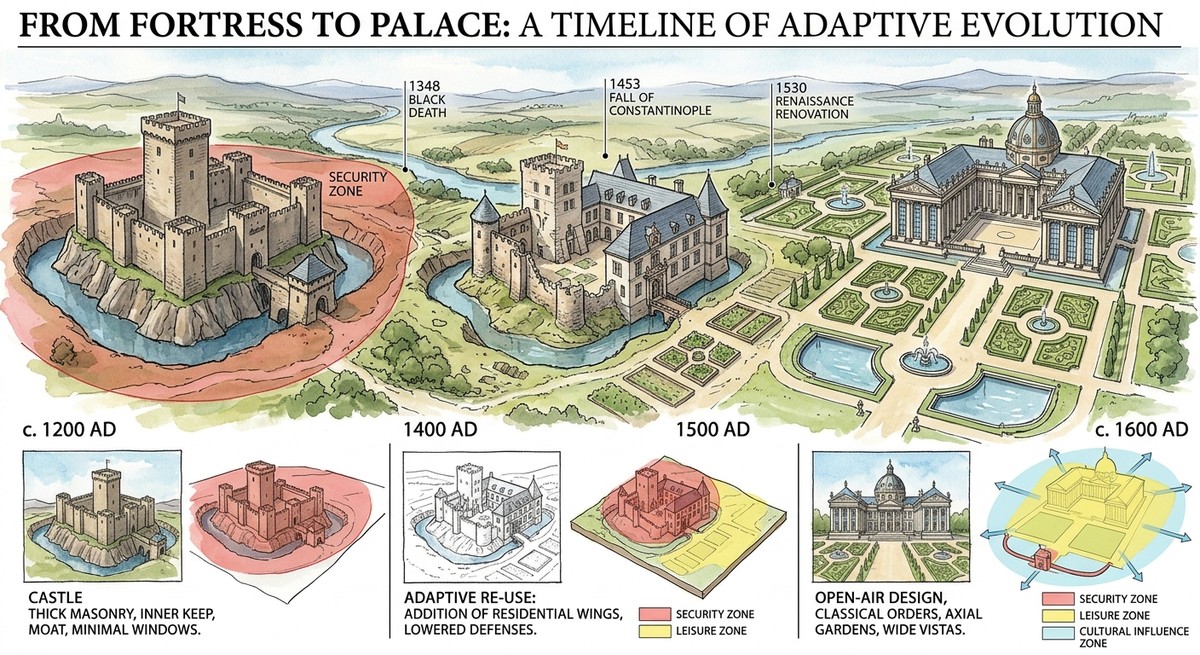
There's also a genuinely interesting historical reason for the blur: many real castles were actually converted into palaces over time. As gunpowder artillery made traditional fortifications obsolete by the 16th and 17th centuries, thick walls stopped mattering as much for actual survival, and nobility increasingly cared more about comfort, status, and entertaining guests. So original medieval castles often got renovated – walls thinned, windows enlarged, gardens added – gradually morphing from war machines into stately residences while keeping their old "castle" name. It's a bit like calling a modern luxury apartment building a "fort" just because a fort used to stand on that exact spot centuries earlier.
Does any of this ruin the magic of visiting these places? Not at all – if anything, it adds a layer of appreciation. Next time you're wandering through a "castle," ask yourself: could this building have actually survived an attack? Look at the windows. Look at the walls. Look at how you got in. You'll start noticing details you'd have walked right past before, and honestly, that's half the fun of travel anyway – seeing familiar things with a slightly sharper eye.
And really, whether you're standing in a genuine 12th-century fortress or a 19th-century romantic fantasy, both tell you something true about the people who built them – one about survival, and the other about ambition. Different goals, same human impulse: build something that lasts, and make it unforgettable.
As a tour guide at one of Wales's Edwardian fortresses once put it to a group of slightly disappointed visitors expecting chandeliers and gold trim: "You wanted a palace. What you got was a war machine that's still standing eight hundred years later. I'd call that the better deal." Hard to argue with that.