Zwingenberg Castle
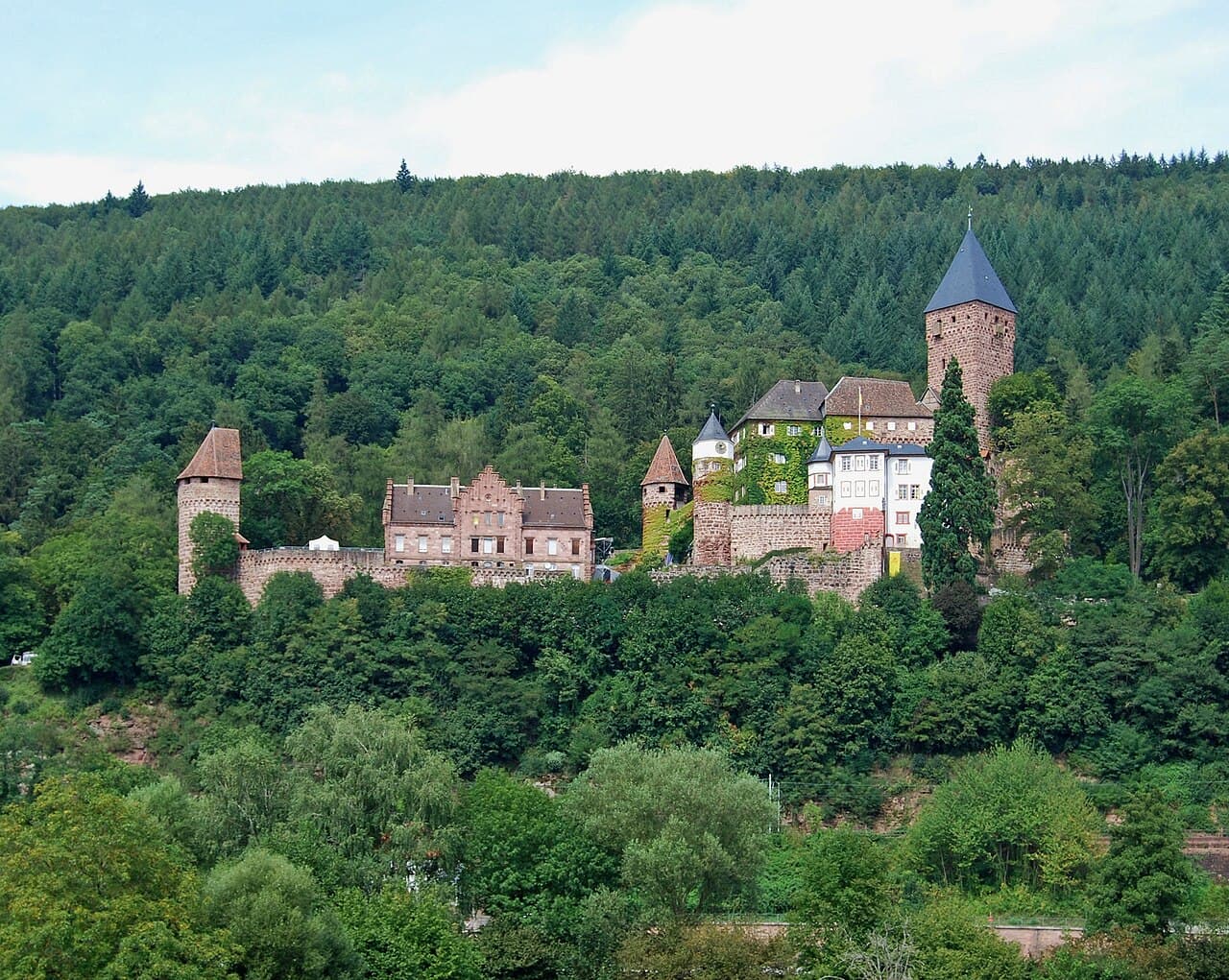
Zwingenberg Castle is a remarkable example of a medieval spur castle strategically perched on a natural hill spur where the steep Wolfschlucht gorge converges with the Neckar valley. Situated approximately 50 meters above the Neckar River, this fortress dominates the surrounding landscape, showcasing the defensive ingenuity of its builders in the High Medieval period. Its commanding position provided natural protection on the eastern side, complemented by man-made fortifications to secure the stronghold against invaders.
The castle's origins trace back to the 13th century, likely founded by Wilhelm von Wimpfen, a ministerial servant under the Staufer dynasty. The earliest documentary mention of the castle dates to 1326, when the lords of Zwingenberg were recorded as owners. This initial phase established the castle as a seat of local noble power, with Wilhelm's nephew adopting the name "von Zwingenberg," signifying the emergence of a noble lineage closely tied to the fortress.
Historical development and ownership
Early history and destruction
During the 14th century, the castle's owners, the Zwingenberg family, gained notoriety as robber knights, conducting raids that destabilized the region. This lawlessness provoked Elector Palatine Ruprecht I to act in 1363 on behalf of the emperor, leading to the castle's conquest and deliberate destruction by imperial forces in 1364. This event marked a significant turning point, as the fortress was dismantled to neutralize the threat posed by its occupants.
Reconstruction and subsequent ownership
Following its destruction, the castle's estate was divided equally between the Electoral Palatinate and the Archbishopric of Mainz. In 1404, the brothers Hans and Eberhard of Hirschhorn were granted the castle and undertook extensive reconstruction efforts. Their work shaped much of the castle's present-day appearance, blending medieval defensive architecture with residential elements.
The von Hirschhorn family maintained control of Zwingenberg Castle until 1632, when their lineage ended. Ownership then passed through various regional powers, including Kurmainz (the Electorate of Mainz), Kurpfalz (the Electoral Palatinate), and ultimately the Grand Duchy of Baden. In 1778, Karl Theodor of the Palatinate bestowed the castle upon his natural son, the Count of Bretzenheim. The castle chapel still houses the tomb of the count's mother, the Countess of Heydeck, underscoring the site's continued familial significance.
Architectural features and layout
Strategic location and fortifications
Zwingenberg Castle exemplifies a spur castle, utilizing the natural topography of a steep hill spur to enhance its defenses. The castle's placement above the Neckar River and adjacent to the Wolfschlucht gorge provided formidable natural barriers, reducing the need for extensive artificial fortifications on those sides.
The castle complex includes a spacious courtyard, notable for its size and exceptional acoustics, which have facilitated cultural events such as open-air opera performances in modern times. The courtyard's design reflects the dual function of the castle as both a defensive stronghold and a noble residence.
Remaining structures and surrounding sites
While detailed architectural plans and decorative elements of the castle are limited in surviving records, the existing structures demonstrate typical medieval construction techniques reinforced by later restorations. The castle's walls, towers, and gatehouses reflect the practical military architecture of the High Medieval period.
Nearby, the ruins of Fürstenstein Castle indicate the area's longstanding strategic importance. This proximity suggests a network of fortifications that controlled the Neckar valley and surrounding routes.
Cultural significance and modern use
In the 20th century, Zwingenberg Castle played a notable role during the November Revolution of 1918, when Friedrich II, the last Grand Duke of Baden, took refuge within its walls and temporarily abdicated his governmental powers. This event highlights the castle's continued political relevance beyond its medieval origins.
Since 1983, the castle has hosted an annual open-air opera festival each August, frequently featuring Carl Maria von Weber's Der Freischütz. The opera's connection to the nearby Wolfsschlucht (Wolf's Gorge) adds a layer of cultural resonance, intertwining the natural landscape with artistic expression.
Today, the castle remains under the stewardship of Ludwig, Prince of Baden, a direct descendant of Grand Duke Karl Friedrich of Baden. This continuity preserves the castle's historical legacy and maintains its status as a cherished cultural monument in the region.
Frequently asked questions (FAQ)
- How do I visit Zwingenberg Castle?
- Zwingenberg Castle is privately owned but open to visitors during specific events such as the annual open-air opera festival in August. Check local tourism websites for exact visiting times and ticket information.
- What is the historical significance of Zwingenberg Castle?
- Zwingenberg Castle dates back to the 13th century and played a key role in regional power struggles, including its destruction in 1364 and reconstruction by the Hirschhorn family. It also served as a refuge for the last Grand Duke of Baden in 1918.
- Can I attend events at Zwingenberg Castle?
- Yes, the castle hosts an annual open-air opera festival every August, featuring performances inspired by the nearby Wolfsschlucht. These events provide a unique cultural experience in a historic setting.
- What architectural style is Zwingenberg Castle?
- The castle primarily exhibits features of High Medieval military architecture typical of spur castles, with later modifications reflecting the needs of residential nobility.
- Is Zwingenberg Castle accessible for people with mobility issues?
- Due to its hilltop location and medieval structure, accessibility may be limited. Visitors with mobility concerns should inquire in advance about accommodations and accessible routes.
Photo gallery

Information
Sources & official resources
Verify the information above using these authoritative references.
Loading map...
Visitor reviews
No reviews yet. Been here? Write the first review and help other travelers!
Write the first reviewVisited this castle? Share your experience
Your review helps other travelers and adds first-hand knowledge to our encyclopedia.