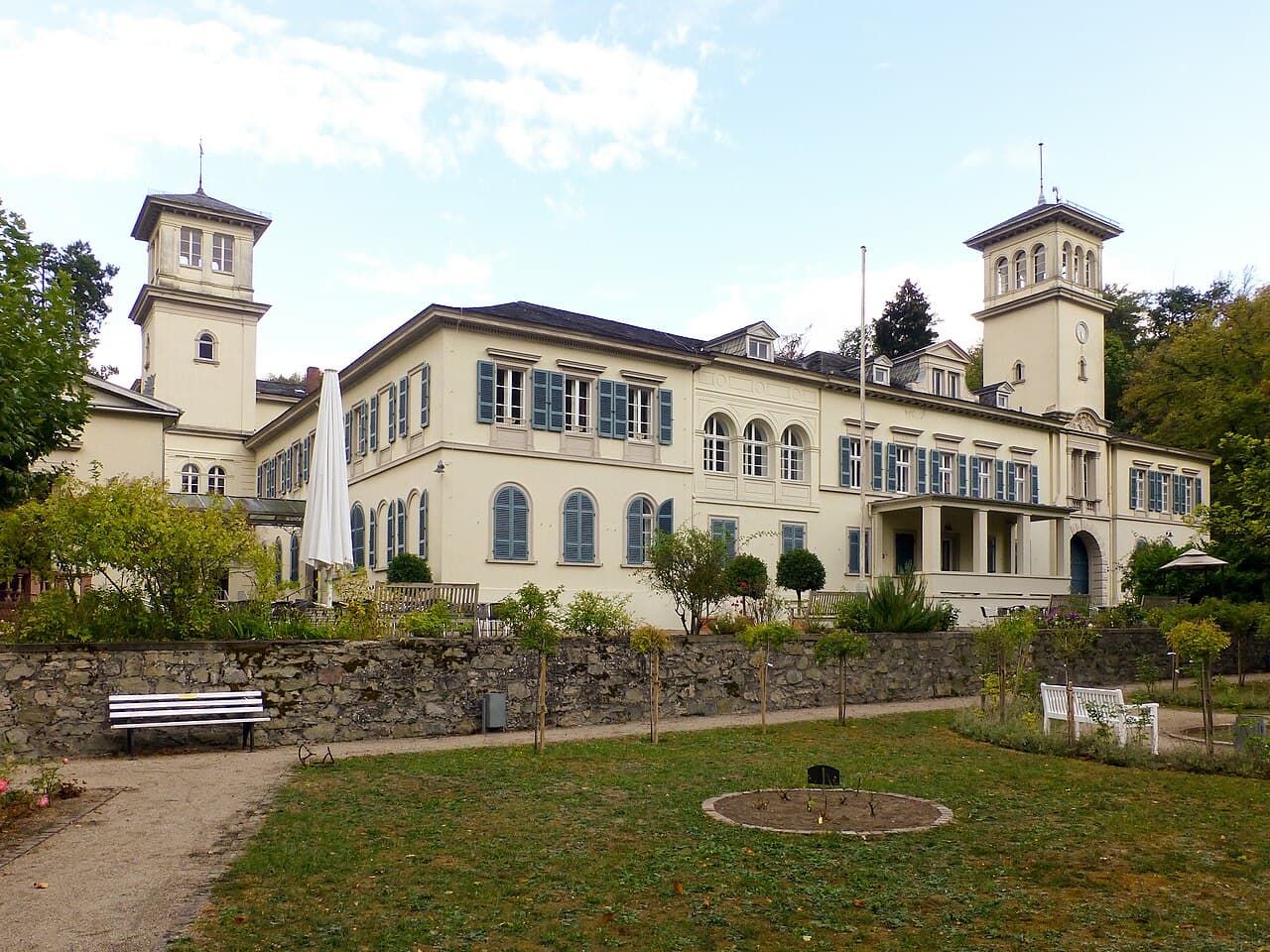
Schloss Heiligenberg
Schloss Heiligenberg stands as a remarkable example of a historic hill castle located in the municipality of Seeheim-Jugenheim in the German state of Hesse. Perched approximately 209 meters above sea level on the Heiligenberg hill, the castle overlooks the expansive Rhine valley and forms a significant cultural and architectural landmark in the region. Its evolution from a modest agricultural estate into a stately castle complex reflects the changing social and political landscapes of 18th and 19th-century Germany.
The origins of Schloss Heiligenberg date back to the late 18th century, with the earliest documented use of the site in 1769 as a farming estate. This initial agricultural function laid the groundwork for the estate's later transformation. In 1811, the property was acquired by August Konrad Hofmann, who constructed a farmstead near the adjacent Marienberg hill between 1813 and 1816. While the exact involvement is uncertain, the prominent architect Georg Moller is believed to have influenced the early design plans during this period.
Transformation into a castle under grand ducal patronage
By 1827, ownership passed to Grand Duchess Wilhelmine of Hesse, who recognized the estate's potential beyond its agricultural roots. She commissioned Georg Moller in 1831 to oversee the conversion of the property into a castle, marking the beginning of a significant architectural and functional shift. This transformation was characterized by expansions and stylistic enhancements that elevated the estate's status to that of a noble residence.
Residence of the Battenberg family and architectural expansions
From 1862, Schloss Heiligenberg became the home of Prince Alexander of Hesse and by Rhine and his wife Julia von Battenberg. Their marriage was morganatic, meaning it involved a union between unequal social ranks, which influenced the social standing of their descendants. Over the next two decades, the couple undertook extensive renovations and enlargements of the castle, guided by architectural plans dating from 1846 by Moller. These efforts not only enhanced the castle's grandeur but also established the Battenberg family as a prominent noble house with influence extending across Europe. Notably, the English branch of the family later anglicized their name to Mountbatten.
Schloss Heiligenberg also holds historical significance as a venue for European royal visits prior to World War I, including visits from the Russian Tsar. It was the birthplace of Princess Louise of Battenberg in 1889, who would become the Queen of Sweden, further cementing the castle's place in European aristocratic history.
20th-century transformations and wartime roles
The early 20th century brought challenges to Schloss Heiligenberg, with financial difficulties forcing Prince Ludwig Alexander (known in Britain as Louis Mountbatten) to sell the estate in 1920 to a group of investors. The castle's purpose shifted during the tumultuous years of the Nazi regime, when it was repurposed as a school for the Bund Deutscher Mädel (BDM), the League of German Girls, and later served as a hospital during World War II.
Following the war, Schloss Heiligenberg adapted to educational uses, housing the Pädagogisches Institut Jugenheim, a teacher training college, from 1946 to 1963. Under the direction of notable educators such as Friedrich Trost, the castle played an important role in post-war educational reconstruction.
Architectural ensemble and landscape features
The castle complex as it stands today is the result of expansions primarily between 1831 and 1886, largely under the guidance of Georg Moller. The architectural style blends elements characteristic of the period, with a focus on harmonious integration into the natural landscape of the northern Bergstraße region. The castle is surrounded by a park originally designed as an open landscape, featuring notable botanical specimens such as a large incense cedar (Calocedrus) and a giant sequoia near a pond, which contribute to the estate's distinctive natural character.
Medieval heritage: klosterruine heiligenberg
Adjacent to the castle are the ruins of a small 12th-century convent known as Klosterruine Heiligenberg. Founded by the noble Herren von Bickenbach family, this religious site was active until the late 15th century before falling into decline, particularly after the devastation wrought by the Thirty Years’ War. These ruins provide a tangible link to the medieval ecclesiastical history of the area, contrasting with the castle's later architectural phases.
Notable landmarks: goldene kreuz and battenberg mausoleum
One of the most visually prominent features on the Heiligenberg hill is the Goldene Kreuz (Golden Cross), an approximately 8.5-meter-tall gilded cross erected in 1866. It stands on a base of black syenite, a durable igneous rock, serving as a memorial to Grand Duchess Wilhelmine. This landmark is visible from across the Rhine plain and serves both as a memorial and a navigational marker.
Nearby, the Battenberg family mausoleum, constructed in 1894, serves as the final resting place of Prince Alexander and Princess Julia. Over time, this mausoleum was converted into a memorial chapel and houses a commemorative stone for their grandson Louis Mountbatten. This structure holds deep personal and historical significance, symbolizing the enduring legacy of the Battenberg family.
Contemporary use and preservation
In recent decades, Schloss Heiligenberg has continued to serve the community in various capacities. Since 2012, the castle has included municipal spaces for civil wedding ceremonies and functions as a cultural venue hosting events and seminars. The interior, adapted post-World War II to accommodate educational institutions, now includes a restaurant and seminar rooms, blending historical ambiance with modern utility.
The castle and its estate are situated within the Natura 2000 protected area known as "Kniebrecht, Melibocus und Orbishöhe," underscoring the site's combined cultural, historical, and environmental importance. Owned by the state of Hesse and managed by a foundation dedicated to preserving art and cultural heritage, Schloss Heiligenberg remains a vital landmark that reflects centuries of architectural evolution, noble lineage, and community significance.
Frequently asked questions (FAQ)
- How do I visit Schloss Heiligenberg?
- Schloss Heiligenberg is located in Seeheim-Jugenheim, Hesse. Visitors should check local tourism websites for current opening hours and any guided tour availability. The castle grounds and park are accessible for public visits.
- What is the historical significance of Schloss Heiligenberg?
- Schloss Heiligenberg is historically significant as the residence of Prince Alexander of Hesse and Julia von Battenberg, founders of the Battenberg family, and as a site hosting European royals before World War I.
- Can I hold events or weddings at Schloss Heiligenberg?
- Yes, since 2012, Schloss Heiligenberg offers municipal spaces for civil wedding ceremonies and cultural events, making it a popular venue for special occasions.
- What architectural styles are represented in Schloss Heiligenberg?
- The castle's architecture reflects its evolution from an 18th-century agricultural estate to a 19th-century noble residence, with expansions primarily guided by architect Georg Moller, blending styles typical of the post-Renaissance period.
- Is Schloss Heiligenberg accessible for visitors with mobility issues?
- Accessibility details may vary; visitors are advised to contact the management or local tourism offices for specific information regarding mobility access and accommodations.
Photo gallery

Information
Sources & official resources
Verify the information above using these authoritative references.
Loading map...
Visitor reviews
No reviews yet. Been here? Write the first review and help other travelers!
Write the first reviewVisited this castle? Share your experience
Your review helps other travelers and adds first-hand knowledge to our encyclopedia.


