Zolochiv Castle
Zolochiv Castle stands as a remarkable example of a 17th-century bastion fortress and noble residence located in the town of Zolochiv, within modern-day Ukraine. Constructed between 1634 and 1636, the castle was commissioned by the Polish–Lithuanian Commonwealth under the direction of Jakub Sobieski, father of the famed King Jan III Sobieski. This imposing fortress replaced an earlier wooden stronghold and was designed in the palazzo in fortezza style, combining military fortification with residential grandeur. Situated on a strategic hill east of the town, it served as a critical defensive bastion along the Commonwealth's southeastern frontier and as a noble estate.
Architectural design and fortifications
The castle's layout is a roughly square platform measuring approximately 110 meters on each side, elevated on a hill to maximize defensive advantage. Its perimeter is defined by substantial earth ramparts, reinforced at each corner with pentagonal bastions. These bastions feature distinctive hexagonal stone watchtowers, embellished with heraldic shields and inscriptions dated 1634, marking the year of construction. The design reflects the bastion fortress architectural style popular in the early modern period, emphasizing angular bastions for improved defensive coverage and reduced blind spots.
The main entrance was originally secured by a gatehouse tower characterized by a lion-head portal, a symbolic and decorative element that remains evident today. Beyond the gatehouse lies a reconstructed ravelin, a detached outwork typical of bastion fortresses, designed to protect the main gate from direct assault. The castle is also surrounded by a moat and drawbridge, both rebuilt in recent times to reflect their historical appearance, enhancing the site's authenticity for visitors.
Palatial buildings within the castle
The great palace
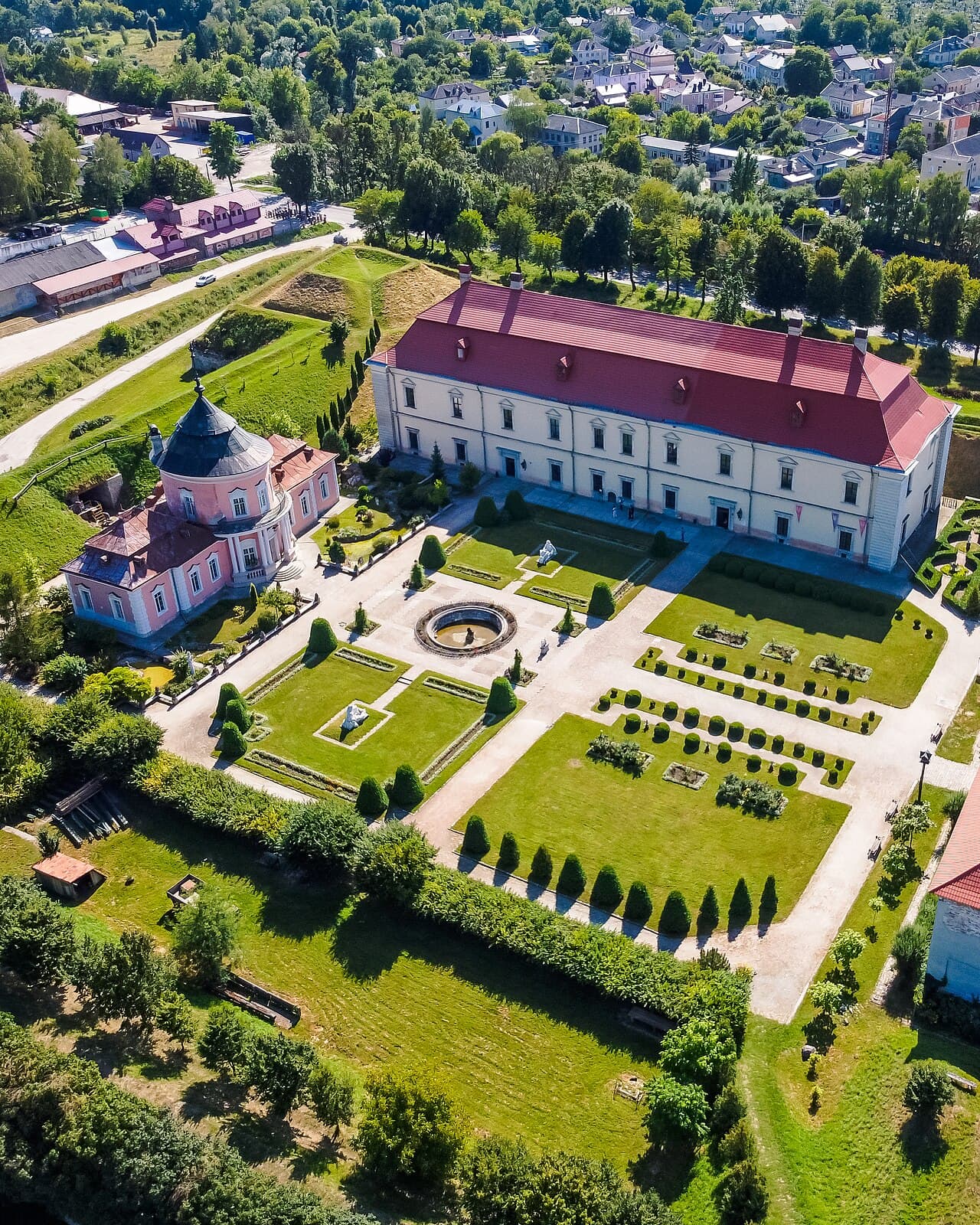
Within the castle's courtyard rise two principal palatial structures. The larger, known as the Great Palace, measures 72 by 22 meters and is a two-story rectangular building with cellars beneath. Its interior layout remains largely intact, preserving original room configurations, including six early 18th-century toilets, hidden passageways, and chimney structures. Although many original features such as stoves, fireplaces, and flooring have not survived, some door portals remain, offering insight into the castle's historical residential function.
Today, the Great Palace houses a museum collection with over 550 exhibits, including 122 paintings, 123 pieces of furniture, arms, porcelain, sculptures, and carpets. Noteworthy are copies of masterpieces by European artists such as Albrecht Dürer, Peter Paul Rubens, Rembrandt van Rijn, and Anthony van Dyck. A significant highlight is a battle scene painted by Martin Altomonte, reflecting the castle's martial heritage.
The chinese palace
Adjacent to the Great Palace is the Chinese Palace, an architectural curiosity featuring a central spired rotunda flanked by one-story wings added in the 18th century. The palace is adorned with decorative reliefs above the second-floor windows and doors, showcasing intricate craftsmanship. Inside, the rotunda contains a tea room and five exhibition halls displaying approximately 250 works of Eastern art and archaeological artifacts. These include items from ancient civilizations such as Egypt, Sumer, China, Japan, India, Indonesia, the Ottoman Empire, and Persia. Among the exotic exhibits are a falcon mummy and fragments of Egyptian sarcophagi, enriching the castle's cultural tapestry.
The Chinese Palace is complemented by an Eastern-style park with a gazebo, enhancing its thematic presentation and offering visitors a unique glimpse into historical cross-cultural influences.
Historical significance and military role
Zolochiv Castle played a pivotal role in the turbulent military history of the region throughout the 17th century. It withstood multiple sieges by Tatar and Turkish forces, serving as a key defensive position along the southeastern border of the Polish–Lithuanian Commonwealth. The castle was frequently used by Jan III Sobieski, who would later become one of Poland's most celebrated kings, as a base for launching military campaigns against the Ottoman Empire and its allies.
Following the First Partition of Poland in 1772, the castle came under Austrian rule. Over subsequent centuries, it passed through the hands of various administrations, including Austro-Hungarian, Russian, and Polish authorities during the interwar period. These changes reflected the shifting political landscape of Eastern Europe and impacted the castle's function and preservation.
Use as a prison and memorial site
Between 1870 and 1926, Zolochiv Castle was repurposed as a prison, a role it retained under successive regimes including Austro-Hungarian, Russian, Polish, and Soviet governments. During the Stalinist period, the castle housed a special prison controlled by the NKVD, the Soviet secret police. This dark chapter in the castle's history is marked by mass executions, with victims buried in mass graves on the grounds.
To commemorate those who suffered and perished during this era, a chapel-monument was erected near the entrance. Designed by architect Vasyl Kamenshchyk with sculpture by Teodozya Bryzh, this solemn memorial serves as a powerful reminder of the human cost of political repression.
Archaeological discoveries and restoration efforts
Archaeological investigations at Zolochiv Castle have uncovered intriguing artifacts, including inscribed stones dating from the late 14th to early 15th centuries. These stones were relocated from the nearby village of Novosilky in 2000 and have prompted speculation about possible connections to the Knights Templar, highlighting the layered and complex heritage of the site.
Restoration efforts have been significantly supported by private benefactor Petro Pysarchuk, enabling the rehabilitation of key structures and infrastructure. These efforts have allowed parts of the castle to function as a museum affiliated with the Lviv Art Gallery, preserving and showcasing its extensive history for future generations.
The castle's restored ravelin has been adapted for modern use, housing a restaurant, souvenir shop, and restroom facilities. This adaptive reuse balances historical preservation with contemporary visitor needs, maintaining the castle's relevance and accessibility.
Visitor experience and cultural importance
Today, Zolochiv Castle offers visitors a rich cultural and historical experience. The combination of military architecture, palatial residences, and museum collections provides a comprehensive insight into the region's past. The castle's location on a hill affords commanding views of the surrounding landscape, enhancing its appeal as a tourist destination.
The museum's diverse exhibits, ranging from European paintings to Eastern artifacts, reflect the castle's multifaceted history and its role as a crossroads of cultures. The memorial chapel adds a poignant dimension, inviting reflection on the site's complex and sometimes tragic history.
Overall, Zolochiv Castle stands as a testament to the architectural ingenuity, historical significance, and cultural resilience of this region of Ukraine, making it a must-visit landmark for those interested in military history, art, and heritage.
Frequently asked questions (FAQ)
- How do I get to Zolochiv Castle?
- Zolochiv Castle is located in Zolochiv, Ukraine, and can be accessed by car, bus, or train. The nearest major city is Lviv, which has regular transport connections to Zolochiv, making it a convenient starting point for your visit.
- What is the historical significance of Zolochiv Castle?
- Zolochiv Castle, built in the 17th century, is a remarkable example of Renaissance architecture and played a crucial role in the defense of the region. It served as a residence for Polish nobility and reflects the turbulent history of Ukraine, showcasing various architectural styles over the centuries.
- When was Zolochiv Castle constructed?
- Construction of Zolochiv Castle began in 1634 and was completed in the late 17th century. It was designed by the Italian architect Giovanni Maria Bernardoni and has undergone several renovations since its original completion.
- Can I take guided tours of Zolochiv Castle?
- Yes, guided tours are available at Zolochiv Castle, providing visitors with in-depth knowledge about its history and architecture. These tours are typically led by knowledgeable guides who can share fascinating stories and insights about the castle's past.
- Why is Zolochiv Castle considered an architectural gem?
- Zolochiv Castle is celebrated for its unique blend of Renaissance and Baroque architectural styles. The castle features impressive fortifications, ornate interiors, and beautifully landscaped gardens, making it a stunning example of 17th-century design.
- Is it possible to visit Zolochiv Castle year-round?
- Yes, Zolochiv Castle is open to visitors throughout the year, although certain areas may have limited access during winter months. It's advisable to check the official website for any seasonal changes in opening hours or special events.
- What are the opening hours for Zolochiv Castle?
- Zolochiv Castle typically opens at 10 AM and closes at 6 PM, but hours may vary depending on the season. It's recommended to verify current opening times before your visit to ensure you have ample time to explore the castle.
- Are there ticket prices for visiting Zolochiv Castle?
- Yes, there is an admission fee to enter Zolochiv Castle, with discounts available for students and groups. Ticket prices may vary, so it's best to check the official site for the most up-to-date information.
- What nearby attractions can I visit while in Zolochiv?
- While visiting Zolochiv Castle, you can explore several nearby attractions, including the historic town center and local churches, such as St. Nicholas Church. Additionally, the scenic landscapes of the surrounding region offer opportunities for hiking and outdoor activities.
Photo gallery

Information
Loading map...
Visitor reviews
No reviews yet. Been here? Write the first review and help other travelers!
Write the first reviewVisited this castle? Share your experience
Your review helps other travelers and adds first-hand knowledge to our encyclopedia.