Olesko Castle
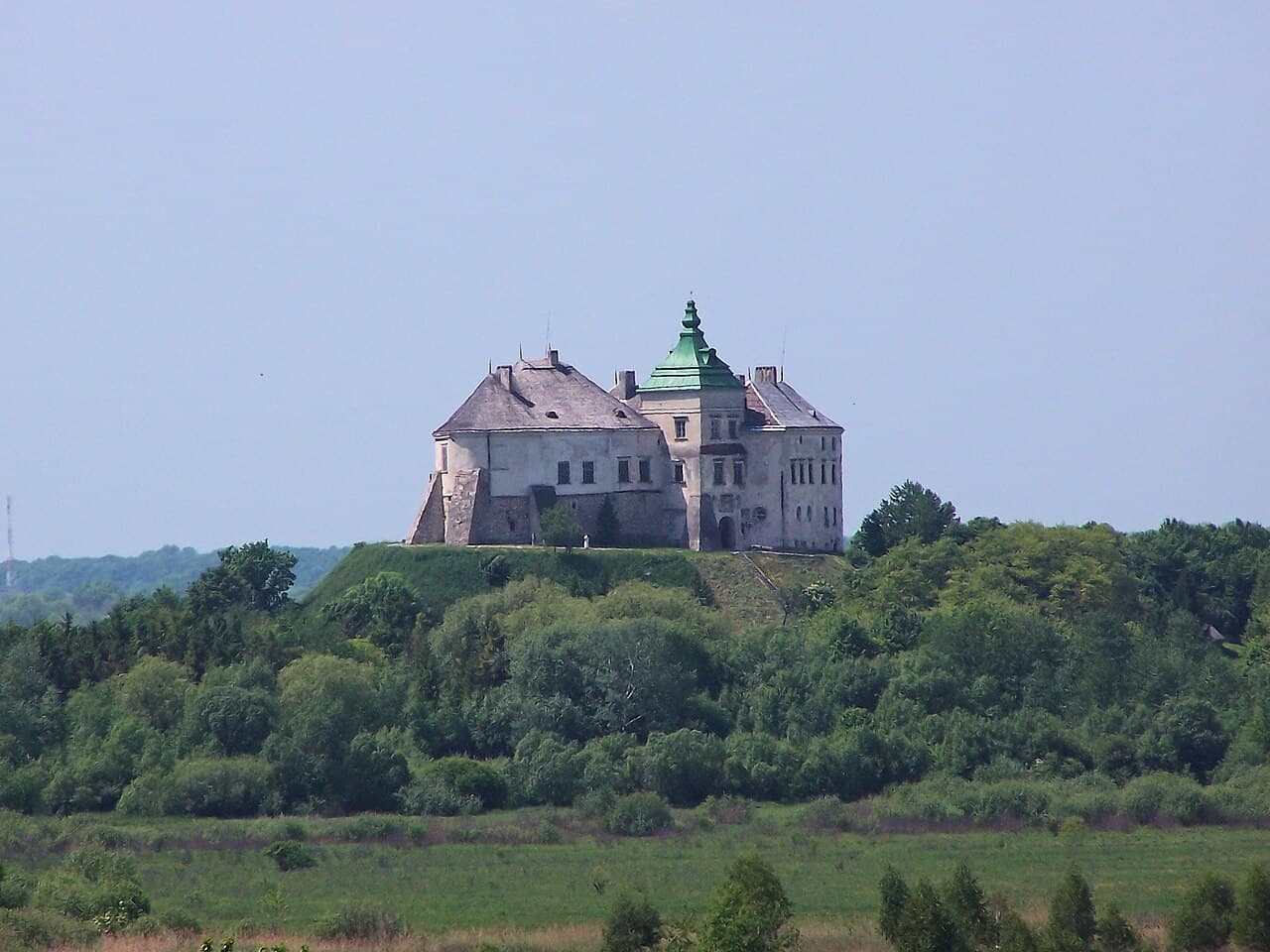
Olesko Castle stands as a remarkable example of a hill castle in western Ukraine, perched atop a natural hill approximately 50 meters high. Its origins trace back to the 13th century, when it was founded by the medieval Galician-Volhynian civilization. The castle's strategic location allowed it to serve as a vital border fortress, controlling key routes and asserting regional power in a contested landscape.
The earliest written record of Olesko Castle dates to 1327, confirming its established role as a defensive stronghold by the early 14th century. Its initial construction featured a compact oval layout that conformed to the hill's natural contours, with a multi-layered defensive system including wooden palisades, earthen ramparts, moats, and ultimately thick stone walls. These walls, reaching about 10 meters in height and 2.5 meters in thickness, represent the castle's third and most formidable line of defense.
Medieval origins and strategic importance
Olesko Castle was likely founded by a son of Prince Yurii Lvivych, possibly Andrii or Lev, during the period of the Galician-Volhynian principality. The castle was a crucial military and administrative center on the volatile borderlands between the Kingdom of Poland and the Grand Duchy of Lithuania. Throughout the 14th and 15th centuries, it changed hands multiple times, reflecting the shifting political landscape of Eastern Europe.
Notably, the castle was held by the Lithuanian prince Liubart in 1340 and was captured by King Casimir III of Poland in 1366. By 1375, it came under the control of the Latin Archbishop of Halych, highlighting its significance in both secular and ecclesiastical governance.
Conflicts and ownership changes in the 15th century
The early 15th century was marked by local uprisings and military conflicts centered around Olesko Castle. During the 1431-1432 rebellion, the castle supported the Lithuanian prince Svidryhailo in his challenge against the Polish king Jogaila. Following a siege, Polish forces captured the fortress and granted it to Jan from Senno and his descendants, the Oleski family.
This period also saw the establishment of a Catholic church on the castle grounds, signaling the growing influence of Catholicism in the region and the castle's evolving role beyond purely military functions.
Renaissance transformations and royal connections
In the early 17th century, the castle underwent significant expansion and renovation under the ownership of Ivan Danilovych, a magnate who introduced Renaissance architectural features including a two-story residential wing and a chapel. This transformation reflected the shift from a fortress to a noble residence.
One of the castle's most notable historical moments occurred in 1629, when Theophilia Danilovych gave birth to Jan III Sobieski within its walls. Jan III Sobieski would later become a celebrated King of Poland and military leader.
Military significance during uprisings and royal ownership
Olesko Castle played a role in the Khmelnytsky Uprising of 1648, briefly falling to Cossack-peasant insurgents before being reclaimed by the Koniecpolski family. In 1682, King Jan III Sobieski acquired the castle and undertook restoration efforts between 1684 and 1687, focusing on roofing and landscaping, including the enhancement of the surrounding park.
18th and 19th century modifications and decline
The castle's transformation into a grand residence continued under the Rzewuski family in the 18th century. French sculptor Leblanc contributed richly decorated stucco interiors, paintings, and fireplaces. A modest third floor was added to accommodate servants, reflecting changes in domestic arrangements and social hierarchy.
Despite these enhancements, the castle suffered significant damage from two major fires in 1806 and 1836, followed by a severe earthquake in 1838. These disasters left the castle largely in ruins by the end of the 19th century.
20th century restoration and museum establishment
In 1898, restoration efforts repurposed the castle as an agricultural school, which functioned until its closure by Soviet authorities in 1939. During World War II, the castle was occupied by military units and served as a prisoner-of-war camp. A devastating fire in 1951 further reduced the structure to a shell.
Starting in 1954, extensive restoration work revived the castle, culminating in the opening of a museum in 1975. Today, Olesko Castle stands as a well-preserved monument to the region's medieval and Renaissance heritage, attracting visitors interested in history, architecture, and art.
Architectural features and defensive design
The castle's oval layout is adapted to the hill's natural topography, with the oldest surviving elements including the lower defensive walls dating from the late 13th and early 14th centuries. These stone walls, approximately 10 meters high and 2.5 meters thick, formed the third line of defense, superior to earlier wooden palisades and earthworks.
The fortress employed a sophisticated defensive system with multiple layers: an initial wooden palisade, followed by an earthen rampart with a moat and another palisade, culminating in the stone castle crowned by a powerful gate tower. The gate tower features a carved coat of arms of the Danilovych family, linking the architecture to prominent historical owners.
Residential and ceremonial spaces
Between the 15th and early 17th centuries, two-story residential buildings were constructed within the walls, reflecting the castle's transition from a purely military fortress to a noble residence with administrative functions. The Italian Renaissance-style residential wing and chapel added in the early 1600s introduced elegant architectural details such as arched galleries, decorated portals, and ornate window frames.
Interior decoration flourished in the 18th century under the patronage of Severyn Rzewuski, with French sculptor Leblanc creating stucco work, paintings, and fireplaces that enriched the castle's aesthetic appeal. The addition of a third floor for servants indicated evolving social structures within the noble household.
Water supply and sustainability features
To address the practical challenges of its hilltop location, a deep well measuring 42 meters was excavated in the courtyard, ensuring a reliable water supply despite the distance to groundwater. Although partially collapsed today, this well exemplifies the ingenuity required to sustain life within the castle's elevated position.
Cultural heritage and collections
Olesko Castle houses a rich collection of artifacts spanning several centuries. These include fragments of 12th-century unglazed tiles, a variety of Ukrainian icons, and portraits of noble families such as the Potocki, Żółkiewski, and Koniecpolski. Renaissance marble busts, including one of Queen Barbara Radziwiłł, complement the collection.
The castle also features Baroque and Mannerist tapestries and wooden sculptures by Johann Georg Pinzel and his followers, adding to its cultural richness. These collections underscore the castle's role as a repository of regional art and history.
Grounds and landscape park
The castle is surrounded by a formal garden and a 13-hectare landscape park originally planted with rare species such as citrus, cypress, and oleander. Restoration efforts beginning in the 1970s revived the park's historic character, including the restoration of ponds fed by the Liberciya River and the installation of modern sculptures.
This integration of natural beauty with historic architecture enhances the visitor experience and preserves the castle's setting as a cultural landmark.
Frequently asked questions (FAQ)
- What is the historical significance of Olesko Castle?
- Olesko Castle is a significant landmark in Ukraine, known for its rich history dating back to the 14th century. It has served various roles, including a royal residence and a military fortress, reflecting the tumultuous history of the region.
- When was Olesko Castle built?
- Olesko Castle was constructed in the early 14th century, making it one of the oldest castles in Ukraine. It has undergone several renovations and restorations throughout the centuries, preserving its historical architecture.
- What are the opening hours for Olesko Castle?
- Olesko Castle is open to visitors year-round, with varying hours depending on the season. Typically, the castle is open from 10 AM to 5 PM, but it's advisable to check the official website for any seasonal changes.
- Can I visit Olesko Castle with children?
- Yes, Olesko Castle is family-friendly and offers a great experience for visitors of all ages. There are educational exhibits and beautiful grounds for children to explore, making it a wonderful outing for families.
- Is it possible to take guided tours at Olesko Castle?
- Absolutely! Guided tours are available and provide a detailed overview of the castle's history and architecture. These tours are often led by knowledgeable guides who share fascinating stories about the castle's past.
- What is the best time to visit Olesko Castle?
- The best time to visit Olesko Castle is during the spring and early autumn when the weather is mild and the surrounding landscapes are particularly beautiful. This period also tends to have fewer tourists, allowing for a more enjoyable experience.
- What are the ticket prices for Olesko Castle?
- Ticket prices for Olesko Castle are quite reasonable, with discounts often available for students and seniors. It's best to check the official website for the most current pricing and any special offers.
- How do I get to Olesko Castle from Lviv?
- Olesko Castle is approximately 70 kilometers from Lviv, making it accessible by car or public transport. Buses and taxis frequently run from Lviv to the nearby town of Olesko, where the castle is located.
- What nearby attractions can I visit while at Olesko Castle?
- While visiting Olesko Castle, you can also explore nearby attractions such as the picturesque village of Olesko and the beautiful landscape of the Lviv region. Additionally, other historical sites like Pidhirtsi Castle and Zolochiv Castle are within a short drive.
Photo gallery

Information
Website
Visit websiteSources & official resources
Verify the information above using these authoritative references.
Loading map...
Visitor reviews
No reviews yet. Been here? Write the first review and help other travelers!
Write the first reviewVisited this castle? Share your experience
Your review helps other travelers and adds first-hand knowledge to our encyclopedia.