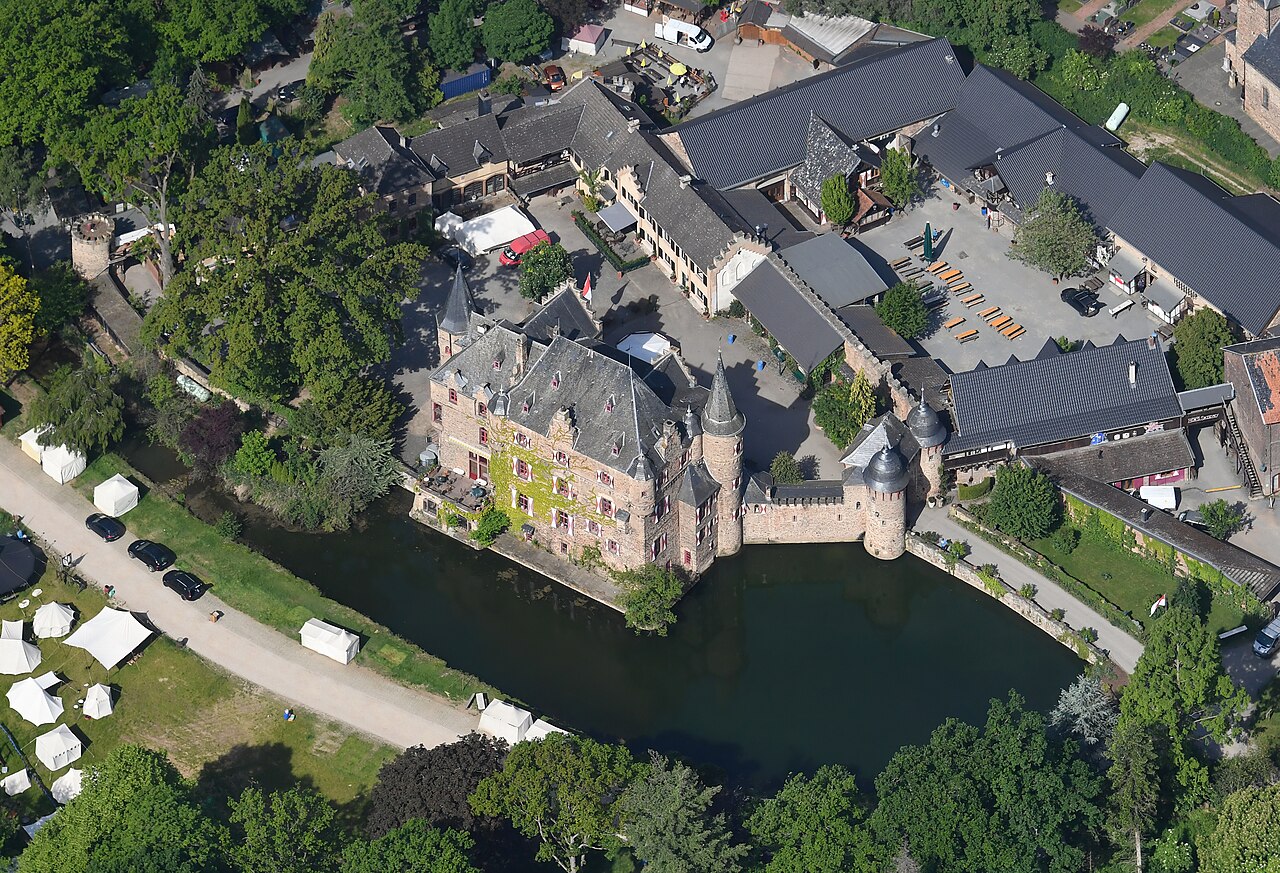
Zievel Castle
Zievel Castle, located near Mechernich in Germany, stands as a striking example of a medieval hill castle with a rich history spanning several centuries. Its imposing presence in the landscape, distinct from the nearby village of Zievel, captures the essence of a traditional knight's fortress, embodying the architectural and historical characteristics of a noble estate from the Late Medieval period.
First documented in 1107 as the free property of the Counts of Limburg, Zievel Castle's origins trace back to the early 12th century. Over the centuries, the castle witnessed a succession of noble owners, including the von Daun family who adopted the name von Zievel, and later the influential Schmeich von Lissingen family in the 14th century. The castle's current recognizable form largely stems from construction and alterations made during the 15th century, notably the addition of the twin-tower gate and the establishment of its dual structure comprising a fore-castle and main castle.
Architectural features and layout
The castle's original design reflected a rectangular water castle layout, surrounded by a moat that has since disappeared. Its strategic position near the Billiger Berg forest and the Veybach valley provided natural defenses and control over surrounding lands. The most prominent architectural feature is the round bergfried on the western side, which served as the main defensive tower. This bergfried incorporates elements of earlier medieval construction but was later modified with a distinctive baroque dome, painted white, which altered its medieval silhouette.
Two gate towers, located at the southwest and northwest corners of the castle precinct, controlled access and fortified the castle's defenses. Adjacent to the bergfried is a notable two-story building with stepped gables dating from 1661, constructed during the expansion by the Metternich family. This building illustrates the castle's continuous development beyond the medieval period.
The current manor house, painted pink, was built between 1825 and 1828 by the Krewel family who acquired the estate in the early 19th century. This structure replaced the original 15th-century manor house and reflects a baroque architectural style, marking a transformation from a fortified medieval castle to a more comfortable noble residence.
Historical significance and ownership
Zievel Castle's history is deeply intertwined with the noble families of the region. After its initial ownership by the Counts of Limburg, the castle passed through ecclesiastical hands briefly when Archbishop Philip of Cologne held it in 1190. By the 13th century, it was controlled by the von Daun family, who became known as von Zievel, emphasizing the castle's importance as a noble seat.
In the 14th century, the castle came under the ownership of the Schmeich von Lissingen family, with records from 1337 mentioning Ritter Johann Schmeich von Lissingen. The estate included nearby villages such as Lessenich and Rißdorf, highlighting the castle's role as a local administrative and territorial center.
The 15th century marked another significant transition when the Metternich family acquired the castle, making it their principal residence. This lineage maintained control until the mid-17th century, after which the estate was divided among heirs who constructed a second manor house in 1661, expanding the castle complex.
In the late 18th century, the castle was leased to the Krewel family, who purchased it outright in 1822. Their stewardship brought modernization and preservation efforts, including the replacement of the old manor house with the current baroque-style building. The Krewel family remains the castle's owners, continuing to maintain its historical legacy.
Castle grounds and surrounding landscape
The castle is set within a park-like landscape featuring mature trees and ponds bordered by reeds, remnants of an English-style garden once designed to complement the estate. In the 1990s, the grounds were adapted to include an 18-hole golf course, integrating recreational use with the historic setting.
Despite modern additions, the castle's external grounds remain accessible to visitors, offering views of the castle's architectural evolution and its enduring connection to the natural environment. The location near the Billiger Berg forest and the Veybach valley continues to provide a picturesque backdrop that enhances the castle's historical ambiance.
Architectural evolution through centuries
Zievel Castle exemplifies the architectural transition from a medieval fortress to a noble residence adapting to changing needs and styles. The original defensive structures, including the moat, bergfried, and gate towers, reflect typical Late Medieval military architecture. Over time, the castle incorporated Baroque elements, especially evident in the dome atop the bergfried and the manor house's design.
The 17th-century expansions by the Metternich family introduced residential enhancements such as the two-story building with stepped gables, blending functionality with stylistic updates. The 19th-century reconstruction under the Krewel family further transformed the castle into a more comfortable and representative estate, replacing older structures with the current baroque manor house.
Visitor information and cultural importance
Today, Zievel Castle remains a significant cultural landmark in the North Rhine-Westphalia region. While privately owned by the Krewel family, the castle and its grounds contribute to the area's historical heritage and architectural diversity. Visitors can appreciate the castle's medieval origins, baroque transformations, and the integration of natural and designed landscapes.
The castle's preservation offers insights into noble life across centuries, showcasing how defensive needs and residential comforts evolved. Its setting, architecture, and history make Zievel Castle a valuable site for those interested in medieval fortifications, noble estates, and German regional history.
Frequently asked questions (FAQ)
- What is the historical significance of Zievel Castle?
- Zievel Castle, located in Mechernich, Germany, dates back to the 13th century and has played a crucial role in the region's history. Originally built as a defensive fortress, it showcases the architectural evolution of medieval strongholds and reflects the feudal system of the time.
- When was Zievel Castle built?
- Zievel Castle was constructed in the early 13th century, making it over 800 years old. Its long history is evident in its preserved structures and the archaeological findings around the site, which tell the story of its past inhabitants.
- What are the opening hours for Zievel Castle?
- Zievel Castle is open to visitors from April to October, typically from 10 AM to 6 PM. However, it's advisable to check the official website for any seasonal variations or special events that may affect opening times.
- Can I visit Zievel Castle year-round?
- While the castle is primarily open to visitors from April to October, guided tours may be available in the off-season upon request. It's best to contact the castle's administration for specific arrangements if you plan to visit outside the regular season.
- Is it possible to access Zievel Castle with a wheelchair?
- Zievel Castle has some accessibility features, but due to its historical nature and terrain, not all areas may be fully accessible to wheelchair users. It is recommended to check in advance regarding specific access points and any assistance that may be available.
- What is the best time to visit Zievel Castle?
- The best time to visit Zievel Castle is during the late spring and early autumn months when the weather is pleasant, and the surrounding natural scenery is at its most beautiful. Additionally, visiting during the castle's open season allows you to enjoy guided tours and special events.
- Are there any nearby attractions to Zievel Castle?
- Yes, visitors to Zievel Castle can explore various nearby attractions, including the beautiful Eifel National Park and the historic town of Mechernich. The area is rich in nature trails, cultural sites, and opportunities for outdoor activities.
- What are the ticket prices for Zievel Castle?
- Ticket prices for Zievel Castle typically range from €5 for adults to €3 for children and students. Discounts may be available for groups or special events, so it's advisable to check the official website for the latest pricing information.
Information
Website
Visit websiteSources & official resources
Verify the information above using these authoritative references.
Loading map...
Visitor reviews
No reviews yet. Been here? Write the first review and help other travelers!
Write the first reviewVisited this castle? Share your experience
Your review helps other travelers and adds first-hand knowledge to our encyclopedia.