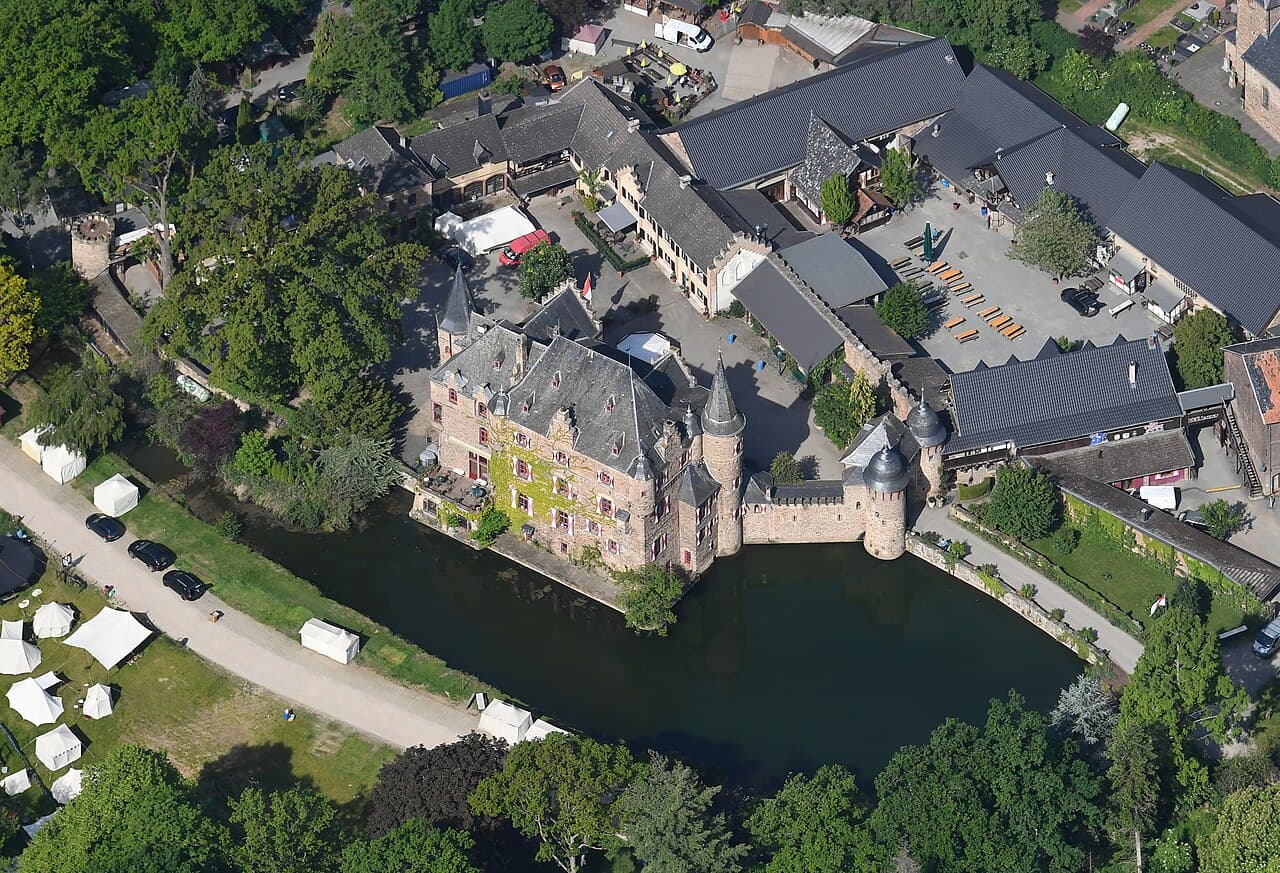
Burg Satzvey
Burg Satzvey, located in the municipality of Mechernich in North Rhine-Westphalia, Germany, is a remarkable example of a medieval water castle that has retained much of its original character and charm. Built between 1396 and 1406 on an island in the middle of a large pond fed by the Veybach stream, the castle is surrounded by moats and water defenses typical of lowland castles designed to compensate for the absence of natural hill fortifications. Its strategic location and architectural features reflect the military and residential needs of the late medieval period.
The castle's history stretches back to the 12th century, originally known as Vey, serving as a fortified manor for local nobility overseeing the surrounding Eifel region. Initially under the stewardship of the Benedictine convent at Dietkirchen, it passed to the von Vey family, who acted as vogts—administrative stewards—for church possessions. The earliest documented owner was Otto von Vey in 1368. After the extinction of the male von Vey line, ownership transferred through marriage to Heinrich von Krauthausen in 1391, who was responsible for erecting the first independent two-story Gothic castle house in 1396, establishing the core of the present structure.
Architectural features and medieval fortifications
Burg Satzvey is distinguished by its well-preserved Gothic architectural elements, including the original castle house and a gatehouse with twin towers dating from the early 15th century. The gatehouse serves as the imposing entrance, featuring a stone archway bearing the coat of arms of the Wolff-Metternich zur Gracht family, who later owned the castle. Defensive features include a zwinger—an enclosed outer ward designed to trap attackers between walls—and a fortified outer bailey, which provided both protection and space for service buildings.
The castle's moats and water defenses are fed by the Veybach stream, surrounding the main island that hosts the primary castle buildings. The secondary island contains the outer bailey, emphasizing the castle's layered defense system. The northern wall and tower have remained intact for over six centuries, exemplifying the durability of medieval construction techniques.
Manor house and later expansions
In the late 19th century, Count Dietrich Wolff-Metternich zur Gracht undertook extensive renovations that transformed the castle from a medieval fortress into a grand noble residence. These works included drying out parts of the original moat, adding new wings and towers to the manor house, and constructing buildings on the former outer bailey in a style reminiscent of English stables. A manor farm with agricultural buildings was also established, reflecting the estate's economic self-sufficiency.
The manor house today showcases a richly structured appearance with multiple wings and a tower, blending medieval Gothic elements with 19th-century romantic style. The presence of stables on the grounds continues the tradition of equestrian culture associated with noble estates.
Historical significance and ownership lineage
The castle's ownership history is intertwined with several noble families and regional powers. After the von Vey family, the castle passed to Heinrich von Krauthausen, who initiated the main castle construction. In the 15th and 16th centuries, families such as the von Meller and Wilhelm Spies von Büllesheim, with the support of the Archbishop of Cologne, controlled the castle. Notably, Duke Wilhelm V of Jülich occupied the castle temporarily in 1578, compelling the lord to pledge allegiance to both the Duke and the Archbishop.
By the late 16th century, the vogtei of Satzvey attained the status of an immediate imperial lordship within the Holy Roman Empire, granting it a degree of autonomy. In 1747, Karl Otto von Gymnich purchased the castle, and the Gymnich family has maintained ownership to the present day. The castle's political role diminished after 1794, transitioning to a knightly estate with limited political influence.
Following the extinction of the Gymnich main line in 1882, ownership passed to Count Dietrich Wolff-Metternich zur Gracht, who restored and expanded the castle. The estate later came into the possession of the Beissel von Gymnich family through marriage. Despite suffering damage during World War II, the family has undertaken significant restoration efforts to preserve the castle's historical integrity.
Cultural events and visitor experience
Burg Satzvey is renowned for its vibrant program of cultural events that bring medieval history to life. The castle hosts regular jousting tournaments and medieval markets, attracting visitors interested in authentic historical reenactments. The Fantasy Days event includes lectures, art classes, musical performances, and competitions, appealing to diverse audiences.
Seasonal celebrations such as witches' festivals around Halloween and the traditional Christmas market transform the castle grounds into festive venues. The castle's courtyards, surrounded by impressive walls, provide atmospheric settings for these events and excellent photographic opportunities.
Inside, the Hall of Crests displays the heraldic emblems of noble families associated with the castle, while the Hall of the Bourbon Lilies, adorned with burgundy tapestries decorated with golden lilies, serves as a concert hall and banquet space. These interiors reflect the castle's noble heritage and architectural grandeur.
Visitor information and accessibility
Burg Satzvey is conveniently located about 55 kilometers south of Cologne in the town of Mechernich. Visitors can reach the castle by car via the Autobahn A1, exiting at 111, or by train, with the Satzvey station just a two-minute walk from the castle entrance. The address "Burg Satzvey, 53894 Mechernich-Satzvey" is recommended for navigation.
The castle offers guided tours and hosts a variety of events throughout the year. Accommodations are available within the castle's bel étage and nearby estate houses, as well as outdoor camping areas. The castle grounds include stables that continue to support equestrian activities, maintaining a living connection to the estate's historical functions.
Memorial plaques near the gatehouse honor Countess Adeline Helene Huberta Maria Beissel von Gymnich, née Wolff-Metternich, and her husband Franz Josef Count Beissel von Gymnich, recognizing their contributions to the castle's preservation and public accessibility.
Architectural legacy and preservation
Burg Satzvey stands as a testament to the evolution of castle architecture from the late medieval period through the 19th century. Its combination of defensive features such as moats, zwingers, and gatehouses alongside later romantic expansions illustrates the transition from fortress to noble residence. The castle's preservation, despite wartime damage, highlights the commitment of its owners to maintaining historical authenticity and cultural heritage.
Today, the castle remains a well-preserved example of a Rhineland water castle, showcasing centuries of architectural styles and noble lifestyle. Its ongoing use as a cultural venue and residence ensures that Burg Satzvey continues to be a vibrant part of Germany's historical landscape.
Frequently asked questions (FAQ)
- How do I get to Burg Satzvey?
- Burg Satzvey is located in Mechernich, Germany, and can be easily reached by car or public transport. If traveling by car, there are parking facilities available nearby. Alternatively, you can take a train to Mechernich and then use local buses or taxis to reach the castle.
- What is the historical significance of Burg Satzvey?
- Burg Satzvey dates back to the 13th century and is one of the most well-preserved medieval castles in the Rhineland. It served as a noble residence and has witnessed significant historical events over the centuries. The castle is a prime example of medieval architecture, showcasing the region's rich heritage.
- When was Burg Satzvey built?
- Construction of Burg Satzvey began in the early 13th century, with the castle being completed in the following decades. It has undergone various renovations and restorations, preserving its historical charm while adapting to modern needs. Today, it stands as a testament to the architectural styles of that era.
- Can I visit Burg Satzvey year-round?
- Yes, Burg Satzvey is open to visitors year-round, although specific events and guided tours may vary by season. It’s advisable to check the castle's official website for the most accurate information regarding opening times and special events. This allows you to plan your visit accordingly.
- Why is Burg Satzvey a popular tourist attraction?
- Burg Satzvey attracts visitors due to its stunning medieval architecture, beautiful surroundings, and rich history. The castle hosts various events, including medieval markets and reenactments, which enhance the visitor experience. Its picturesque landscape makes it an ideal spot for photography and exploration.
- Is it possible to take guided tours of Burg Satzvey?
- Yes, guided tours are available at Burg Satzvey, providing an in-depth look at the castle's history and architecture. These tours are led by knowledgeable guides who share fascinating stories and insights about the castle's significance. It's recommended to book in advance, especially during peak tourist seasons.
- What are the ticket prices for Burg Satzvey?
- Ticket prices for Burg Satzvey vary depending on the type of tour and the visitor's age. Generally, adults pay a standard fee, while discounts are available for children, students, and seniors. Check the official website for the latest pricing information and any special offers.
- What are the opening hours of Burg Satzvey?
- Burg Satzvey typically opens from 10 AM to 6 PM, with extended hours during the summer months. However, hours may change on public holidays or for special events, so it’s best to verify before your visit. This ensures you have ample time to explore the castle and its grounds.
- What nearby attractions can I visit while at Burg Satzvey?
- While visiting Burg Satzvey, you can explore several nearby attractions, including the beautiful Eifel National Park and the charming town of Mechernich. Additionally, the area is rich in hiking trails and scenic views that enhance your experience. Don't miss the opportunity to discover the region's natural beauty and historic sites.
Photo gallery

Information
Sources & official resources
Verify the information above using these authoritative references.
Loading map...
Visitor reviews
No reviews yet. Been here? Write the first review and help other travelers!
Write the first reviewVisited this castle? Share your experience
Your review helps other travelers and adds first-hand knowledge to our encyclopedia.



