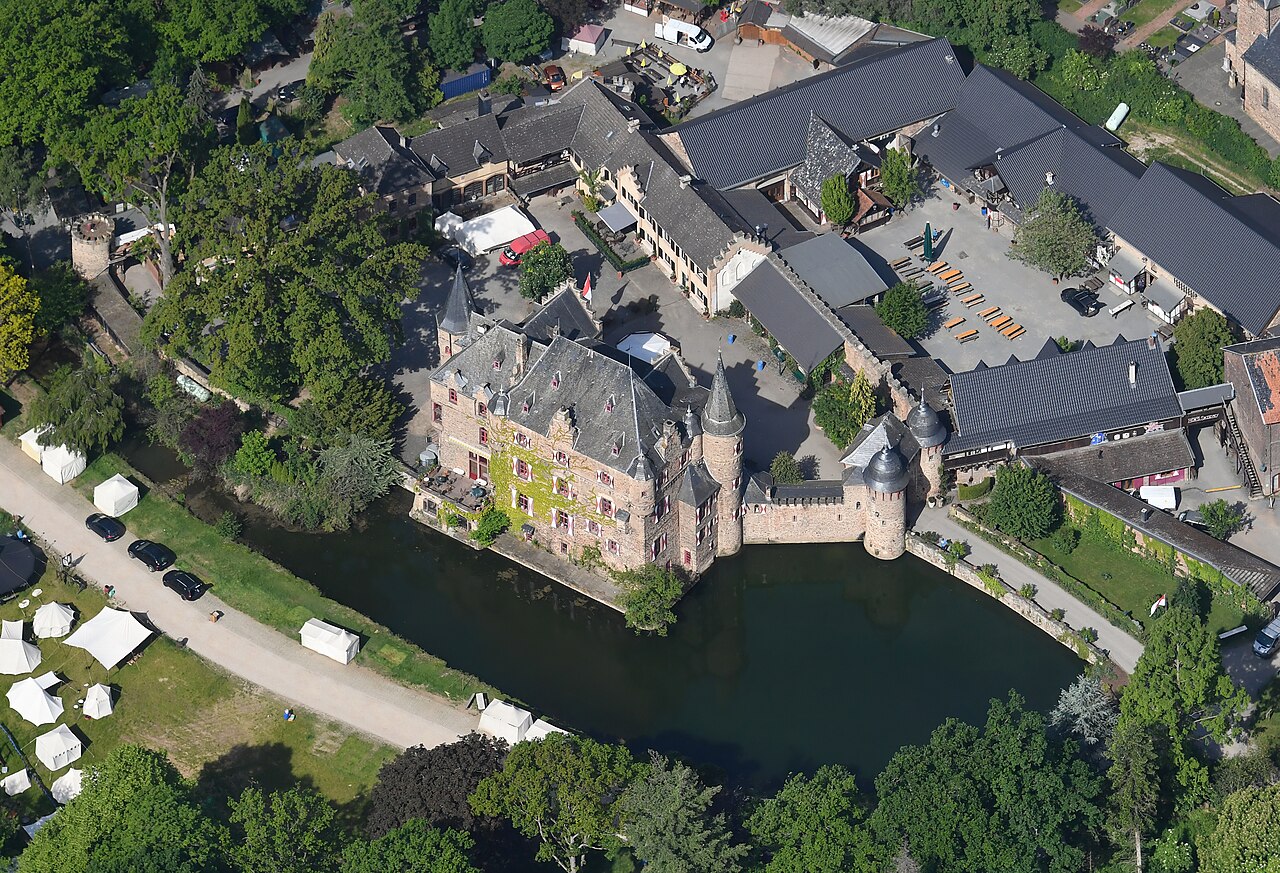
Wachendorf Castle
Wachendorf Castle, located near the village of Wachendorf in Mechernich, Germany, stands as a notable example of an aristocratic country seat transformed over centuries. Originally established as a medieval knight's castle, it has evolved architecturally and historically, reflecting the turbulent past and changing ownership that shaped its current form as a baroque palace.
The medieval origins and early history
The castle's earliest recorded mention dates back to 1190, when it was documented as the country seat of the aristocrat Vogt. At that time, the property was under church ownership, indicating its strategic and administrative importance in the region. Initially, Wachendorf functioned as a knight's castle, a fortified residence typical of the medieval period, designed to assert local control and provide defense.
The Palandt family and the witch trials
During the early 16th century, ownership passed through marriage to Johann von Palandt, a prominent member of the Jülich knights. The Palandt family played a significant role in the castle's history, especially under Marsilius III von Palandt in 1628. Marsilius III held witch trials at Wachendorf, despite lacking proper authorization. These trials resulted in the execution of 16 individuals, marking a dark chapter in the castle's history and reflecting the broader climate of witch hunts in early modern Europe.
Architectural transformation in the post-medieval period
By the late 18th century, the medieval fortress had fallen into disrepair. In 1780, the castle was acquired by Bavarian Major-General Adolph, Baron von Ritz. He ordered the demolition of the gothic-style castle, replacing it with a smaller baroque palace. This transformation marked a shift from a defensive stronghold to a more comfortable aristocratic residence, typical of the post-Renaissance period's architectural trends.
Expansion and modernization in the 19th century
In 1877, the property passed to Baron Solemacher-Antweiler through the Landrat of Euskirchen. He expanded the small baroque palace into the larger structure seen today. This period saw the enhancement of the estate's residential and representational functions, aligning with 19th-century tastes for grandeur and comfort.
Later, in 1896, the castle was sold to Dr. Paul von Mallinckrodt, continuing its legacy as a private aristocratic residence.
Architectural features and landscape
The castle is set within a large park that extends into the surrounding countryside via an impressive avenue, emphasizing its status as a country seat. Remnants of the original moat and a cannon bastion remain visible, serving as tangible evidence of its defensive past and unsettled history.
The current palace reflects baroque architectural style with its emphasis on symmetry, classical details, and an elegant yet restrained scale compared to the original gothic fortress. The transition from a fortified castle to a baroque palace illustrates the broader architectural evolution from medieval military functions to aristocratic residential comfort.
Historical significance and legacy
Wachendorf Castle's history encapsulates several important themes in German regional history, including the role of knightly families, the impact of witch trials, and shifts in architectural styles from the medieval to the modern era. Its survival and adaptation through centuries highlight the changing nature of aristocratic estates in Germany.
Today, the castle remains a significant cultural landmark in North Rhine-Westphalia, illustrating the layered history of aristocratic life and regional power dynamics from the medieval period through the post-Renaissance era.
Information
Loading map...
Visitor reviews
No reviews yet. Been here? Write the first review and help other travelers!
Write the first reviewVisited this castle? Share your experience
Your review helps other travelers and adds first-hand knowledge to our encyclopedia.