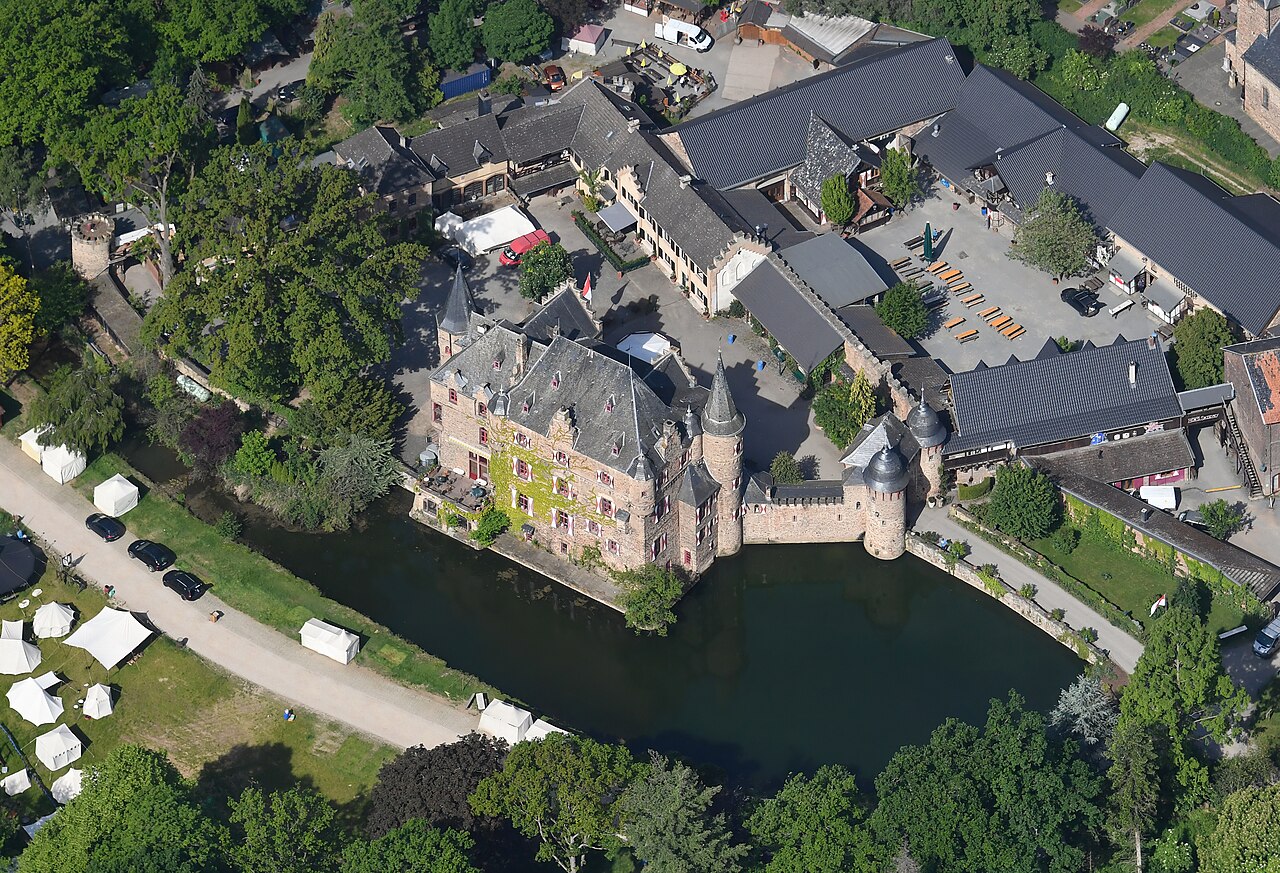
Kommern Castle
Kommern Castle, located in Mechernich, Germany, is a remarkable example of a high medieval hill castle with origins dating back to the 13th century. The castle's oldest surviving structure is the residential tower situated on the slope of the valley, which likely dates from the castle's initial construction period. Unlike many castles that served as noble residences or military fortresses, Kommern Castle primarily functioned as an administrative center for the surrounding region, reflecting the evolving role of castles in medieval governance.
Historical background and ownership
The castle's history is closely intertwined with the Arenberg family, who acquired Kommern Castle in the 13th century. The Arenbergs were a prominent noble lineage originally holding the title of burgraves of Cologne during the 12th and 13th centuries. Their status was elevated in the 17th century when they were granted ducal rank. The family's wealth was largely derived from extensive mining operations in the region, which enabled them to acquire multiple villages around Kommern, including Roggendorf, Gehn, Strempt, Katzvey, and Weingarten.
Throughout its history, Kommern Castle was never intended as a noble residence but served as the seat for the bailiff who managed the Reichsherrschaft Kommern—the sovereign lordship associated with the castle's territory—until 1794. This administrative function highlights the castle's role in local governance rather than military defense or aristocratic living.
Following the upheavals of the French Revolutionary Wars in the late 18th century, the castle's ownership changed hands. The Arenbergs lost control, and the property was leased to the Abels family, who eventually purchased it in 1807. Since 1927, Kommern Castle has been under private ownership by the Seul family, who have overseen extensive restoration efforts and currently lease the property to an extended family.
Architectural features and layout
The castle complex is centered around the residential tower from the 13th century, which forms the core of a labyrinthine arrangement of interconnected buildings. This complex is concealed behind a lavish symmetrical wooden façade that faces a carefully designed courtyard. The courtyard itself is noted for its balanced and ornamental layout, which is unusual for a castle primarily serving administrative purposes.
Situated at an elevation of approximately 263 meters, Kommern Castle is classified as a hill castle, combining strategic defensive positioning with aesthetic considerations. The castle's façade and courtyard design reflect a blend of functionality and decorative ambition, characteristic of the high medieval period.
The surrounding estate includes a magnificent landscaped park featuring a collection of rare and unusual tree species. This park enhances the castle's historic ambiance and marks its transition from a purely functional administrative site to a refined estate appreciated for its natural beauty.
Unique interior elements and cultural significance
One of the castle's most notable interior features is a rare example of colored wallpaper produced in 1804 by Josef Dufour in Mâcon, France. This wallpaper vividly depicts scenes from the voyages of Captain James Cook, the renowned British explorer. Globally, only nine such pieces are known to exist, with six preserved in mansions in the southern United States. The presence of this wallpaper at Kommern Castle adds significant cultural and historical value to the site.
Preservation and heritage status
Kommern Castle has been recognized for its historical and architectural importance with official protection status granted by the city of Mechernich in December 1989. More recently, in 2019, the castle and its park were designated as private green and historic spaces in local land use plans, ensuring continued preservation of the estate's unique character.
The castle remains well preserved thanks to ongoing restoration and maintenance efforts by its private owners. The main structures, including the residential tower, courtyard façade, and surrounding parkland, have been maintained in a way that respects their historic integrity while allowing for modern use.
The castle in the context of regional history
Kommern Castle's role as an administrative hub rather than a noble residence is reflective of the broader historical context in which many castles served multiple functions beyond defense. Its connection to the Arenberg family, a powerful ducal house with economic interests in mining, underscores the castle's importance in regional governance and resource management during the high medieval and early modern periods.
The castle's survival through periods of political upheaval, including the French invasion and subsequent changes in ownership, illustrates the shifting landscape of territorial control in western Germany. Its transformation into a private estate with a landscaped park demonstrates the adaptive reuse of medieval castles in later centuries.
Architectural style and influences
While primarily a high medieval hill castle, Kommern Castle exhibits architectural features typical of administrative castles of its era, including a residential tower designed for both habitation and oversight. The symmetrical courtyard façade suggests influences from later periods emphasizing order and aesthetics, possibly reflecting renovations during the 17th or 18th centuries.
Visitor experience and cultural heritage
Today, Kommern Castle stands as a testament to the multifaceted history of medieval fortifications adapted for administrative use. Visitors can appreciate the castle's historic architecture, the unique Josef Dufour wallpaper, and the tranquil beauty of its landscaped park. The castle's preservation as a protected monument ensures that it remains an important cultural landmark within the region.
Frequently asked questions (FAQ)
- What is the historical significance of Kommern Castle?
- Kommern Castle served primarily as an administrative center for the Arenberg family, managing local governance and mining interests from the 13th century through the 18th century.
- Can visitors see the rare wallpaper by Josef Dufour inside the castle?
- Yes, the castle houses a rare 1804 colored wallpaper by Josef Dufour depicting Captain James Cook's voyages, one of only nine known worldwide.
- Is Kommern Castle open to the public?
- Kommern Castle is privately owned and leased to an extended family, so public access is limited and typically by special arrangement or events.
- What architectural style characterizes Kommern Castle?
- Kommern Castle is primarily a high medieval hill castle with a residential tower and symmetrical courtyard façade, reflecting administrative design rather than noble residence style.
- When was Kommern Castle built?
- The oldest part of Kommern Castle, the residential tower, dates back to the 13th century, with the main complex developed around the mid-14th century.
Information
Current owner
Private owner
Loading map...
Visitor reviews
No reviews yet. Been here? Write the first review and help other travelers!
Write the first reviewVisited this castle? Share your experience
Your review helps other travelers and adds first-hand knowledge to our encyclopedia.