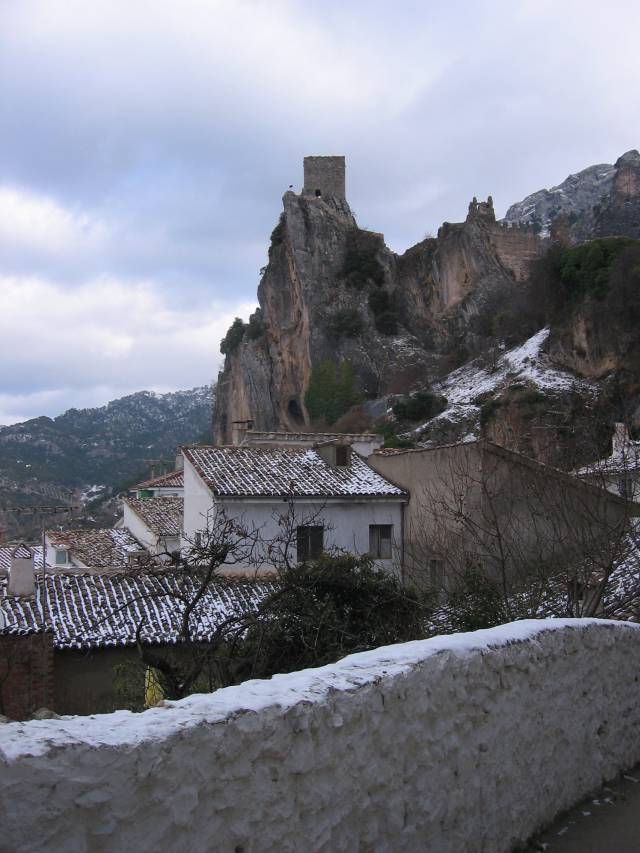
Yedra Castle
Yedra Castle, located in Cazorla, Spain, stands as a remarkable example of medieval military architecture with a rich history spanning from the Islamic period through Christian reconquest and beyond. Perched on the lower slopes of Salvatierra hill, this hill castle commands strategic views over the town of Cazorla and the nearby Cerezuelo river. Its origins likely trace back to the Almohad era during the 11th century, when the first fortress was constructed by Muslim builders, reflecting the Islamic presence in the region during the High Medieval period.
The castle underwent significant transformation following the Christian reconquest in the late 12th century, adapting to new military and administrative needs. The most notable phase of construction occurred in the 13th and 14th centuries, particularly under the auspices of Archbishop Pedro Tenorio of Toledo between 1357 and 1399. During this time, the castle was expanded and fortified, including the addition of the alcazarejo—a small inner fortress enclosure—and the imposing keep tower that dominates the site today.
Historical development and significance
Islamic origins and early construction
The initial fortress at Yedra was likely built by Berber-Al-Andalusian forces during the 11th century, possibly during the Almohad dynasty. This early structure served as a military stronghold controlling the surrounding territory. Archaeological evidence, including ceramic fragments, suggests a longer history of occupation in the area, with indications of earlier Roman presence, though no Roman structures remain on the site.
Christian reconquest and architectural evolution
Following the Christian reconquest of the region in the late 12th century, the castle was adapted and reinforced to meet the defensive requirements of its new rulers. The fortress transitioned from Muslim to Christian control, marking a significant shift in its function and symbolism. The 14th-century reconstruction led by Archbishop Pedro Tenorio brought a more complex layout and stronger fortifications, including the construction of the alcázar or inner keep, which served both military and administrative purposes.
Later modifications and preservation
In the early 17th century, the castle saw maintenance and repairs, as evidenced by the inscription dated 1606 above the main gate. This period reflects the continued strategic and administrative importance of the fortress under the Spanish monarchy. By the 20th century, the castle ceased to serve military functions and was repurposed for cultural preservation. The Spanish government acquired it in 1972, and it soon became home to the Museo de Artes y Costumbres “Alto Guadalquivir”, showcasing local arts and history. In 1993, Yedra Castle was declared a cultural monument of Spain, ensuring its protection and recognition as a heritage site.
Architectural features and defensive design
Layout and fortifications
The castle’s design is characterized by a tiered system of defensive walls that respond to the natural topography of Salvatierra hill. It comprises three nested enclosures: the outermost albacara, the intermediate enclosure, and the innermost alcazarejo. This layered defense maximized protection by forcing attackers to breach multiple barriers, each increasingly difficult to overcome.
The albacara originally formed a broad defensive courtyard, although much of it is now in ruins. Constructed primarily from rammed earth, it was later reinforced with ashlar stone towers to improve durability. Inside this outer wall lies the intermediate enclosure, built with a combination of ashlar masonry, rubble stone, and sections of rammed earth, illustrating the castle’s evolution through various construction phases and repairs.
Keep tower and inner courtyard
The most prominent architectural feature is the square keep tower within the alcazarejo, rising over 30 meters tall with walls nearly 4 meters thick. This tower served as the last line of defense and a symbol of lordly power. It contains three floors of chambers above an underground cistern (aljibe) that stored water essential for withstanding sieges.
Access to the keep is deliberately complex, involving a narrow, winding path with ramps and stairs designed to hinder attackers. The small parade ground or courtyard surrounding the keep provided space for military assembly and daily activities within the fortress.
Main gate and decorative elements
The main entrance to the albacara courtyard is framed by finely cut ashlar stones and includes repairs made with brickwork. The gate’s arch is a distinctive blend of architectural styles: a pointed horseshoe arch typical of Islamic design, surmounted by a semicircular relieving arch to distribute structural weight. Above the entrance, the carved coat of arms of Sandoval and Rojas commemorates the archbishop associated with the castle’s later history, alongside the renovation date of 1606.
Location and cultural importance
Situated in the historic town of Cazorla within the province of Jaén, Andalusia, Yedra Castle occupies a commanding position that allowed control over the surrounding valley and river routes. Its location on Salvatierra hill not only provided natural defenses but also enhanced the castle’s role as a military and administrative center during the medieval period.
Today, the castle is a significant cultural monument reflecting the complex history of southern Spain, where Islamic and Christian influences merged over centuries. It attracts visitors interested in medieval fortifications, Spanish history, and architectural heritage. The castle’s preservation as a museum enhances public understanding of the region’s past and the evolution of military architecture.
Visiting Yedra Castle
Visitors to Yedra Castle can explore its multiple defensive walls, the impressive keep tower, and the courtyards that illustrate medieval military design. The onsite museum offers insights into local customs and historical artifacts, enriching the experience. The castle’s elevated position also provides panoramic views of Cazorla and the surrounding natural landscape, making it a favored destination for history enthusiasts and tourists alike.
Accessibility and visitor information are managed by local authorities, with opening hours and ticket prices subject to seasonal changes. Prospective visitors are encouraged to check current details before planning their visit to maximize their experience of this historic fortress.
Frequently asked questions (FAQ)
- How do I get to Yedra Castle in Cazorla?
- Yedra Castle is located on Salvatierra hill overlooking Cazorla. Visitors can reach the castle by foot via marked paths from the town center, or by car to nearby parking areas followed by a short walk.
- What is the historical significance of Yedra Castle?
- Yedra Castle reflects the layered history of southern Spain, showcasing Islamic origins and Christian reconquest adaptations. It was a key military and administrative fortress from the 11th century onward.
- Can I visit the museum inside Yedra Castle?
- Yes, the castle houses the Museo de Artes y Costumbres “Alto Guadalquivir,” which exhibits local arts, crafts, and history. The museum is open during regular visiting hours and offers a cultural complement to the castle tour.
- When was Yedra Castle built?
- The original fortress dates back to the 11th century, with major expansions and reconstructions in the 13th and 14th centuries under Christian rule.
- Is Yedra Castle suitable for families and children?
- Yedra Castle is suitable for families; however, visitors should be aware of uneven terrain and some steep paths. Children will enjoy exploring the castle’s towers and courtyards, but supervision is recommended.
Information
Sources & official resources
Verify the information above using these authoritative references.
Loading map...
Visitor reviews
No reviews yet. Been here? Write the first review and help other travelers!
Write the first reviewVisited this castle? Share your experience
Your review helps other travelers and adds first-hand knowledge to our encyclopedia.