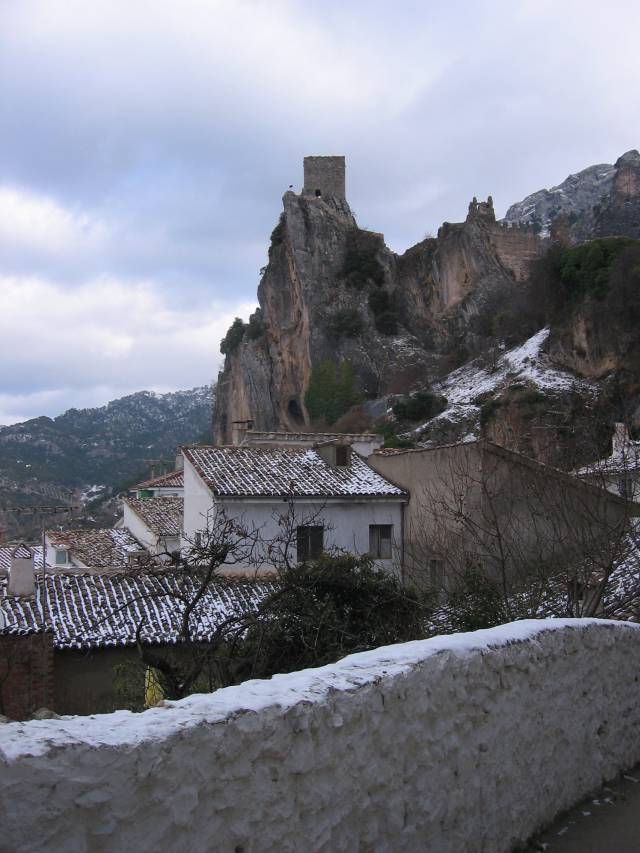
Castillo de Tíscar
The Castillo de Tíscar is a historic hill castle located near the Sanctuary of the Virgin of Tíscar within the municipality of Tíscar in Spain. This fortress dates back to the Andalusian period, constructed by Muslim builders as part of the defensive network guarding the frontier of the Nasrid Kingdom of Granada. Its strategic position atop a rocky ridge allowed it to control the surrounding territory and serve as a military outpost during centuries of border conflicts between Muslim and Christian forces.
The castle's role in the Nasrid frontier defense
During the Medieval Islamic period, the Castillo de Tíscar was recognized for its formidable defenses. Noted medieval Islamic geographers and writers such as Al-Razi and Al-Idrisi praised the fortress as nearly impregnable. It functioned as an advanced military base on the Cazorla frontier, from which raids were launched towards the Christian-held town of Quesada. This highlights its importance in the ongoing border skirmishes and military campaigns between the Nasrid emirate and the Christian kingdoms to the north.
The 1319 siege and Christian conquest
A pivotal moment in the castle's history came in May 1319, when Christian forces captured the fortress after a thirteen-day siege. The assault was led by Infante Pedro of Castile, son of King Sancho IV and Queen María de Molina, commanding a coalition that included various Christian military orders and clergy. The decisive action was carried out by Pero Fidalgo, who scaled the adjacent rocky outcrop known as Peña Negra, gaining a tactical advantage that enabled the castle's fall.
Following the surrender, the Muslim lord Mahomad Handon and approximately 4,500 residents were allowed to leave safely, escorted to the nearby city of Baza. This negotiated transition reflects a relatively peaceful transfer of control rather than a violent expulsion. After conquest, the castle remained under Christian control with royal protection, and local communities were required to contribute resources for its upkeep.
Post-conquest significance and royal support
Between 1321 and 1338, King Alfonso XI granted privileges and financial aid to the city of Úbeda to encourage settlement and strengthen the castle's defenses. This was crucial as the region remained vulnerable to Nasrid incursions. The fortress continued to serve as a key defensive point within the border system securing the Christian kingdom's frontier against Granada well into the mid-14th century. Its role was integral to the political and military struggles of the Castilian-Granadan border.
Architectural features and construction techniques
The Castillo de Tíscar is a compact fortified complex constructed atop a rocky ridge, effectively utilizing the natural terrain to enhance its defenses. The castle consists of a small enclosure with a prominent keep tower located at the east end, emphasizing a design focused on defense and surveillance.
The castle walls combine sections of rough tapial (rammed earth construction) with masonry elements. This mixed technique allowed builders to integrate the fortifications seamlessly with the natural rocky outcrops surrounding the site. The stone formations were enclosed by walls to close gaps in the defenses, demonstrating a practical adaptation that made the fortress difficult to assault.
At the center of the enclosure lies a large basaltic rock known as Peña Negra, which likely functioned as the castle's inner stronghold or alcazarejo, a term used historically to describe a citadel or keep within Muslim fortresses. This rocky prominence was critical during the 1319 siege, as it was the position from which Pero Fidalgo launched his surprise attack, enabling the Christian capture of the castle.
Preservation and cultural heritage
While detailed measurements and decorative elements of the castle are not extensively documented, the Castillo de Tíscar is recognized as a cultural heritage site. Photographic evidence shows the survival of its medieval construction integrated with the raw geology of the ridge. The fortress stands as a notable example of the ingenuity of its original builders in blending man-made defenses with natural features to create a formidable military stronghold.
Today, the castle remains a partially preserved ruin that offers insight into the military architecture of the Nasrid frontier and the complex history of border conflicts in medieval Spain. Its location near the Sanctuary of the Virgin of Tíscar also adds to its cultural significance, attracting visitors interested in both history and architecture.
Strategic importance in medieval Spain
The castle's position on a rocky ridge provided a commanding view of the surrounding landscape, making it an ideal lookout point for monitoring enemy movements. Its design reflects the military needs of the time, combining natural topography with robust construction to resist sieges and assaults.
The use of rammed earth (tapial) alongside stone masonry in the walls showcases the adaptation of Islamic military architecture to local materials and terrain. This method allowed for rapid construction and repair, essential for frontier fortresses exposed to frequent attacks.
The role of the keep and enclosure
The keep tower at the eastern end served as the last line of defense and a vantage point for surveillance. The small enclosure around it provided a protected area for the garrison and storage of supplies. The integration of the natural rock formations into the defensive walls helped close vulnerabilities and strengthened the overall fortification.
Historical context of the Nasrid Kingdom frontier
The Nasrid Kingdom of Granada was the last Muslim state on the Iberian Peninsula, maintaining a fragile frontier with the expanding Christian kingdoms. Fortresses like Castillo de Tíscar were vital in controlling border territories, launching raids, and defending against Christian advances.
The castle's capture in 1319 marked a significant shift in control of the region, contributing to the gradual Christian reconquest of southern Spain. Its continued use and reinforcement by Christian rulers illustrate the ongoing strategic importance of this site well beyond the medieval Islamic period.
Frequently asked questions (FAQ)
- How do I get to Castillo de Tíscar?
- Castillo de Tíscar is located near the Sanctuary of the Virgin of Tíscar in the municipality of Tíscar, Andalusia, Spain. Visitors typically reach it by car or local transport from nearby towns such as Úbeda or Cazorla.
- What is the historical significance of Castillo de Tíscar?
- The castle was a key frontier fortress of the Nasrid Kingdom of Granada, playing a strategic role in border conflicts between Muslim and Christian forces during the medieval period.
- Can I visit the castle ruins?
- Yes, the castle is accessible to visitors as a partially preserved ruin. While there are no extensive visitor facilities, the site offers valuable insights into medieval military architecture and stunning views of the surrounding landscape.
- When was Castillo de Tíscar built?
- The exact construction date is uncertain, but the castle dates back to the Andalusian period during the High Medieval era, prior to its capture by Christian forces in 1319.
- Why is Peña Negra important in the castle's history?
- Peña Negra is a large basaltic rock within the castle enclosure that served as the inner stronghold or alcazarejo. It was the critical position from which Christian forces launched a decisive assault during the 1319 siege.
Information
Website
Visit websiteSources & official resources
Verify the information above using these authoritative references.
Loading map...
Visitor reviews
No reviews yet. Been here? Write the first review and help other travelers!
Write the first reviewVisited this castle? Share your experience
Your review helps other travelers and adds first-hand knowledge to our encyclopedia.