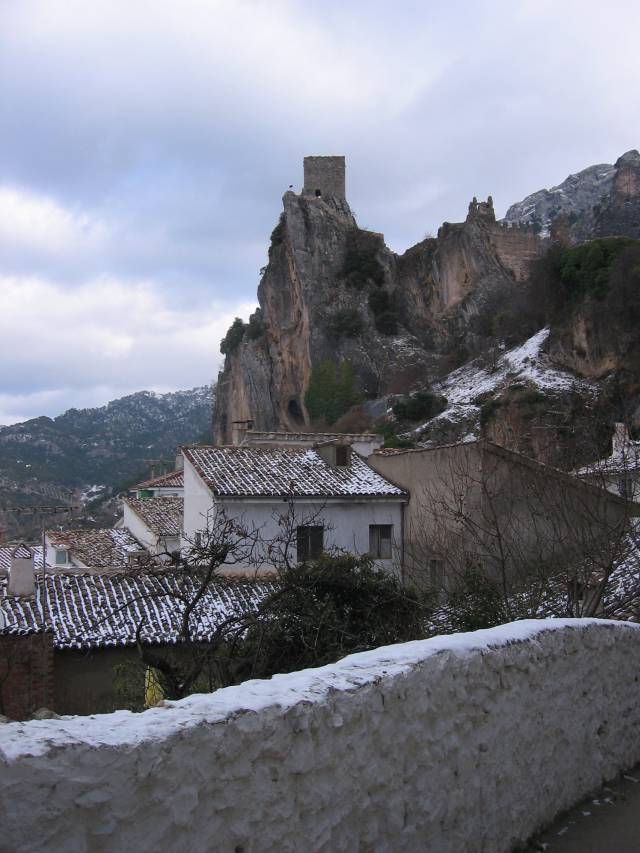
Castillo de las Cinco Esquinas
The Castillo de las Cinco Esquinas, also known as Castillo de Salvatierra, is a compelling example of medieval military architecture situated near the summit of Cerro Salvatierra in the municipality of Cazorla, Spain. This hill castle was constructed in the second half of the 14th century by the Kingdom of Castile, during a period marked by intense military and political challenges on the frontier with the Nasrid kingdom of Granada.
The castle's strategic location atop a rocky plateau at over 1100 meters above sea level allowed it to serve as a formidable defensive stronghold overseeing the surrounding terrain. Its rectangular layout, measuring approximately 62 meters in length and 20 meters in width, reflects the practical military design principles of the late medieval period. The fortress's construction employed a combination of carefully placed ashlar stone and regular masonry, with outer walls reaching a thickness of about 2.55 meters, underscoring the emphasis on durability and defense against siege warfare.
The historical context and significance
The area where the castle stands was incorporated into Castilian control between 1225 and 1230 under King Fernando III. Shortly thereafter, in 1231, the territory was granted as the Adelantamiento de Cazorla to the archbishopric of Toledo, highlighting the church's administrative and military influence in the region. The castle's construction is likely linked to the tenure of Archbishop Pedro Tenorio, who played a significant role in fortifying the frontier during a period of heightened conflict.
This era was characterized by the expansionist pressures of the Nasrid kingdom of Granada, led by Mohammed V, who advanced southward, capturing key cities such as Algeciras, Ronda, and Gibraltar. The Castillo de las Cinco Esquinas thus held a critical position in the borderlands between Christian Castile and Muslim Granada, serving as a military bastion during these late medieval confrontations.
Architectural features and layout
Overall structure and defensive elements
The fortress exhibits a rectangular plan with dimensions that provided ample space for garrison and defensive operations. The castle's main entrance is located on the southern side, anchored by the prominent keep, or torre del Homenaje. This tower is distinctive for its five-sided (pentagonal) base, a rare architectural feature designed to optimize defensive coverage.
The pentagonal keep includes three sides of roughly equal length meeting at right angles, while the two shorter sides contain a spiral staircase. The tower's entrance is elevated, accessed via the side facing the inner courtyard, and framed by a pointed stone arch approximately 1.5 meters wide. This entrance is fortified with strong door jambs and a slot for a closure bar, enhancing security.
Above the entrance, the remains of four stone corbels suggest the presence of a machicolated balcony. This defensive platform would have allowed defenders to target assailants directly beneath the tower walls, a common feature in late medieval fortifications aimed at improving vertical defense.
Interior spaces and courtyard arrangement
Inside the keep, the ground floor comprises a rectangular chamber covered by two brick vaults supported by a central pointed arch resting on pilasters attached to the east and west walls. The chamber is illuminated by two arrow slits near the entrance, indicating its dual function as a defensive lookout and secure space.
The castle's courtyard is divided by a north-south wall into two smaller courtyards. While much of the northern and western perimeter walls have been reduced to foundations, the eastern wall remains partially intact. The southern wall, however, is severely damaged, reflecting centuries of exposure and conflict.
Strategic role in the Castilian-Granadan frontier
The Castillo de las Cinco Esquinas played a crucial role in the defense of the Kingdom of Castile's southern border during the late medieval period. Its position on Cerro Salvatierra allowed for surveillance and control over the surrounding landscape, which was vital in monitoring movements from the Nasrid kingdom of Granada.
Throughout the 14th century, the castle was part of a network of fortifications aimed at securing the frontier, reflecting the ongoing military tensions between Christian and Muslim powers on the Iberian Peninsula. Its robust construction and strategic design demonstrate the importance placed on maintaining territorial control during this turbulent era.
Preservation and current condition
Today, the remains of Castillo de las Cinco Esquinas provide valuable insights into 14th-century military architecture. Although some walls are partially ruined, key features such as the pentagonal keep, the machicolated balcony corbels, and the vaulted chambers remain visible. The site offers a tangible connection to the complex history of the Castilian-Granadan frontier and the ecclesiastical and royal efforts to fortify this contested region.
Visitors to the castle can explore the rugged terrain of Cerro Salvatierra and appreciate the strategic ingenuity embodied in the fortress's design. The castle stands as a testament to the enduring legacy of medieval fortifications in Spain and their role in shaping the historical landscape of Andalusia.
Frequently asked questions (FAQ)
- What is the historical significance of Castillo de las Cinco Esquinas?
- Castillo de las Cinco Esquinas, located in Cazorla, Spain, is a remarkable example of medieval military architecture. Built in the 14th century, it served as a strategic fortress during the Reconquista, protecting the region from invasions. Its unique pentagonal shape and well-preserved structure make it an important site for understanding Spain's historical defenses.
- When was Castillo de las Cinco Esquinas built?
- The construction of Castillo de las Cinco Esquinas began in the 14th century and was completed in the following decades. This period was marked by significant military activity in the region, as the fortress was essential in the fight against Moorish forces. The castle's architecture reflects the military needs of that era.
- Can I visit Castillo de las Cinco Esquinas?
- Yes, Castillo de las Cinco Esquinas is open to visitors throughout the year. Guests can explore the castle's structures, enjoy panoramic views of the surrounding landscape, and learn about its rich history. Guided tours are often available to enhance your experience.
- What are the opening hours for Castillo de las Cinco Esquinas?
- The opening hours for Castillo de las Cinco Esquinas vary by season. Generally, the castle is open from 10 AM to 6 PM during the spring and summer months, and from 10 AM to 4 PM in the fall and winter. It is recommended to check the official website or local tourist information for the most current hours before planning your visit.
- Is it possible to access Castillo de las Cinco Esquinas with limited mobility?
- Access to Castillo de las Cinco Esquinas may be challenging for visitors with limited mobility due to its historical architecture and uneven terrain. However, some areas can be navigated with assistance. It is advisable to contact the site in advance to discuss accessibility options and any available accommodations.
- What is the best time to visit Castillo de las Cinco Esquinas?
- The best time to visit Castillo de las Cinco Esquinas is during the spring and fall when the weather is mild and pleasant. These seasons also attract fewer crowds, allowing for a more enjoyable experience while exploring the castle. Summer can be quite hot, while winter may present some accessibility issues due to weather conditions.
- Are there any nearby attractions to visit when I go to Castillo de las Cinco Esquinas?
- Yes, there are several nearby attractions worth visiting, including the beautiful Cazorla Natural Park, which offers stunning landscapes and hiking opportunities. Additionally, the town of Cazorla itself is rich in history and charm, with lovely streets, shops, and local cuisine to explore. Combining these attractions will make for a fulfilling day trip.
- What are the ticket prices for Castillo de las Cinco Esquinas?
- Ticket prices for Castillo de las Cinco Esquinas are generally affordable, with discounts available for children, seniors, and groups. Adult tickets typically range around €5, while reduced prices may apply to students and families. It is advisable to check for any special promotions or combined tickets with nearby attractions.
Information
Loading map...
Visitor reviews
No reviews yet. Been here? Write the first review and help other travelers!
Write the first reviewVisited this castle? Share your experience
Your review helps other travelers and adds first-hand knowledge to our encyclopedia.