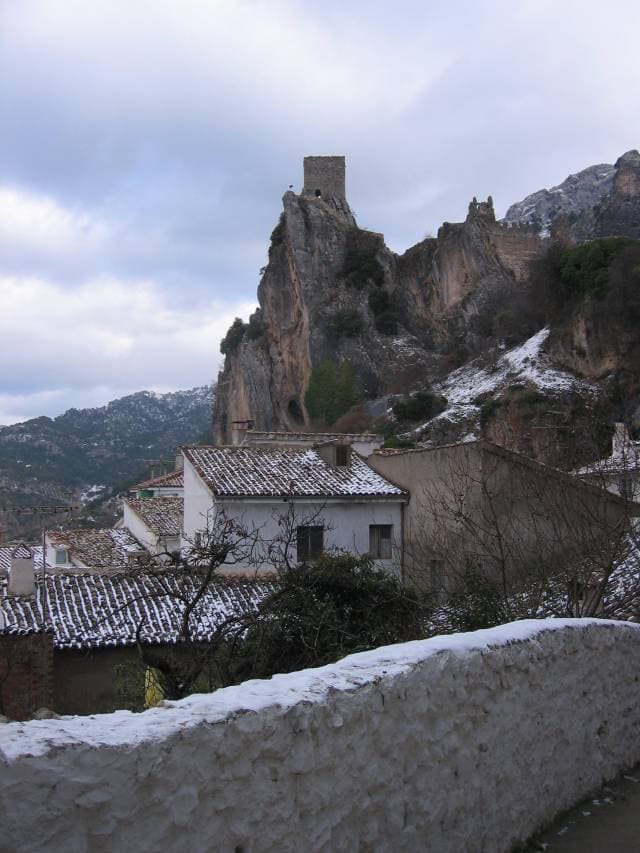
La Iruela Castle
La Iruela Castle stands as a remarkable example of medieval military architecture perched atop a steep crag in the Sierra de Cazorla, Segura y Las Villas Natural Park in Spain. This hill castle offers commanding views of the surrounding landscape and the nearby town of La Iruela, reflecting its strategic importance throughout history. The castle's origins trace back to the 11th century, during the High Medieval period, with significant layers of construction from both Islamic and Christian eras. Its location on a rocky summit known as El Picacho allowed it to function as a formidable defensive stronghold controlling the surrounding valleys.
Historical evolution and strategic significance
The earliest human presence in the La Iruela area dates back to the Copper Age, with continuous occupation through the Bronze Age. Initially, the site was a modest agricultural settlement. In the 11th century, a defensive wall and a small fortress were constructed to protect the farming community. This early fortress was likely built by Muslim rulers during the period of Andalusian control, reflecting the region's complex cultural history.
During the late 12th century, under the Almohad Empire, the castle was fortified with defensive walls, transforming it into a significant Islamic stronghold. An Islamic settlement developed just south of the fortress, emphasizing its importance as a military and administrative center.
The castle and its surrounding lands were conquered by Christian forces in 1231 under King Fernando III of Castile. Following the conquest, ownership was granted to Rodrigo Jiménez de Rada, Archbishop of Toledo. He oversaw the construction of Christian fortifications atop the existing Muslim fortress, marking a pivotal shift in the site's religious and cultural identity.
In the mid-14th century, during the Castilian civil war (1351-1369), La Iruela played a politically strategic role, supporting Archbishop Gómez Manrique and Enrique de Trastámara. The settlement was officially recognized as a villa in 1370 and gained full independence in 1378 through Archbishop Pedro Tenorio, who initiated important building projects including the castle's keep (torre del homenaje) and the gate tower, further enhancing its defensive capabilities.
Architectural features and layout
Castle structure and defensive elements
The fortress occupies a natural rocky summit with a distinctive three-tiered layout, each level strategically positioned on rock outcrops to maximize defense and visibility. The castle walls, partially preserved and featuring crenellations, are built directly on the rock, blending the man-made fortifications with the natural terrain.
The keep, or torre del homenaje, is the most prominent structure, built on the site of a former Muslim alcázar (fortified palace). It has a square base and relatively small dimensions, situated at the highest point of the crag. This tower served as both a defensive stronghold and a symbol of lordly power. Surrounding the keep is a small courtyard enclosed by thick walls, forming the castle's first enclosure.
Bailey and additional fortifications
The second level, or bailey, is enclosed by walls that incorporate remnants of several defensive towers. The entrance to this bailey is designed as a bent passage through one of the towers, a defensive architectural feature intended to slow and control attackers. Within this enclosure lies a large cistern (aljibe), essential for collecting and storing rainwater to sustain the castle's occupants during sieges.
A third level is believed to have existed, though it no longer stands intact, with only limited traces remaining. The overall condition of the castle is that of ruins, with significant remains especially visible in the main tower and enclosing walls.
Religious and cultural significance
Within the castle grounds lie the ruins of the Church of Santo Domingo, built in honor of La Iruela's patron saint by Francisco de los Cobos, secretary to Emperor Charles V. Architectural plans for the church are attributed to prominent architects such as Andrés de Vandelvira or Rodrigo de Gibaja. The church suffered significant damage when it was attacked and burned on June 4, 1810, during the Peninsular War. Subsequently, it served as a municipal cemetery until 1953, illustrating the site's layered history of military, religious, and civic functions.
In recent years, the castle enclosure has been adapted to include an open-air theater, built as a tribute to the Greek and Classical Eras. This venue hosts various artistic and cultural events throughout the year, integrating the historic site into contemporary cultural life.
Modern recognition and preservation
In the 20th century, La Iruela Castle and its adjoining village were designated as a Historic-Artistic Ensemble, receiving protection under Spanish heritage laws initially enacted in 1949 and reaffirmed in 1985. These measures have helped preserve the castle's ruins and promote its historical significance.
The castle also gained cultural prominence as a filming location for the television series Curro Jiménez in the late 1970s, bringing wider public attention to its dramatic setting and historical ambiance.
Visiting la iruela castle
Today, visitors to La Iruela Castle can explore the ruins and enjoy panoramic views of the Sierra de Cazorla natural park. The combination of medieval fortifications, Islamic architectural remnants, and the Church of Santo Domingo ruins offers a rich historical experience. The open-air theater adds a unique cultural dimension to the site, making it a vibrant destination for history enthusiasts and cultural tourists alike.
The castle's location on a steep hill requires a moderate hike, but the rewarding vistas and historical atmosphere make it a worthwhile visit. Interpretive signage and guided tours help visitors appreciate the castle's complex history and architectural features.
Frequently asked questions (FAQ)
- How do I get to La Iruela Castle?
- La Iruela Castle is located in the town of La Iruela within the Sierra de Cazorla Natural Park in Andalusia, Spain. It is accessible by car and then a moderate hike up to the castle on El Picacho hill. Local signage and maps in La Iruela help guide visitors to the site.
- What is the historical significance of La Iruela Castle?
- La Iruela Castle is a notable medieval fortress with origins in the 11th century, reflecting both Islamic and Christian influences. It played a strategic role during the Reconquista and the Castilian civil war, and later served religious and civic functions.
- Can I visit the Church of Santo Domingo ruins inside the castle?
- Yes, visitors can explore the ruins of the Church of Santo Domingo within the castle grounds. Although damaged during the Peninsular War, the church remains an important historical and architectural feature of the site.
- Is there an entrance fee to visit La Iruela Castle?
- Visiting La Iruela Castle is generally free of charge, making it an accessible cultural and historical site for tourists and locals alike.
- When is the best time to visit La Iruela Castle?
- The best time to visit La Iruela Castle is during spring and autumn when the weather is mild and the natural surroundings of the Sierra de Cazorla park are particularly beautiful. Summer can be hot, and winter may bring challenging conditions for hiking.
Photo gallery

Photo by No machine-readable author provided. Juandiegocano~commonswiki assumed (based on copyright claims).•CC BY 3.0
Information
Website
Visit websiteSources & official resources
Verify the information above using these authoritative references.
Loading map...
Visitor reviews
No reviews yet. Been here? Write the first review and help other travelers!
Write the first reviewVisited this castle? Share your experience
Your review helps other travelers and adds first-hand knowledge to our encyclopedia.



