Wolfsburg Castle
Wolfsburg Castle stands as a remarkable example of a Renaissance water castle in eastern Lower Saxony, Germany. Originally a medieval fortress, the castle has evolved over centuries into a significant cultural monument, reflecting the architectural and historical developments of the region. It is located in the town of Wolfsburg, which derives its name from the castle itself, and has been under the town's possession since 1961.
The castle's origins date back to the 13th century, when it was established by the noble von Bartensleben family, ministeriales who served higher lords and were granted land in the area. The initial structure was a stone tower house or bergfried, replacing an earlier wooden watchtower, strategically positioned on the River Aller to control vital trade routes. Over time, Wolfsburg Castle developed into a water castle with two moats fed by the Aller and Hasselbach streams, surrounded by defensive walls and bastions that enhanced its military significance.
Architectural evolution and design features
Medieval origins and fortifications
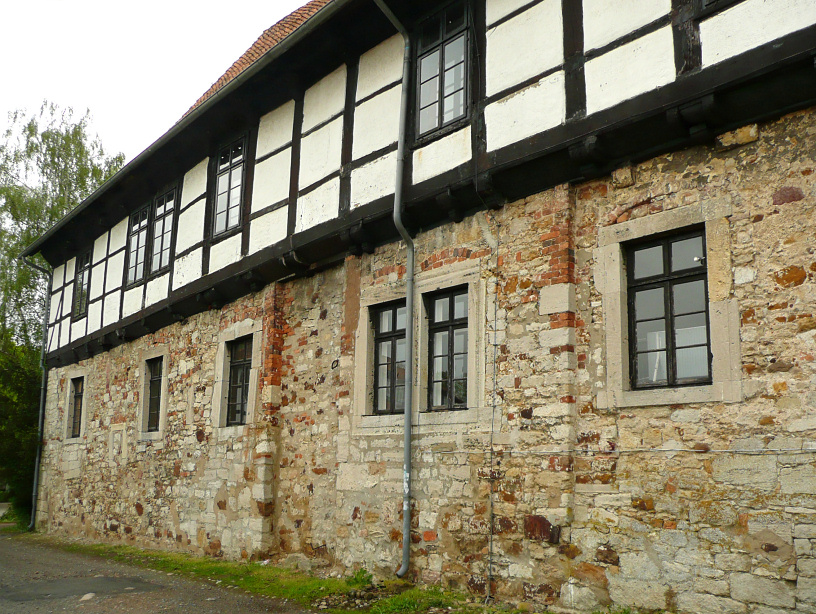
The oldest surviving part of the castle is the bergfried, a square tower integrated into the west wing, measuring approximately 9 by 9 meters at the base and rising about 23 meters high with walls up to 3 meters thick. This tower served multiple functions, including defense, imprisonment, and as a lookout point. The castle's fortifications were progressively enhanced, with the addition of bastions and curtain walls that enclosed the site, forming a formidable defensive complex.
Renaissance transformation
During the 16th and early 17th centuries, Wolfsburg Castle underwent significant transformation into a representative palace while maintaining its defensive capabilities. The castle became the northernmost example of the Weser Renaissance style, characterized by ornate cross-gables, lucarnes (small dormer windows), and pointed tower roofs. The north and south wings were primarily converted into living quarters, while the east wing was designed as a grand reception area featuring the Gartensaal (Garden Hall), the Kaminzimmer (Chamber Room), and the Gerichtlaube, which functioned as a district office or courtroom.
Notable architectural elements
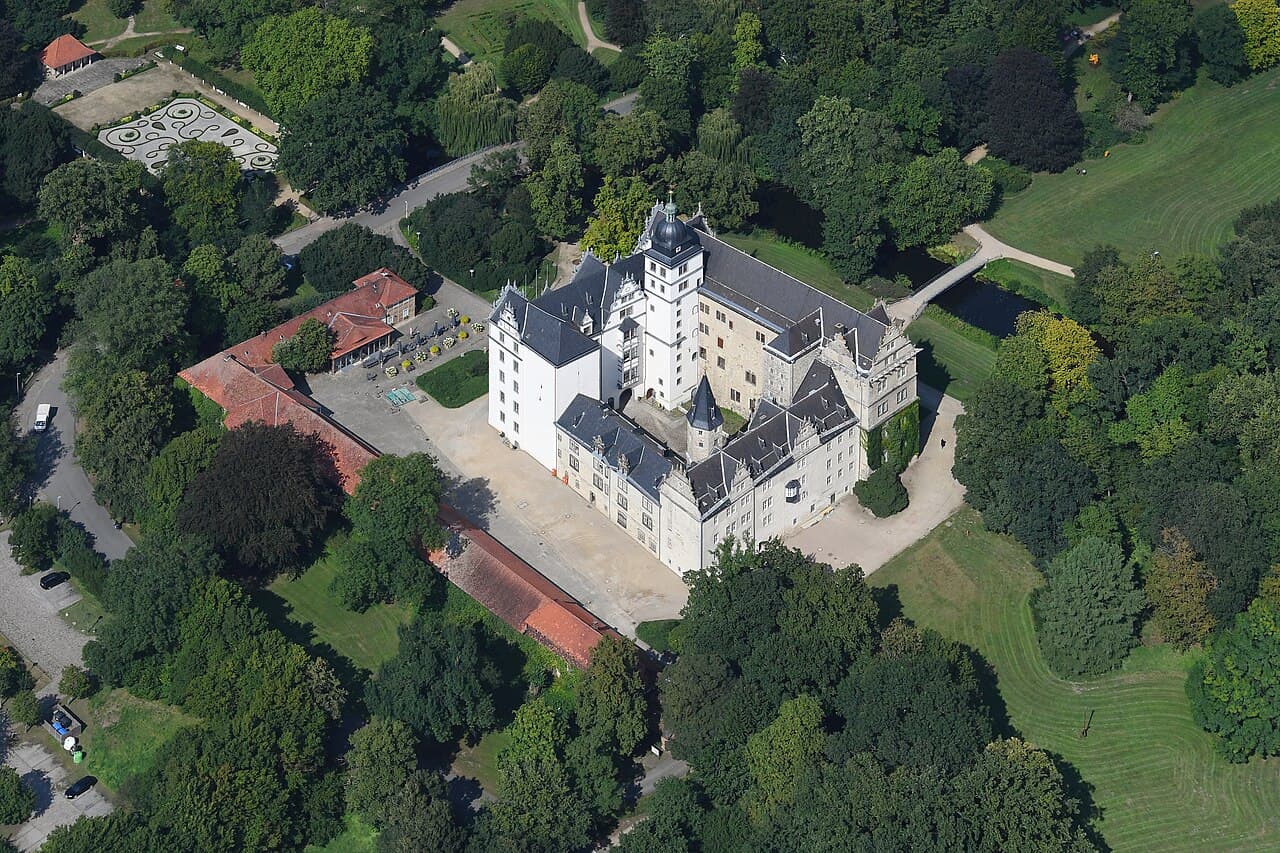
The castle complex includes three stair towers at the inner courtyard corners: the Hausmannsturm, the tallest at about 30 meters; the Uhlenturm; and the hexagonal Wendelstein containing a spiral staircase. The main entrance is marked by a round arch adorned with large stone figures of knights on horseback, the von Bartensleben coat of arms, chimera sculptures called Neidköpfe, and equestrian statues. A terrace with a grand staircase on the park side dates from the 19th century, adding to the castle's grandeur.
Historical significance and ownership
Medieval and early modern period
Wolfsburg Castle played a strategic role throughout its history. It was first mentioned in records in 1302 and was heavily involved in regional conflicts. In 1464, it suffered damage during a feud with Duke Otto of Lüneburg but was subsequently repaired. The castle was equipped with cannons by 1437, underscoring its military importance. During the Thirty Years' War, it was repeatedly occupied by troops but remained largely intact. In 1650, its fortifications were ordered to be slighted but were rebuilt by the von Bartensleben family six years later.
Later ownership and modern use
The von Bartensleben line ended in 1742, passing ownership to the counts of Schulenburg, who used the castle as their main residence for over two centuries. In the 19th century, the castle became a Prussian exclave. During World War II, it was sold to the city associated with the KdF-Wagen project, precursor to the modern city of Wolfsburg. Post-war, the castle served various social roles, including housing disabled persons, functioning as a youth hostel, and providing refuge for displaced people.
Since 1961, Wolfsburg Castle has been owned by the city of Wolfsburg, which has undertaken extensive renovations. It now serves as a cultural center housing the Kunstverein Wolfsburg for contemporary art exhibitions, the Städtische Galerie, and formerly the Stadtmuseum. The castle also hosts cultural events and official ceremonies such as civil weddings.
Castle grounds and surroundings
The castle is set within historic gardens and parks that contribute to its picturesque setting. To the north lies a Baroque garden featuring a Broderie-Parterre design and a tea house, while the south side hosts a New Garden dating from the late 17th century. The east side includes a 19th-century landscape park with a large staircase. The Baroque garden was restored in 2000 and features sandstone putti representing the four seasons.
Historically, the castle was surrounded by two water-filled moats, with the inner moat encircling the main castle and crossed by drawbridges, emphasizing its status as a true water castle. Archaeological investigations have uncovered parts of the moat's retaining wall, and some sections have been preserved and made visible through paving, gravel, and a walkable glass panel.
The castle complex also includes former domestic and economic buildings attached to the curtain wall, now repurposed as coach houses called Remisen. It forms part of a heritage ensemble that includes nearby half-timbered houses and St. Mary's Church, the former patron church of the castle's lords.
Cultural and architectural legacy
Wolfsburg Castle's name derives from the heraldic wolf on the von Bartensleben family coat of arms, rather than local wolf populations. The modern city of Wolfsburg, founded in 1938 near the castle, took its name from this historic site. The castle exemplifies the evolution from medieval fortification to Renaissance palace while maintaining its defensive character, making it a unique architectural and historical landmark in Lower Saxony.
The castle's preservation and adaptive reuse as a cultural venue have ensured its continued relevance. Its blend of medieval and Renaissance architectural elements, combined with its historical significance and scenic surroundings, attract visitors interested in history, architecture, and art.
Frequently asked questions (FAQ)
- How do I visit Wolfsburg Castle?
- Wolfsburg Castle is located at Schloßstraße 8 in Wolfsburg, Lower Saxony. It is open to the public during regular cultural events and exhibitions. Visitors should check the local tourism website for current opening hours and guided tour availability.
- What architectural styles are visible at Wolfsburg Castle?
- Wolfsburg Castle showcases a mix of medieval fortifications and Weser Renaissance architectural features, including cross-gables, lucarnes, and pointed tower roofs, reflecting its evolution from a defensive fortress to a representative palace.
- When was Wolfsburg Castle built?
- The castle was originally built in the 13th century by the von Bartensleben family as a stone tower house, later expanded into a water castle with Renaissance modifications in the 16th and 17th centuries.
- Can I see the moats at Wolfsburg Castle?
- Yes, parts of the original water-filled moats surrounding Wolfsburg Castle have been preserved and are visible on the surface. Archaeological excavations have revealed sections of the moat's retaining walls, some of which are marked with paving, gravel, and a walkable glass panel.
- Why is the castle named Wolfsburg?
- The name Wolfsburg comes from the heraldic wolf on the von Bartensleben family coat of arms, not from local wolf populations. The modern city of Wolfsburg took its name from this historic castle.
Photo gallery

Information
Sources & official resources
Verify the information above using these authoritative references.
Loading map...
Visitor reviews
No reviews yet. Been here? Write the first review and help other travelers!
Write the first reviewVisited this castle? Share your experience
Your review helps other travelers and adds first-hand knowledge to our encyclopedia.