Wojnowice
Wojnowice Castle, located approximately 25 kilometers from Wrocław in Poland, stands as a remarkable example of a late medieval defensive residence that has retained its historical character through centuries of change. The castle's origins trace back to the mid-14th century, with the first documented ownership recorded in 1343 when Duke Henryk IV Probus sold the estate to the von Zindal brothers. This early period marks the establishment of a modest fortified manor amid marshlands, characterized by a single-wing building and a defensive wall crowned with crenellations enclosing a small courtyard. A water-filled moat surrounded the entire complex, enhancing its defensive capabilities, while access was controlled via a wooden bridge with a drawbridge section. Notably, the castle's foundation was reinforced with oak piles filled with clay and stones, a testament to the ingenuity of medieval construction techniques in challenging terrain.
Historical development and ownership transitions
The village of Wojnowice itself appears in written records as early as the 12th century, with various name forms such as Wognowice (1278) and Woynewicz (1338). Over time, the castle evolved alongside the fortunes of its owners. By the 15th century, the region saw a rise in wealth among the urban patricians of Wrocław, while many knightly families experienced decline. This shift led to several affluent city families acquiring rural estates and transforming them into prestigious residences, a trend reflected in Wojnowice's ownership history.
In 1513, the castle came into the possession of Mikołaj von Schebitz, who initiated significant rebuilding efforts. The first phase focused on the northern wing, distinguished by its thick walls and meticulous craftsmanship. Construction paused in 1518 but resumed in 1525 after the estate was repurchased from pledge. The expansion continued with the addition of eastern and southern wings, although these later sections featured thinner walls and less refined brickwork, indicating a possible shift in priorities or resources.
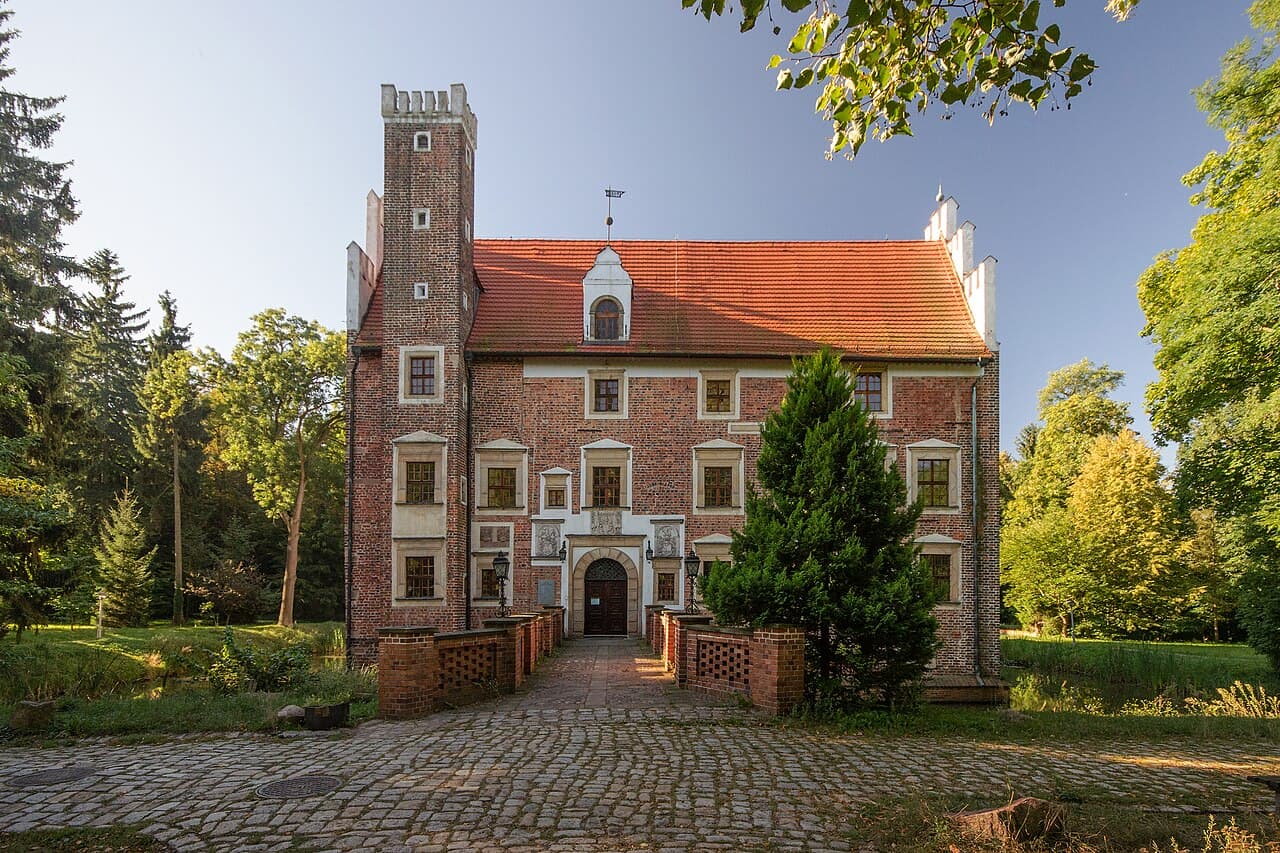
By 1537, the castle was acquired by Lukrecja Boner, wife of the prominent Wrocław banker Jakub Boner, and later married to Andrzej Hartwig. Under their stewardship, the castle underwent further transformation, including the construction of a western wing serving economic functions. Completed around 1560, the castle took on a regular four-winged layout measuring approximately 22 by 24 meters, surrounded by a double moat. The use of brick was predominant, with sandstone reserved for portals and window frames. The residential buildings featured steep gable roofs, with the northern wing rising three stories and housing the main entrance, known as the "lord's house."
Architectural features and renaissance influences
The inner courtyard was designed with inspiration from princely castles, featuring a ground-floor cloister supported by Renaissance arcades. An additional loggia was added to the eastern wing, serving as a ceremonial corridor with concealed courtyard stairs. A richly decorated well stood at the courtyard's center, while a square turret with overhanging consoles was constructed at the northern wing's corner near the entrance. The residential buildings were adorned with stepped gables and volutes, and the main facade displayed heraldic inscriptions and coats of arms, symbolizing the owners' prestige.
Subsequent owners, including the Huber family, completed the castle's transformation. Minor modifications occurred in later centuries, such as the replacement of the wooden bridge with a brick one supported by three arches in the mid-19th century and the addition of crenellations to the turret's top. Despite these changes, the castle largely retained its Renaissance character layered over a Gothic foundation.
Preservation, damage, and modern use
Remarkably, Wojnowice Castle avoided destruction from wars and fires for centuries, a rarity among Polish castles. However, in the 20th century, following World War II, the castle suffered significant neglect. Left ownerless, it was stripped of its furnishings and fell into disrepair. Restoration efforts began in the 1960s, spearheaded by the Association of Art Historians, which repurposed the castle as a creative work center and an art gallery named "Prezentacje."
Today, the castle is set in a picturesque park near Wrocław, making it a popular destination for day trips. Its unique combination of water defenses and Renaissance detailing atop a Gothic structural base offers valuable insight into the architectural evolution of fortified residences in Silesia. While its defensive features are modest, reflecting the social ambitions of its builders more than military necessity, Wojnowice Castle remains an important cultural and historical landmark.
Architectural details and artistic heritage
The castle's construction primarily utilizes brick, typical for the region, with sandstone accents enhancing windows and portals. The Renaissance portal is particularly notable for bearing the Boner family coat of arms alongside Latin and German inscriptions, including the phrases "IACOB BONER BAVET MICH" and "INICIVM SAPIENCIÆ TIMOR DOMINI," linking the castle's identity to its patrons' values.
The surrounding moat, though partially restored, continues to define the castle's water castle character. The northern access bridge replaced the original drawbridge, reflecting changes in defensive architecture and comfort. A slender tower topped with battlements and stepped gables on the wings highlight regional architectural motifs.
Inside the courtyard, the well and cloister arcades evoke princely castle designs, while the eastern wing retains original latrine oriel windows. The oldest northern wing section preserves Gothic portal jambs, offering a tangible connection to the castle's medieval origins.
The interior includes a Renaissance arcade hall with a central Corinthian column and surviving wall paintings from the period. Heraldic reliefs, including the combined coat of arms of Lukrecja Boner and Andreas von Hertwig by sculptor Andreas Walther the Elder, enrich the castle's artistic legacy.
Historical significance and cultural context
Wojnowice Castle exemplifies the transition from medieval fortified manors to Renaissance noble residences in Silesia. Its layered architectural styles and continuous use reflect the region's social and political changes from the 14th century onward. The castle's preservation allows for study of defensive architecture adapted to lowland marshy environments, as well as the display of Renaissance art and heraldry in a provincial setting.
As the oldest lowland castle in Silesia still in use, Wojnowice holds a unique place in Polish heritage. It offers visitors a window into the lives of Silesian nobility, their aspirations, and the architectural trends that shaped their residences over centuries.
Frequently asked questions (FAQ)
- How do I get to Wojnowice Castle from Wrocław?
- Wojnowice Castle is located about 25 kilometers from Wrocław and can be reached by car or local bus services. The journey typically takes around 30 to 40 minutes, making it a convenient day trip destination from the city.
- What architectural styles are represented in Wojnowice Castle?
- The castle showcases a blend of Gothic and Renaissance architectural styles. Its original late medieval Gothic structure was expanded and enhanced with Renaissance features such as arcades, loggias, and decorative portals during the 16th century.
- Is Wojnowice Castle open to the public?
- Yes, Wojnowice Castle is open to visitors and currently serves as a cultural venue hosting art exhibitions and creative workshops. Opening hours and ticket prices may vary, so it is advisable to check with local tourist information before planning a visit.
- What is the historical significance of Wojnowice Castle?
- Wojnowice Castle is significant as one of the oldest lowland castles in Silesia with continuous use since the 14th century. It reflects the social and architectural evolution of noble residences from medieval defensive structures to Renaissance manor houses.
- Can I explore the castle's interior and courtyard?
- Visitors can explore the castle's well-preserved courtyard featuring Renaissance arcades, a central well, and the cloister. Interior access may be limited depending on events and exhibitions, so it is recommended to inquire in advance.
Photo gallery

Information
Website
Visit websiteSources & official resources
Verify the information above using these authoritative references.
Loading map...
Visitor reviews
No reviews yet. Been here? Write the first review and help other travelers!
Write the first reviewVisited this castle? Share your experience
Your review helps other travelers and adds first-hand knowledge to our encyclopedia.